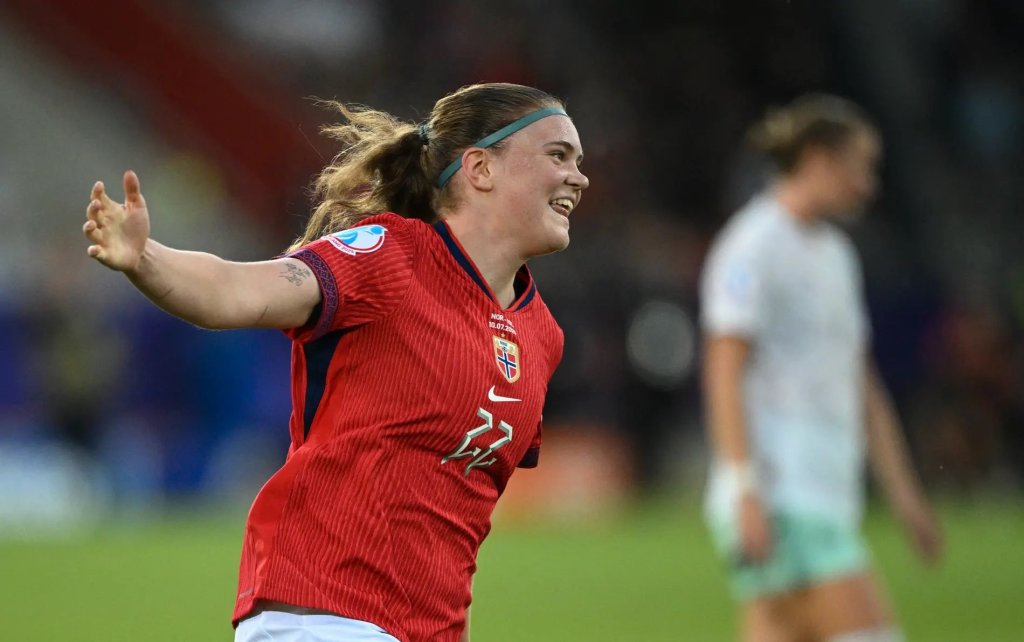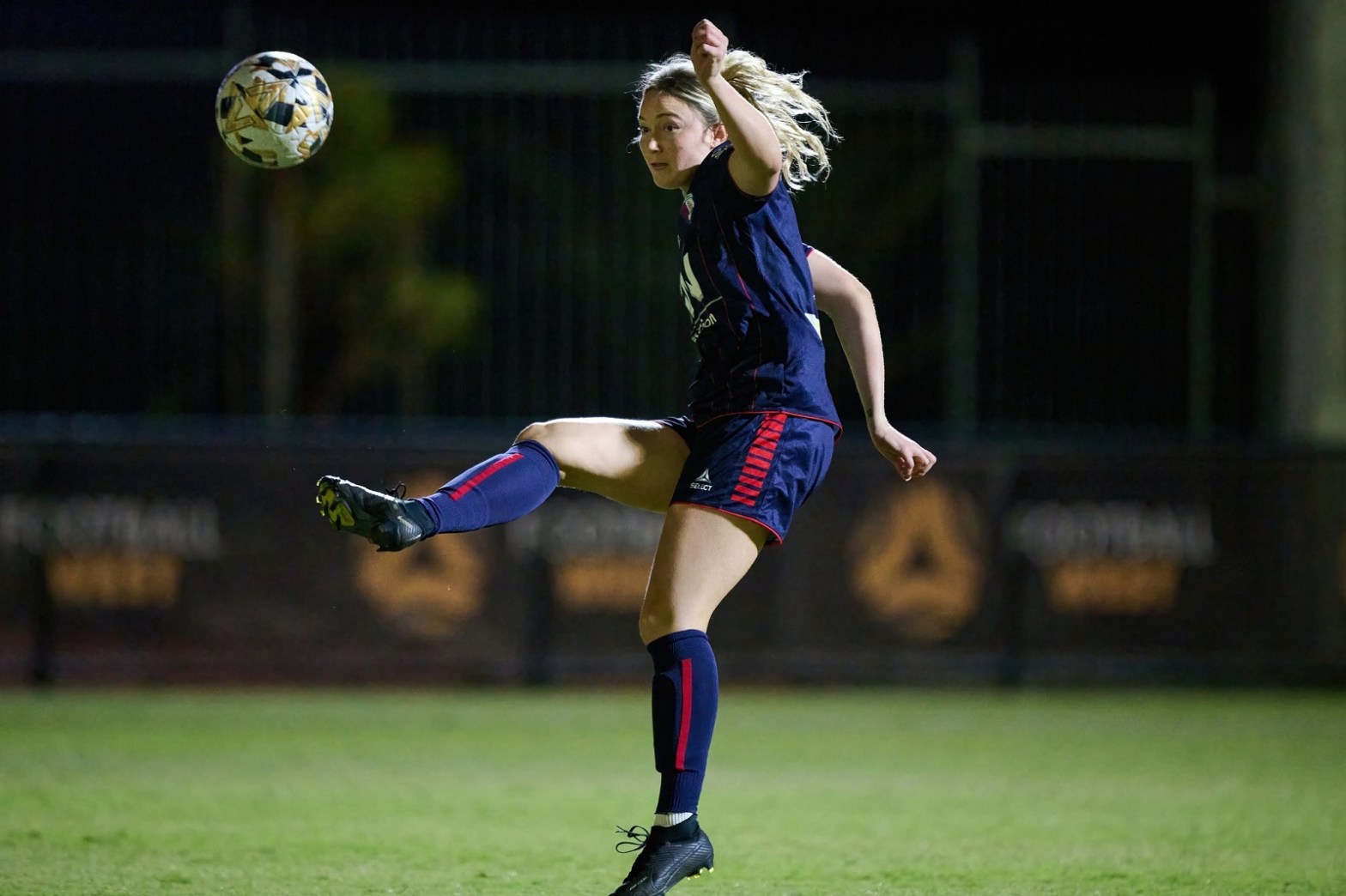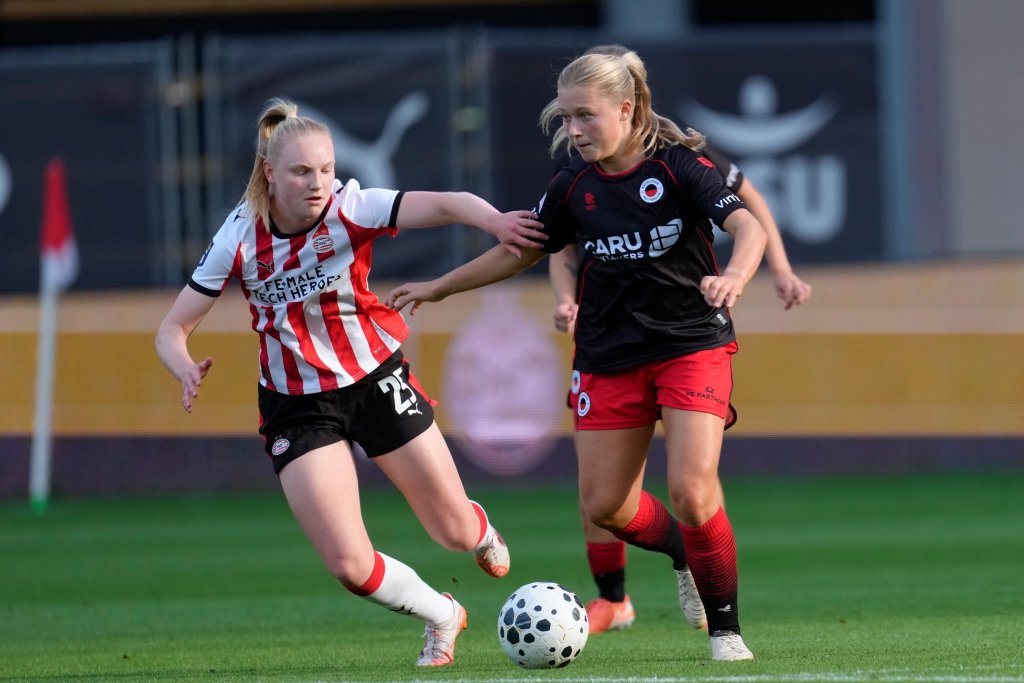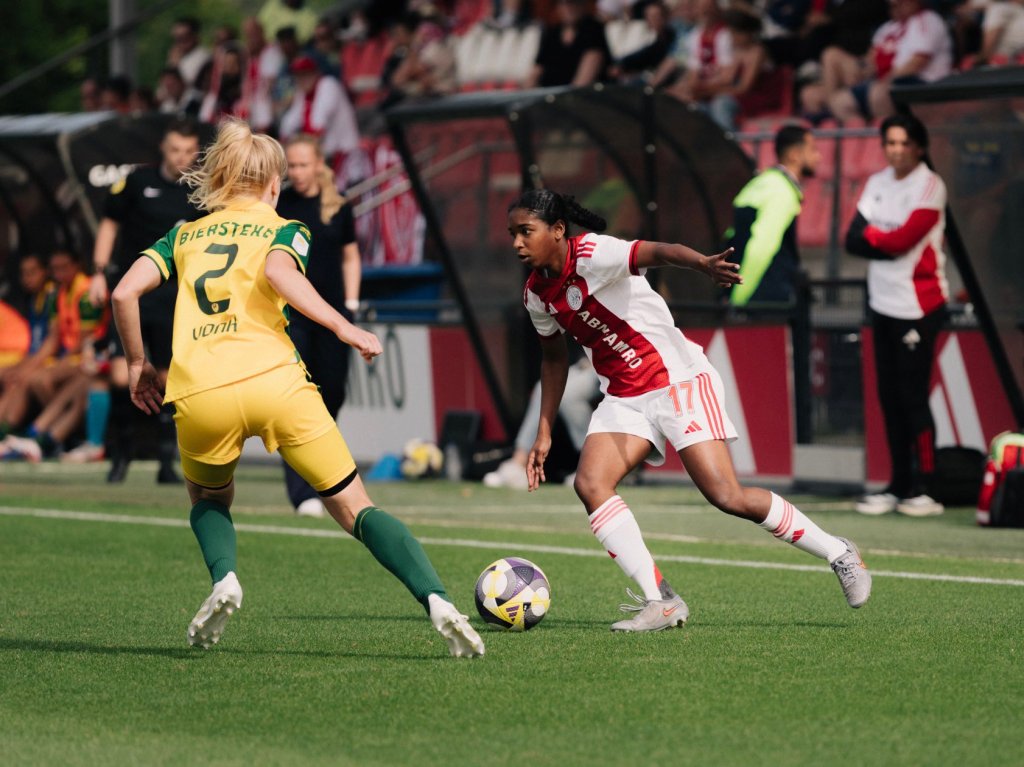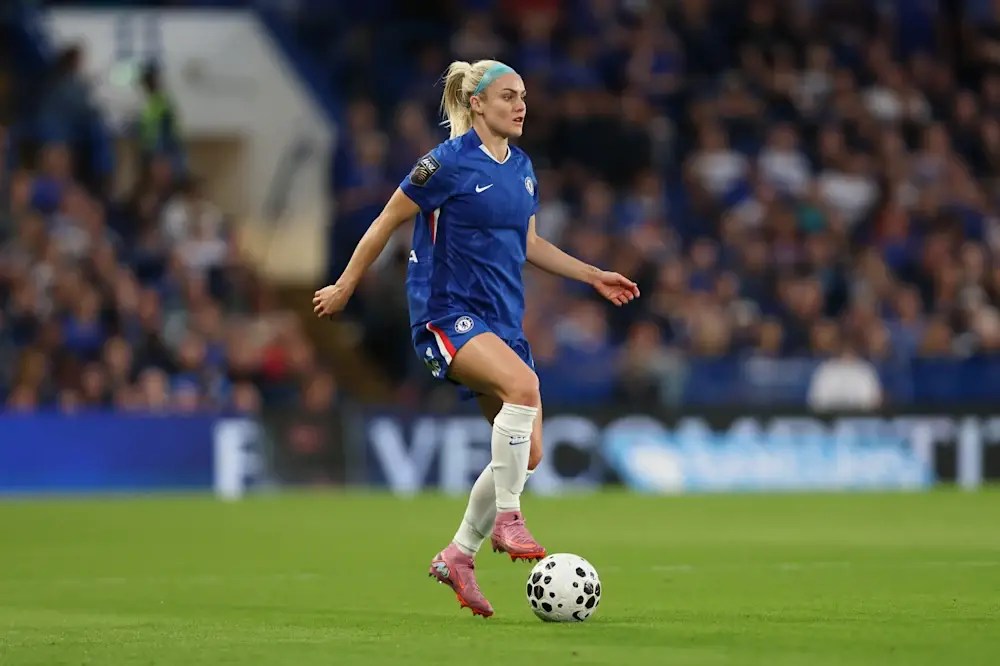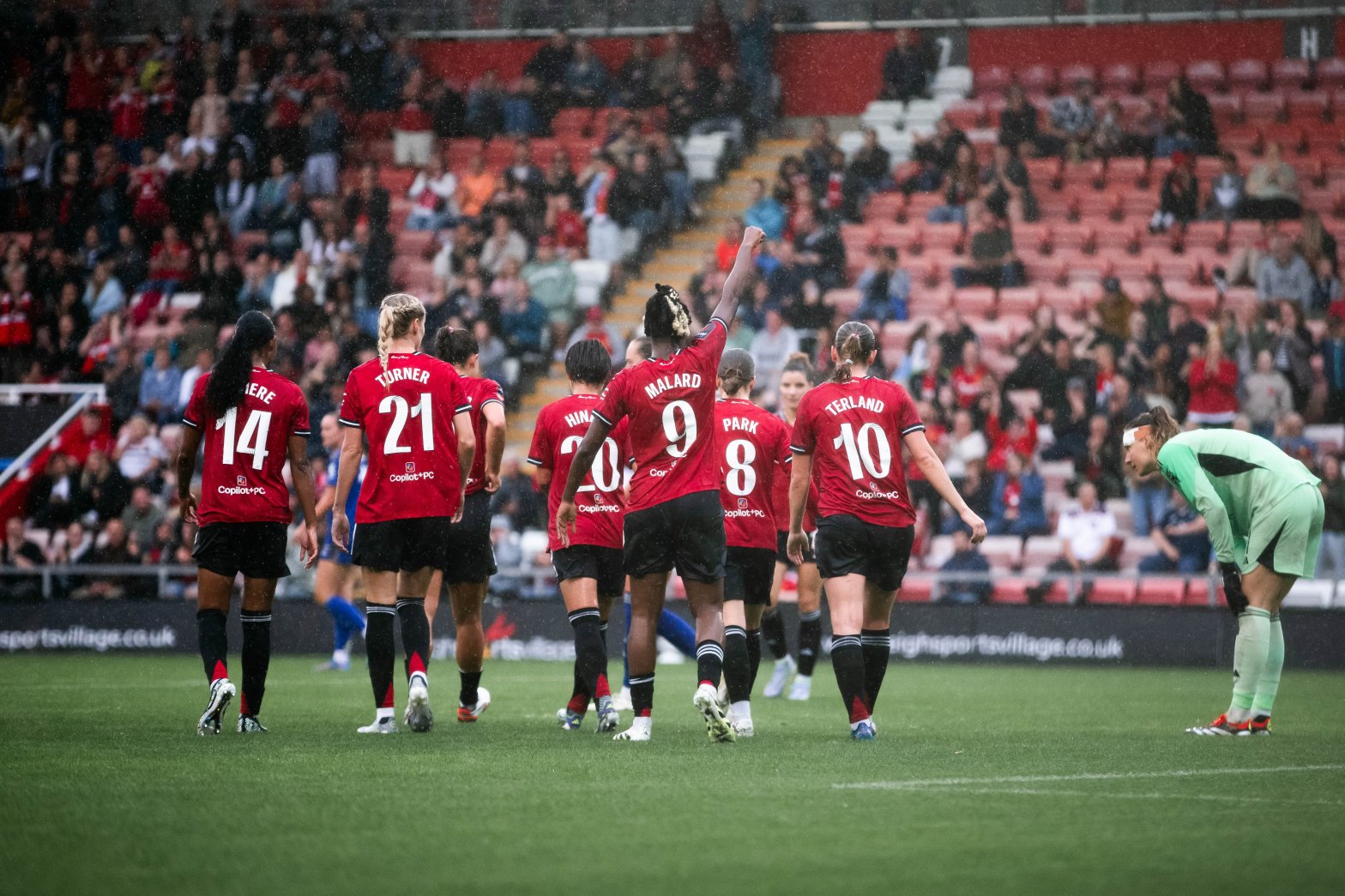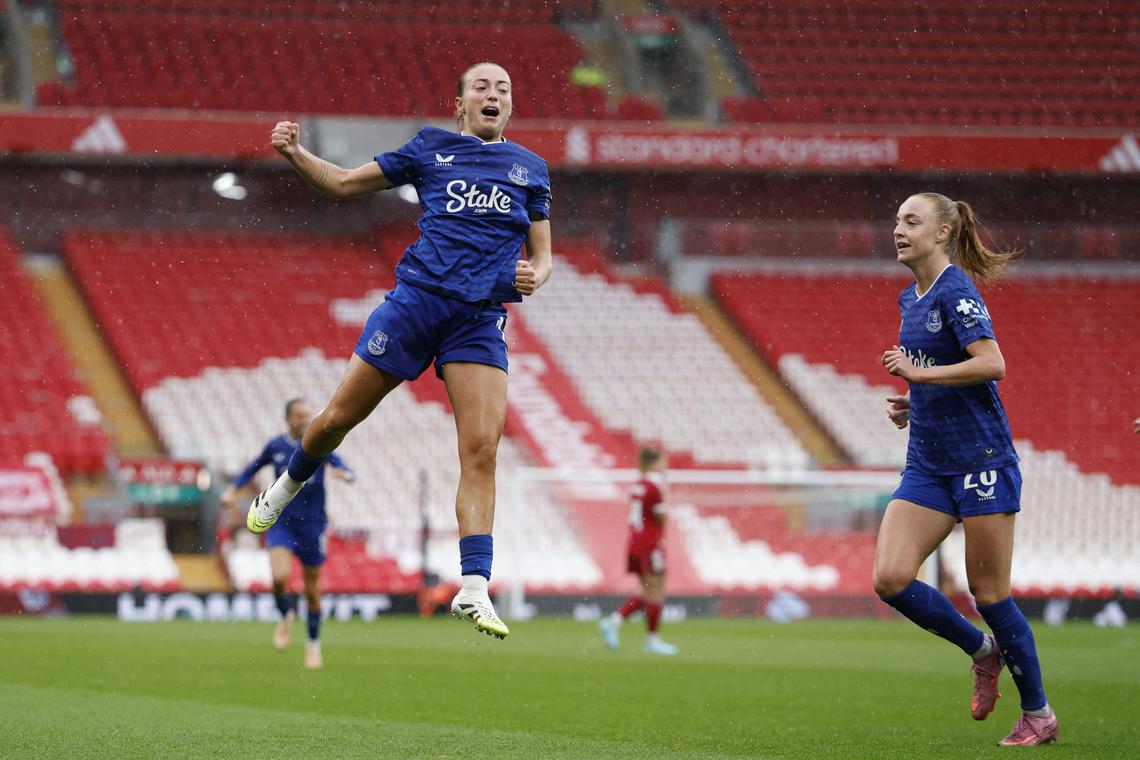
Above: Record-breaking Swiss fan march. Photo: Keystone/Jean-Christophe Bott.
The group stage of the 2025 Women’s Euros has concluded and the stage is set for the quarterfinals this week. Defending champions England secured their place and will play Sweden on Thursday, whilst Spain, Germany, France, Norway, Switzerland, and Italy also booked their places in the final eight.
The group stage had it all – own goals, red cards, press conference arguments, and some standout moments on and off the pitch. Impetus Football’sGethin Thurlow, Catherine MacKenzie, Eloise Smallbone and Hannah Chadwick break down their favourite moments from the group stage below.
Group A – Switzerland, Finland, Iceland, Norway
ByGethin Thurlow
Above: Switzerland head coach Pia Sundhage celebrates reaching the quarterfinals with her team. Photo: UEFA website.
Being lucky enough to report on a group that had the hosts in, seeing all the build up and excitement towards that first game between Switzerland and Norway was incredible. That Switzerland put such a strong first half performance in was also really special. Another highlight was the effort and resilience of Finland. Coming into the tournament with almost no eyes on them, they claimed an underdog win over Iceland in the first match and this was a well earned victory. What impressed me even more was how they played in the Norway loss and Switzerland draw. Despite the results going against them, they looked nothing like a team ranked 30th in the world and were only goal difference away from a quarter final appearance.
Final group standings:
Norway (Q)
Switzerland (Q)
Finland
Iceland
Group B – Spain, Belgium, Portugal, Italy
ByEloise Smallbone
Above: Spain celebrate. Photo: UEFA website.
Group B has seen some incredible performances as well as spectacular goals, particularly from Spain, who topped the group with an unbeaten record. A highlight of the group stage was Spain’s 6-2 win against Belgium, with six standout goals from five different scorers. Seeing two-time Ballon d’Or winner Aitana Bonmatí recover from viral meningitis in time to come on as a substitute in Spain’s first game was also a highlight of the group stage. Belgium winning their final group stage game despite already being eliminated was a significant moment too. The Red Flames put up a fight against both Spain and Italy, building momentum against two top sides, and scoring twice against the tournament favourites, Spain. Hence, seeing them get their first win of the tournament was a highlight too, and was thoroughly well deserved.
Final group standings:
Spain (Q)
Italy (Q)
Belgium
Portugal
Group C – Germany, Sweden, Poland, Denmark
ByCatherine MacKenzie
Above: Sweden’s Rolfo celebrates reaching 100 caps. Photo: UEFA website.
A group with an unexpected winner in Sweden, the standout match has to be the final game, between Sweden and Germany. Many had predicted the Germans to top the group, but an unconvincing defence following a major injury to captain Guilia Gwinn meant they finished in second. Ahead of that final game, nobody would have predicted that Sweden would dismantle Germany 4-1, but the Swedes showed their attacking power. Another highlight was the game between Poland and Denmark, which saw Poland get their first ever major tournament win, beating Denmark 3-2 including a goal from legend Ewa Pajor. Simply getting to the Euros was an amazing feat for the Poles, but getting an unlikely win on their way out will be something remembered for years to come.
Final group standings:
Sweden (Q)
Germany (Q)
Poland
Denmark
Group D – England, France, Netherlands, Wales
By Hannah Chadwick
Above: England’s bench celebrates their 6-1 win over Wales. Photo: Rachel O’Sullivan / Girls on the Ball.
Group D was nicknamed the group of death for a very good reason, with England the current champions, 2017 champions the Netherlands, and France, who are looking to make history and win the competition for the first time. They were joined by tournament newcomers Cyrmu. Highlights include Cascarino’s goal against the Netherlands and Pelova’s goal against France, alongside the re-emergence of English star Lauren James following injury. The Dutch said a goodbye to Danielle van de Donk who has possibly played in her last major tournament. From a Cyrmu perspective they had a good tournament considering this is their first ever major tournament and they where drawn into the most challenging group, managing to score against two world class sides in England and France. This tournament will give them something to build on and hopefully lead to more recognition back home in Wales.
Above: England’s bench celebrate their win. Photo: Girls on the Ball.
England 6-1 Wales
Team news and context:
Sarina Wiegman named an unchanged starting 11 from England’s win over the Netherlands. For Wales, Olivia Clark returned between the sticks after losing out for the France game. Ahead of the game, both teams were technically able to qualify for the quarterfinals depending on what happened in the other group D match.
Cymru started the game strong, successfully holding the England attack at bay. That was until Stanway was challenged in the box — the VAR decision was a penalty, which Stanway stepped up to take. Clark went the right way but couldn’t stop it. A defensive mistake from Cymru, alongside the inability to clear their lines, meant the ball fell to Russo, who laid it off to Toone. Her first shot was denied, but her second was not. It was a scramble in the box for the Cymru defenders.
There was hope for Cymru as Fishlock worked her magic and laid the ball off for Angharad James, who sent her shot in, but it was saved by Hampton. England got their third as James made the run, found Toone, who sent the cross in to Hemp — but Clark couldn’t make the save.
England were relentless as James and Stanway both had shots on target, but Clark managed to keep them out. A lapse in concentration from the Cymru defence meant that Toone linked up with Russo and beat Clark to the post. Wales got their chance from a corner as Rowe slammed her effort narrowly over the bar. A lack of concentration from Hampton meant she passed the ball straight to Fishlock, who sent her shot wide.
A switching of players around in the formation caused some confusion as Park was left unmarked in the box, and Clark managed to get her fingertip to it. England continued to press high and remained hungry for more as Beever-Jones found Mead, who sent her shot past Clark.
After being dropped to the bench following a poor performance against France, it seemed Mead had just solidified her place in the lineup for the quarterfinals.
There was joy for Cymru as Fishlock broke through the midfield before finding Cain, who sent a powerful strike past Hampton — Cymru’s second goal of the tournament. Although this goal opened up some issues for England, especially at right back, with Bronze being out of position, just like she was for the French winning goal. Charles came on soon after to replace her, potentially testing out a new formation for the quarterfinals. Charles soon created some action — she picked up the ball in space and found Mead, who successfully sent her cross to the head of Beever-Jones, who sent the ball into the roof of the net.
Player of the match: Ella Toone
Ella Toone was a constant star for England in this game, linking up with Russo on multiple occasions and successfully penetrating the Cymru defence.
Cymru goalkeeper Clark also had a tough game but made some impressive saves.
What next for the teams:
England will play Sweden in the quarter-final, and Wales will take this experience and build their squad. They will also start planning for their next tournament qualifiers, determined to make history again.
Netherlands 2-5 France
Team news and context:
After seeing a slightly different squad when France played Cymru — with several first-team players rested — they were looking to maintain their 100% win record in the tournament. Both teams could still qualify for the quarterfinals, setting the stage for a tense encounter. Depending on the outcome, it would also be Netherlands head coach Andries Jonker’s last match in charge of the OranjeLeeuwinnen.
An early chance came for the Dutch as Pelova’s shot from distance forced Peyraud-Magnin into a save. France went on the attack, meaning Van Domselaar was forced into a double save to send Karchaoui’s effort around the post. The Netherlands looked promising as Chasity Grant forced Peyraud-Magnin to make a save, but could only watch as Pelova connected with the ball outside the box and sent it home.
There was a lot of back and forth between the two teams as Les Bleues broke forward and Pelova brought down Baltimore to keep France at bay. Bacha’s free kick was easily claimed by Van Domselaar.
It was a nightmare moment for France as Bacha made a defensive error and cleared the ball into her own net. The Dutch ignited the fire and were all over the French.
France came out of half-time all guns blazing as Katoto was found in a sea of white shirts, and Van Domselaar was unable to save it. France stayed on the attack as Cascarino danced past orange shirts and sent a strike into the top corner to score her second of the game.
The Dutch continued to crumble under pressure as Casparij brought N’Dongala down in the box and Karchaoui converted from the spot.
Player of the match: Delphine Cascarino
Cascarino was the standout player after her second-half performance. She was always looking for her next goal, and her first was arguably the goal of the tournament so far. Pelova also deserved a mention for her consistent overall performance; she was the best Dutch player on the pitch today.
What next for the teams:
France will play Germany in the quarter-final, while the Netherlands will begin their journey home and prepare for the arrival of their new head coach, Arjan Veurink, who is currently England’s assistant coach.
Moment/player of the day
Has to be Cascarino’s performance for France and her two goals. She had an excellent game and will be hoping to shine against Germany.
Above: Theodora Mouithys (7) breaks through en route to scoring Football West Academy’s dramatic late winner yesterday. Photo: U18sNPL.
Football West Academy 1-0 Balcatta Etna
by Ella McShane
The Football West Academy (FWA) hit a late winner to bring Balcatta’s run of eight league wins in a row to an end, and reignite their own top-two hopes.
Theodora Mouithys’ goal as the clock entered the 90th minute ensured that the teenage side got back on the horse after losing their first against second clash 4-0 to Perth SC last weekend.
This fiercely contested Saturday afternoon encounter was defined by intensity in every area of the pitch. Sturdy defensive lines and a congested midfield made progression into the final third a challenge for both sides throughout the match.
The first breakthrough for the FWA came at the 17-minute mark when the midfield congestion was released by Xuri Dalton, the ball crossed to Lacey Heys on the charge was then passed to Klaudia Houlis on the wing. The home side’s captain made a break into the box, crossed it to Heys, now in prime shooting position, but the effort found the hands of Balcatta keeper Rebecca Bennett rather than the net.
Equally applicable to both teams, the remainder of the half saw many long balls in attempts to disperse a congested midfield and create attacking chances, which often broke down due to tight marking or were intercepted following careless passes.
The second half was introduced with the same intensity, but both sides were calmer and more collected in their approach. Balcatta initiated a threat within two minutes when an ever-busy Alyssa van Heurck cleared a high cross from the left wing. The ball found the head of a lurking Jaime Duncanson, whose attempt struck the crossbar.
With the game still neck and neck in the final quarter of an hour, the hunger for three points became palpable. This part of the game produced more chances than the previous 75.
In the end, it was Theo Mouithys who put the game to bed in the FWA’s favour. In possession, Emily Garnett’s surging run down the right wing created space for a dangerous Mouithys to charge down the midfield and struck the ball clean into the top of the net to seal a huge three points for the teenage side.
Above: Jess Flannery, who put Perth SC ahead at Fremantle City today. Photo: Rob Lizzi.
The Azzurri are two points clear at the top of the NPLW WA after a hard-earned 2-0 victory at Hilton Park this afternoon.
Both teams were without key players, with Abbey Green out for the home side and Tijan McKenna for Perth.
It was a real attritional battle of an opening half, and clear-cut chances remained at a premium with neither goalkeeper called into direct action often during the opening half.
The best chance of the opening 45 came in the 14th minute when Ella Lincoln was played in, but just as she was about to pull the trigger, a superb last-gasp tackle from Freo defender Annabelle Leek denied the Azzurri hotshot.
However, it would take just two minutes of the second half for Perth to hit the front. Lincoln dispossessed Janice Kiama on the edge of the box and curled a shot that came crashing down off the crossbar. Flannery followed up with a header that Megan Phillips in the Fremantle goal repelled, but the rebound came back to the Azzurri attacker, who placed a side-footed volley into the net from close range.
They would double their lead on 56 minutes when, after a Fremantle throw in on parallel with the penalty area, a long clearance from the Perth defence eventually fell for Daisy McAllister to beat a group of three Freo defenders and play a perfectly weighted pass through for Lincoln to dispatch the ball into the top left hand corner.
There were two further opportunities for the Azzurri to extend their lead further. First, when Flannery turned on the edge of the box and hit a shot that Phillips held, and then with six minutes remaining, when substitutes Ruby Marshall and Maja Archibald combined, with Archibald hitting a shot that Phillips did well to get a glove to and push out for a corner.
This would be a pleasing three points for Perth, who had to work their way through the first-half challenges that Fremantle posed. They never looked back once Flannery put them ahead and earned the reward of another week at the top of the NPLW WA ladder.
Above: Renee Leota, who hit a hat-trick for Perth RedStar yesterday at UWA-Nedlands. Photo: Perth RedStar.
Perth RedStar returned to winning ways with this comprehensive victory at a UWA-Nedlands side who are now without a win in five games.
The defending champions were red hot out of the blocks, hitting the front after just two minutes when they won turnover ball along the right, allowing Sarah Carroll to cross in for Renee Leota to tap in.
Just five minutes later, it was 2-0 as Caitlin Doeglas looked up to see home goalkeeper Madison Large off her line, and curled a stunning lofted shot in from over 30 yards.
There were 43 minutes played when RedStar got their third of the afternoon. UWA-Nedlands found it hard to complete a defensive clearance, allowing Doeglas to lay a pass off for Jay Coleman, who put in a low cross for Leota to beat Ginger Cain and lash the ball home from close range.
The visitors stepped on the gas in the middle part of the second half – a spell which saw them score four goals in just six minutes.
First, with 66 minutes on the clock, Carroll pounced after a UWA-Nedlands mis-hit free-kick fell at her feet and the former Perth Glory star advanced to fire home from a central position on the edge of the box.
The home side presented RedStar with another opportunity three minutes later as a throw out from Large went straight to Doeglas, who laid a pass off to Carla Bennett. Her exquisite ball that was lifted in allowed Leota to turn the ball home to complete her hat-trick.
It would be 6-0 shortly afterwards as Quyen Doan played a first-time high ball into the box from the right flank. UWA-Nedlands’ defensive clearance landed perfectly for Lauren Continibali to lift over Large and in.
From the resulting kick-off, RedStar scored again after with Bennett claiming another assist with her ball in for Jayna Ridley to turn home from close range.
UWA-Nedlands’ luckless afternoon continued when Samara Riches’ penalty was saved comfortably by Gabby Dal Busco.
Above: Marianna Tabain (white shirt, smiling) hit a late winner for Subiaco at Murdoch University Melville today. Photo: Denyse McCulloch.
Subiaco ended their six-match winless streak as they came from behind to emerge victorious at Besteam Stadium this afternoon.
Murdoch University Melville (MUM FC) are becoming harder to beat as the season enters its final third, and with Ella Mastrantonio back at the club, they can point to major steadying experience as well as big game know-how.
The home side took the lead with 19 minutes on the clock when Caitlin Symons’ throw on the right deep inside her own half led to Isabella Baldin gaining possession and finding Lucie Hotchin, who drove along the flank and squared the ball. Amalia Caceras couldn’t hold it in the Subi goal, and another of MUM FC’s experienced players, the former Perth Glory attacker Ellis Glanfield, put the ball into the net.
Ten minutes before the break, Subiaco levelled when Greta Bailey advanced and hit a shot that flew into the right-hand corner.
Any hopes that the home side had of a second successive point were dashed with four minutes remaining when Marianna Tabain was released and took the ball round the onrushing Jemma Skinner and smashed the ball home for a Subi victory.
SUNDAY: Balcatta Etna v Fremantle City, Perth SC v Murdoch University Melville, Subiaco v UWA-Nedlands. Football West Academy v Perth RedStar rearranged for 13th August.
Above: Aggie Beever-Jones and Maya Le Tissier. Photo: The FA / Getty.
Read the comments underneath every social media post announcing the starting lineup for a Lionesses game, and you will undoubtedly see several comments complaining that young players are not being given a chance. This has been a consistent trend throughout head coach Sarina Wiegman’s tenure, and some journalists have even suggested that failure to integrate youth could be the Dutchwoman’s downfall as England manager. We have seen before that narratives surrounding England are not always what they seem – so is this even true? Do England really have a problem with bringing young players through, or is this just another narrative that has come out of nowhere?
Is there a problem?
It is arguable that the issue some people have with this is not down to age but rather experience. The backbone of the squad that won the Euros in 2022 and reached the final of the World Cup in 2023 is still in place – with captain Leah Williamson, Alex Greenwood, Jess Carter, and Lucy Bronze making up the defence, Georgia Stanway and Keira Walsh holding down the midfield, and Alessia Russo, Ella Toone, Lauren Hemp, Chloe Kelly and Beth Mead going forward. Only three of these players are aged 30 or over – Mead recently celebrated her 30th birthday, Bronze is 33, and Greenwood is 31. The rest are all in their mid-20s; reaching their peak in the football world, yet they feel like they have been around for a while.
It is the fact that we have seen them for a couple of major tournaments now that is arguably giving the impression that they are aging – whilst Lauren Hemp is a deceptive 24 years old, and Toone and Russo are 25 and 26 respectively.
The average age of an England starting lineup also tends to be similar to their opponents’. Against France in their Euros opener, the Lionesses’ average age was 27, compared to 26 for the French. Against Spain in the Nations League defeat, the average ages were equal at 27 for both countries. Against Portugal in the Lionesses’ 6-0 win at Wembley, the England team was a younger one with an average age of 26 compared to 29 for Portugal. The loss to Belgium in Leuven was another occasion where England fielded a younger team than their opponent – 27 compared to 28.
Maya Le Tissier
A focal point for these frustrations is defender and Manchester United captain Maya Le Tissier. The Guernsey native has had a stellar season for United and has played every minute of the last few WSL seasons. A centre-back for United, Wiegman has said England see her as more of a right-back. Whilst the reasons for this are debateable, it is likely in large part due to the need to develop the player who will eventually succeed Lucy Bronze – and there is not a lot of competition for the role.
Le Tissier is the most obvious choice and faces far less competition for the right-back role than she would at centre-back. This is true even if first-choice pairing Leah Williamson and Alex Greenwood are not available – there are still a variety of options including Jess Carter, Esme Morgan, Lotte Wubben-Moy, Lucy Parker, not to mention Millie Bright when fit.
Above: Maya Le Tissier. Photo: Lionesses on X.
It is difficult to truly compare statistics across WSL players because of the variety of playing styles on offer. For example, Arsenal play a much more total-football influenced possession-based game, particularly under Dutch head coach Renee Slegers. Chelsea like to dominate possession but are also fond of going more direct using the distribution of England number one Hannah Hampton. In contrast, Manchester United are known for their defensive displays, however they finished the season as one of the best pressing teams in the league.
Comparing Le Tissier’s statistics to Bronze – who she is being prepared to eventually usurp at England – is therefore difficult and should only be taken lightly. Bronze played three less games than Le Tissier (19), scoring two goals and registering three assists, whilst Le Tissier scored three goals. They had a similar number of touches per game (79 compared to Le Tissier’s 76), and their passing accuracy is very similar (79% for Bronze, 80% for Le Tissier) – Le Tissier is slightly ahead in long balls (46% compared to 39%, although this could be partly explained by how the two teams prefer to play), and they are both accurate in 33% of their crosses.
For England, Bronze’s dominance combined with the disagreement over position – Wiegman preferring Le Tissier at right-back – mean the Guernsey native’s opportunities have been more limited than fans would like. Her last minutes for England came against Portugal in the Nations League, where she replaced Lucy Bronze and played 36 minutes at right-back.
Her last opportunity before then was in England’s series of winter friendlies in October – December. She started two of the games (against Switzerland and South Africa), once at right-back and once in an improvised midfield role. She also played fifteen minutes of the Lionesses’ loss to Germany at Wembley, coming on for Bronze. There were also the friendlies in February 2024 against Austria and Italy. Le Tissier started the game against Austria, playing the full 90 minutes and notching an assist.
In terms of competitive games, aside from the half-hour against Portugal, her last outing came in July 2024, when she played the full 90 minutes as England faced the Republic of Ireland in Euros qualifying. Bronze was rested for this match (without injury), indicating that Wiegman wanted to see Le Tissier in action.
Aggie Beever-Jones
Aggie Beever-Jones tends to be another player fans want to see starting. Understudy to Alessia Russo, Beever-Jones has had an incredible season for Chelsea. She only started half of Chelsea’s games yet managed to notch nine goals, for a return of 0.4 goals per game or a goal every 124 minutes. She has an average of two shots per game, with one being on target. Over the season, she created two big chances and had an 81% passing accuracy. On her first Wembley start, Beever-Jones scored a hattrick against Portugal within half an hour.
Comparing WSL statistics, Russo started 19 matches, scoring 12 goals with a frequency of a goal every 141 minutes. Russo had more shots per game, more on target per game (3.5 and 1.6 respectively) and notched two assists, creating seven big chances with an 83% passing accuracy.
Above: Aggie Beever-Jones in training. Photo: Lionesses on X.
The primary difference between Beever-Jones and Russo is in their work-rate off the ball. When England faced Belgium in Leuven, Russo was injured and Nikita Parris played in the number nine role with Beever-Jones on her left (Lauren Hemp was also missing through injury). During that game, England struggled to cope without Russo tracking back and covering all areas of the pitch; this highlights the many facets of Russo’s gameplay.
Part of the struggle was that with neither Beever-Jones nor Parris tracking back, there was little in the way of support for Niamh Charles against the pace of Tessa Wullaert. However, it is worth noting that tracking back and helping out the defence is not something Beever-Jones is often tasked with at Chelsea, particularly if playing on the left. With Parris also being a recent reintroduction to the squad, there was little time to create a cohesive attacking unit which would not have helped either – but it does highlight the benefit of having Russo as a more multi-faceted striker.
At twenty-one and already capped with the senior team, it is likely only a matter of time before Beever-Jones has a bigger role within the England squad. Whilst Ellen White was the first-choice striker in 2022 with Russo as her backup, Russo’s time to shine came and so too will Beever-Jones’.
The impact of the Nations League
It is arguable that a major barrier to incorporating youth in senior teams is the emergence of the Nations League (UWNL). Before the Euros in 2022 and World Cup in 2023, there were no competitive games, so England (and other nations) had more opportunities for friendly matches – where the bulk of experimentation tends to happen.
Despite a popular narrative being that Wiegman rarely rotates her squad even for friendlies, the only senior player in the starting lineup against Switzerland was Millie Bright – the 10 other starting players had a combined cap total lower than Bright alone. Grace Clinton, Jess Park, Ruby Mace, Laura Blinkilde-Brown, Le Tissier and Esme Morgan were all on the team-sheet that evening, constituting ten changes from the previous match. Against South Africa the previous window, Le Tissier, Jess Naz, Park and Morgan all started.
The inaugural UWNL occurred mere weeks after the World Cup final in 2023, playing a role in the seedings for the qualifiers for the 2025 Euros. The aim of the UWNL was to increase the number of competitive matches for countries still at early stages of developing women’s football, to increase the standard of the game across Europe. With the league system in operation, in actuality this has meant teams playing each other numerous times – for example, Belgium, Portugal and Spain were in the same group for the 2025 Nations League and then for the 2025 Euros, so they will have played each other four times this year alone.
Whilst these games are often referred to as ‘glorified friendlies’, the fact remains that they are competitive games that impact how a nation qualifies for the next major tournament – winning is important, so there is little room to take risks. Having less time for friendlies means there is less room for experimentation, and less time to bed in younger players. However, some countries did overhaul their squads at the time – Germany for example – at the expense of short-term results.
Protection from expectations
Using the UWNL and qualifying games to incorporate younger or new players is acceptable if you continue to win. Germany suffered friendly defeats last autumn – to Italy and Australia – alongside competitive games in last summer’s Olympics, including a chastening 4-1 loss to the USA. Given the reaction from fans and media if England’s Lionesses lose or have a poor performance, it is likely that our expectations would not allow for this kind of experimentation in competitive games.
For example, the team that lost 4-3 in a friendly against Germany in October 2024 was changed significantly for the following game against South Africa, including a number of younger players – Le Tissier, Naz, Clinton, Park, and Morgan all coming in. Whilst the Lionesses won the game 2-1, the reaction was overwhelmingly negative due to the fact that they had not dominated the game. Sky Sports claimed the win was “unconvincing” in their review, and the Guardian referred to the Lionesses as “sloppy”, showing that the expectations for this team – no matter which players are in it – are extremely high.
Given the expectations that come with winning a major tournament and advancing to a World Cup final, it is perhaps understandable that England choose to take a measured approach to incorporating new players. There is an expectation that new players will have a major impact on first showing, particularly if they have been impressing at club level.
In an interview with the Guardian earlier this year, Beever-Jones acknowledged this, saying: “Last year was a bit of a whirlwind. Having the season I had and scoring a lot of goals, there was a bit of pressure that I wanted to match it. At the start of the season, I maybe got in my own head a little bit, but if I’m playing with a smile on my face and with confidence, then I believe everything else will fall into place.”
Whilst some do manage to have that impact, such as Michelle Agyemang scoring 41 seconds into her debut against Belgium, it should not be the expectation, and carefully introducing young players to the senior team should be the norm – particularly as England have an established and successful under-23s programme.
Predictions
It is likely that Manchester United having Champions League football next season will give Wiegman major headaches when it comes to Le Tissier and Clinton. If the duo sustain their good form in the face of some of the best teams and players in Europe, it is almost certain that they will needle their way into the Lionesses’ starting lineup. For Beever-Jones, her chances likely hinge on the fitness and form of Russo – but at twenty-one, there is still a lot of time to come.
It remains to be seen what further impact England’s young players will have this summer. Agyemang impressed in a cameo against France, and Beever-Jones made a strong showing in a cameo against the Netherlands. These small opportunities are likely all there is for now, but come the World Cup in 2027, the picture may be very different.
Above: Belgium celebrate their first and only win of the tournament. Photo: UEFA.
Portugal 1-2 Belgium
Above: Janice Cayman celebrates her goal. Photo: UEFA website.
Team news and context:
Belgium were already eliminated from the competition before facing Portugal, however Portugal’s fate was also out of their hands to a certain extent. Portugal could have progressed as Group B’s runners-up if they beat Belgium and Italy lost to Spain, subject to goal difference. Portugal and Belgium both only made one change to their starting line-ups from their previous games: Ana Borges, who was sent off against Italy, was replaced by Catarina Amado for Italy, and Hannah Eurlings was replaced by Jassina Blom for the Red Flames.
Tessa Wullaert, the Red Flames’ top scorer, put her side ahead early on, scoring her first goal of the tournament. However, Belgium were on the receiving end of two goals being overturned by VAR later in the game. The first was Toloba’s goal, which was disallowed for a foul in the build-up, and Portugal were given a free kick. They later had a second goal disallowed for offside.
Telma Encarnação scored an equaliser for Portugal in the 87th minute, when she fired the ball inside the near post, however it wasn’t enough to beat Belgium, and potentially send Portugal through to the knockout stages.
Another key moment of the match was Jassina Blom suffered an injury in the first half. She was stretchered off after medics being on the pitch for few minutes, after making her first start for Belgium at the tournament.
Player of the match: Tessa Wullaert
A goal and a would-be assist had Toloba’s effort not been offside, she provided pace down the right wing for Belgium and was the most potent Belgian threat.
What next for the teams:
Belgium had already been eliminated before Group B’s third matchday, however securing their first win of Euro 2025 was a monumental moment for the team.
The loss meant heartbreak for Portugal who finish third in the group and are eliminated from Euro 2025, after having the opportunity to potentially go through to the quarter-finals if they had secured the win.
Italy 1-3 Spain
Above: Spain celebrate their win. Photo: UEFA website.
Team news and context:
Before the start of Matchday 10, Spain had already secured their place in the quarter-finals. Italy had the opportunity to go through to the knockout stages as group winners, if they were able to beat Spain. However, they also knew there was a scenario that would stop them going through: if they were defeated by Spain and there was a six-goal swing between them and Portugal. Spain made six changes to their starting line-up, with Aitana Bonmatí making her first start of the tournament. Laia Aleixandri and Ona Batlle were rested, likely because if either of them received a yellow card against Italy they would be suspended for the quarterfinal.
Scorers: Elisabetta Oliviero (10’), Athenea del Castillo (14’), Patri Guijarro (49’), Esther Gonzalez
Highlights:
Elisabetta Oliviero opened the scoring in the 10th minute of the game, with her first ever international goal. However, it didn’t take long for Spain to equalise, with Alèxia Putellas providing the assist for Athenea del Castillo, to bring Spain level. Patri Guijarro then put Spain ahead in the 49th minute.
It looked like Italy may have had the chance to equalise, when Irene Paredes dived to head the ball, but it made contact with her arm. VAR looked at the penalty call, however, this wasn’t given as Sofia Cantore was offside before the penalty incident.
Spain sealed the win, and the top spot in Group B, with a goal from Esther González in stoppage time, with Putellas securing another assist.
Spain also equalled England’s record of goal involvements in a Euros group stage, with 14 goals.
Player of the match: Alexia Putellas
With two assists, the natural choice. She assisted both del Castillo’s goal and González’s goal, picking up the right positions for her teammates in the penalty box. She has equalled the record for goal involvements in a Euros group stage, which was previously set by Beth Mead in Euro 2022.
What next for the teams:
Both teams have proceeded to the knockout rounds of the competition. Spain have finished top of the group and will face Switzerland in their quarter-final, on Friday 18th July. Italy will face Norway on Wednesday 16th July, after making it out of the group stages for the first time since 2013.
Moment/player of the day
The moment of the day was Cayman’s goal for Belgium, which turned out to be the match winner. Belgium were previously unable to secure a victory at the tournament, despite causing problems for both Spain and Portugal, and what the victory meant to Belgium’s players, fans and staff was evident at the full-time whistle. Cayman’s winner felt special for Belgium within the game itself too, after having two goals previously disallowed for offside.
Above: Switzerland celebrate. Photo: Liawaelti on X.
Team news and context:
It all came down to this. Finland v Switzerland, plucky underdogs v the free-flowing Swiss for a place in the quarter finals. Both were sat on three points in a straight up fight for second place in the group. With the superior goal difference, Switzerland had the huge advantage of knowing a draw would be enough to see them through. In some ways though, this benefitted Finland. They knew only a win was acceptable so could go all out for victory, while the tournament hosts would have to balance between playing out a draw and ensuring it with a win. Given the success of both teams so far, it was no surprise to see both teams unchanged.
Scorers: Kuikka 1-0 (79′), Xhemaili 1-1 (90+2′)
Highlights:
It was a very open start to the match, with Switzerland controlling the ball more and attacking with some nice passing moves, while Finland responded with fast counter attacking moves. As both sides calmed down from that initial rush, it was Finland who started to keep the ball more, and something they will rue so far is not taking enough of their chances when they are in the driving seat of games. They would be hoping to change that in Geneva.
By half time, this was not the case, although it was down to a wonderful tackle by Nadine Riesen and a great reactive save by Peng rather than poor play by Finland. With key player Geraldine Reuteler picking up a yellow card on an aggressive tackle and some other Swiss players flying into some tackles it was a very nervous atmosphere in Geneva, despite the result going the hosts way at that point.
Clearly unhappy with that first half, Ana-Maria Crnogorcevic was brought on to add some defensive experience, while up front it was Wandeler who got the nod to try and push for that Swiss goal. You could instantly see the tactical changes made by Finland, Koivisto and Kosola as wing backs essentially gave up any defensive duties and transitioned to full on wingers.
As Finland started to get more desperate, space opened up for Switzerland and some passes/moves were rushed by Finland – hence the quality dropped too. This worked out well for Switzerland, deploying the classic mantra: ‘the best form of defence is attack’. Ath this point regardless of the match situation, it was the Swiss who were occupying the opponents half – often finding themselves in attacking overlaps and you just wondered what Fingland had left. #
That was until, during a rare Finnish attack that looked like it was going nowhere, Koivisto was brought down for a slam dunk penalty and Kuikka subsequently converted it coolly. The Switzerland kept response would show what they were about. They had 12 minutes and injury, they needed ti find a goal out of somewhere to get them through, keeping calm and composed would be essential to this, but could they handle the pressure? It was none other than Geraldine Reuteler who stepped again and put the hosts on her back, putting in a scintillating low cross, which Xhemaili couldn’t miss. They had done it, Switzerland were through.
Player of the match: Geraldine Reuteler
Yes we have given it to her the last two games, and yes, we are doing it again. She totally ran the show for Switzerland and once more was at the heart of everything good for them, most substantially providing that crucial assist to get them through, proving she is a big moment player.
What next for the teams:
For Switzerland, it is pure delight for a few days as the country celebrates getting into the knockout stages for the first time. This is before they start to look ahead to a quarter final almost certainly against Spain, not quite what you want, but after tonight who knows what they can pull off. Finland can take so much heart from their performances, having really dominated for long periods all games. They totally played a level above their rankings, but if you have that possession and those chances and fail to them, football is going to punish and unfortunately those last two games did just slip out of their grasp. It is a fantastic sign for the future of Finnish football though.
In total opposition to the last game, this was the pure definition of a dead rubber. Norway were guaranteed to finish top, whilst Iceland were locked into 4th place. Given this, it made sense that Norway rested a lot of their top players, meaning starts for stars such as Bizet, Terland, Naalsund and Gaupset. For Iceland, it was a return for Antonsdottir in the place of Brynjarsdottir after what has been a disappointing campaign so far, without scoring at all yet.
Taking advantage of a Norwegian team that hadn’t quite gelled yet, Iceland took control early – pushing forward, winning corners and pushing the goal. After a good save by Fiskerstrand, Jonsdottir was the first to pounce and finally got Iceland on the board at the Euros. This seemed to spring Norway into life, and they hit right back at Iceland, as Gaupset put them level from a corner. This seemed to settle down the Norwegians and they played a more measured game from this point, dominating possession, snuffing out any Icelandic resistance.
It was Gaupset once more who struck for Norway, this time with a beautiful left footed strike from outside the box right into the bottom left corner and past Runnarsdottir. As Norway continued to dominate, it was Frida Maanum who made it three, featuring a lovely one-two with Signe Gaupset. In a match that looked dead and buried, with Norway easily managing the pace and flow of football; it didn’t feel like that was going to be one to keep your eyes on. However this a Norway game after all so you can never count our your opponent, so after Maanum and Gaupset linked up once more to provide a fourth – all hell broke lose.
A beautifully worked counter attack saw Jonsdottir and Eiriksddottir through together facing only the keeper, and it was the Leicester striker that converted well. In another needless moment for Norway, they gave a penalty away in injury time as Marit Lund pulled Eiriksdottir down in the box, landing her a yellow card and Iceland a third goal. This just shows that Norway are never as in control as they seem and therefore teams should never give up against them.
Player of the match: Signe Gaupset
With two brilliant goals and an assist, this decision was already made for me by half time. As part of what was ultimately a ‘B’ team in this game, she gave Gemma Granger a lot to think about for the group stages. Although it is not easy of course to break into an attack of Reiten, Graham Hansen and Hegerberg.
What next for the teams:
For Norway, well the overall game was their first dominant performance, there was still some concern in how they had fallen apart at the end. Given the mass changes and how they seemingly helped, there will be a lot of decisions for Gemma Grainger to make in terms of team selection ahead of a quarter final which looks like it will be more winnable for them.
For Iceland they will look towards a rebuild, having not picked up a single point. Given the favourable draw, they would have hoped to advance to the knockout stages, let alone fail to pick up a point. This is a big blow for a country that seemed to have been making positive progress over the last decade.
Moment/player of the day
After what was quite a scrappy game lacking quality and excitement, a 78th minute penalty sparked the Switzerland Finland game into life, and those last 10 minutes were incredible to watch, as were the celebrations from the hosts and all their fans across the country.
Above: England celebrate with Ella Toone. Photo: Lionesses on X.
England 4 – 0 Netherlands
Above: Lauren James and Ella Toone. Photo: Lionesses on X.
Team news and context:
The most storied fixture in the competition, England’s Lionesses faced the Dutch OranjeLeeuwinnen (Orange Lionesses) under a cloud of heavy media scrutiny and fan pressure. After losing their first game to France and watching as Oranje put three past Wales, their Euros was on the brink of major disaster: a group stage exit, which would be a first for a reigning champion.
It was not smooth sailing for the Netherlands despite that win – a tumultuous time off-pitch recently culminated in head coach Andries Jonker engaging in a verbal row with a journalist – they called each other’s work a ‘puppet show’. Combined with the awareness that this was potentially Jonker’s penultimate game in charge of the team and a number of players recently returned from injury, few would have predicted a smooth win against England.
To the chagrin of many fans and pundits on social media, England’s head coach Sarina Wiegman opted to make only one change in personnel from the loss to France: Ella Toone came in for Beth Mead. The criticism of the lack of changes missed the point that even one change can have a large impact on team shape and formation. With Ella Toone playing in the no.10 role, Lauren James shifted to the right wing (where Mead had played) – allowing her much more freedom to be creative as Toone was covering the physical work in the middle.
Alex Greenwood also shifted to left-back with under-fire Jess Carter moving to centre-back. This had the benefit of giving Carter additional support whilst benefiting the team with a left-footed player at left-back.
For the Dutch, there were also changes. Danielle van de Donk was rested for the first half; a decision that proved controversial. Jonker asserted that van de Donk was not fit enough to play the entire 90 minutes, which the player herself contradicted post-match. Her omission meant a slight formation change: instead of coming in behind the striker, replacement Chasity Grant came in on the right wing.
Young center-back Veerle Buurman retained her starting place despite suffering an injury and being withdrawn at half-time in the previous game.
Scorers: James (22′) 1-0, Stanway (45+2′) 2-0, James (59′) 3-0, Toone (67′) 4-0.
Highlights:
Apart from an early chance for Vivianne Miedema, England’s Lionesses were in control for the first half. Their dominance finally paid off when goalkeeper Hannah Hampton – known for her distribution – put in a sublime cross past the Dutch midfield straight into the path of Alessia Russo at the other end of the pitch. Russo’s decision-making was spot on as she crossed to Lauren James, who shot home for her first goal of the tournament. England struck again before half-time, with a typically rocket-like strike from Georgia Stanway.
Oranje made a number of changes at half-time. Buurman was withdrawn for captain Sherida Spitse (likely fitness related); Jill Roord was withdrawn for physical and pacey forward Lineth Beerensteyn, and Esme Brugts was replaced by Caitlin Dijkstra. This meant a shift in formation to a back three with four in midfield with the aim of more control going forward. This did not pay dividends, however: England scored swiftly after half-time, with the Alessia Russo-scored goal ruled out for offside (her second chalked off goal in two games).
England had to wait until the 60th minute for their third, however James took the chance to shoot in a busy penalty area, passing goalkeeper Daphne van Domselaar into the bottom right corner. Under ten minutes later, Ella Toone made it four – her first England goal since the passing of her father Nick Toone last September. In a touching moment, she dedicated her goal to him, and her teammates recognised the occasion and rushed to celebrate with her.
Players of the match: Alessia Russo and Hannah Hampton
Whilst James scored twice and Toone proved magic in midfield, the workrate of Alessia Russo was unmatched. Registering three assists, Russo was everywhere: making four key passes and putting in a shift defensively. Most impressive was her selflessness: whereas some strikers would impulsively go for goal in certain situations, Russo is consistently willing to put the team ahead of her own goal scoring numbers. A key example is receiving the pass from Hampton; instead of trying to shoot from the corner of the box, she put the extra pass in to James, who slotted home.
Hannah Hampton’s performance is likely to go under the radar, but given the fanfare around her role as number one goalkeeper, she deserves highlighting. Whilst her ability to dictate play with her distribution is widely known (she used to play outfield), the pass to Russo was one that arguably no other goalkeeper could make. The height of the ball was perfect – at chest level, and with a speed meaning some Dutch players likely missed that it even happened. She also made an important pass under pressure, and made the correct decision to make a run out early in the match when the Netherlands had their chance. Had that gone in, it may have changed the game.
What next for the teams:
The Netherlands face an uphill battle in their quest to qualify for the quarterfinals: they must beat France by at least three goals to achieve it. From a very precarious position last Sunday, England are suddenly in control of their progress: win against Wales and they are through. A draw would be enough if the Netherlands lose to France; should they win and England draw, the Dutch would go through.
Wales 1-4 France
Above: Jess Fishlock scores. Photo: AttackingThird on X.
Team news and context:
French head coach Laurent Bonadei made a host of changes to the side that beat England last time out. With the match against the Netherlands on the horizon, the thought was likely to rest key players ahead of the last match of the group stage. Sandie Toletti came in for Sakina Karchaoui, Clara Mateo for Marie-Antoinette Katoto. Manchester United’s Melvine Malard got her first start of the tournament, coming in on the left to replace Kelly Gago.
There were also headlines for the Welsh: goalkeeper Safia Middleton-Patel made her tournament debut as the first South-Asian player to play at the Euros, at only 20 years of age. The Manchester United goalkeeper has also been outspoken about her Autism diagnosis, and it was a pleasant surprise to see the youngster given the nod over established number one Olivia Clark.
This game was certainly the more controversial of the day. A much-changed France side took an early lead, with their first chance coming within the first minute. It was only eight minutes in when a corner found Clara Mateo, who hit the top right corner of the net for France’s first goal.
A historic moment for Wales soon occurred, however, as veteran Jess Fishlock equalised for Wales after a scrappy scramble in the box that France failed to deal with. There was a potential offside which VAR took a typically long time to decide, but the goal was given – and Wales had their first goal at a major tournament.
Wales were defensively organised and compact – they made it difficult for the French attacking line to create much. The deadlock was finally broken in the final minutes of the half when a soft penalty was awarded to Clara Mateo after a foul from Ceri Holland. The penalty was just about converted, with Middleton-Patel almost saving it, and France were ahead.
This proved the turning point for both teams as Wales began to fatigue from their defensive organisation and France’s substitutes brought world class fresh legs to the field. Amel Majri shot home from the middle of the box for the 3-1, and Grace Geyoro made it four minutes later.
Whilst Middleton-Patel might feel she could have done better with one or two of the goals, it was still a decent performance for the debutant. Four saves, a successful run out and a couple of tackles kept the scoreline down.
Player of the match: Amel Majri
The Lyonnes midfielder was at the heart of everything for France. One goal, 86% pass accuracy, dribbles, duels and tackles – much like Russo for England, Majri’s impact was significantly more than just scoring goals.
What next for the teams:
France are in touching distance of the quarterfinals – avoid defeat against the Netherlands and they are through. Wales will exit at the group stage with their last match coming against rivals England – where tensions will undoubtedly run high. Wales can take a huge amount from this performance, however: their first tournament goal, a young goalkeeper with major tournament experience against a world class opponent, and for large parts of the first half they did shut France down.
For Poland, their first major tournament ends at the group stage. They can take some major positives from the experience, however, and they looked solid defensively for much of the match. They face Denmark in their last game of the tournament, who will be searching for the win.
Moment/player of the day
There are two standout moments of this gameday. The first comes in the opening match as Lauren James put England ahead after that simply sublime pass from Hannah Hampton – which will be talked about for years. The second is Wales’ first tournament goal – the poetry of it being scored by Welsh legend Jess Fishlock – and the moment that caused the Red Wall to race to their feet.
Above: Marta and Brazil, the current title-holders, celebrate. Image: FIFA Women’s World Cup.
By Emmanuel Faith (10/7/25).
From July 11 to August 2, the heart of South American football will beat from Quito, Ecuador.
The 10th edition of the Copa América Femenina is more than a continental tournament; it’s a statement of evolution, resilience, and rising momentum in women’s football. For anyone who has enjoyed the electric buzz of WAFCON so far, this tournament promises a similar pulse, with different rhythms, same intensity.
Below are the reasons why you should add Copa America Femenina to your watch-list this summer.
High Stakes, Higher Ambitions
The tournament now carries more weight than ever. The two finalists automatically qualify for the 2028 Olympic Games in Los Angeles, while the third to fifth-place teams earn spots in the 2027 Pan American Games. With qualification on the line and legacy at stake, expect every match to feel like a final.
It’s also worth noting that since 2022, the Copa América Femenina has been held biennially, aligning with global trends and providing teams with more consistent exposure and competition. This has raised the standard across the board and deepened the player pool.
Brazil: The Bar, Not the Limit
You can’t talk about women’s football in South America without mentioning Brazil. With eight titles under their belt, the Canarinhas are the undisputed queens of the continent. But this edition feels different.
Marta is back, possibly for her last Copa América, and there’s a fresh crop of talent blending into the squad. The likes of Kerolin, Tarciane and Ary Borges are looking to carry on the legacy from the outgoing generation.
Above: Linda Caicedo is a player to watch this tournament. Image: FIFA Women’s World Cup.
Colombia, who reached the final in 2022 and pushed Brazil to the edge, come into the tournament as serious contenders. The dazzling Linda Caicedo leads a youthful but battle-tested side. Argentina, bolstered by increased domestic investment, arrive hungry to reclaim their place among the elite.
The Format: Clean, Cutthroat
Ten teams. Two groups of five. The top two from each group advance to the semi-finals, while the 3rd-place finishers play off for 5th spot — crucial for Pan Am qualification.
All matches take place in Quito, with venues ranging from the historic Estadio Rodrigo Paz Delgado to the more intimate Gonzalo Pozo Ripalda.
The single-location approach is both logistical and strategic. At high altitude, Quito adds an extra layer of challenge, testing teams’ fitness, tactical discipline, and squad rotation. Those who play out of the continent might struggle to adapt to this intensity.
It’s not just football; it’s altitude chess and a lot of factors might contribute to the outcome of different matches.
Here are some highlights to keep you glued to your screen.
Above: Marta celebrates. Image: FIFA Women’s World Cup.
Storylines Worth Following
Marta’s Last Dance?: At 39, Marta returns, possibly for one last major tournament on South American soil. Whether off the bench or starting, her presence elevates the narrative and inspires a generation.
Linda Caicedo’s Ascendancy: The Real Madrid forward continues to dazzle. Still just 20, she could be the face of South American women’s football for the next decade. Her flair, intelligence, and fearlessness make Colombia must-watch on TV especially when combined with other attacking talents like Mayra Ramirez and Catalina Usme.
Argentina’s Steady Climb: The Albiceleste have been quietly rebuilding. With Yamila Rodríguez leading the charge and a more structured league back home, they’re not just participants, they are one of the under-dogs whose stories might quickly change.
Ecuador’s Host Factor Home advantage, passionate fans, and familiarity with the conditions could see the hosts overperform expectations. Keep an eye on their midfield engine and defensive setup.
Above: Yamila Rodriguez celebrates a goal with her team. Image: FIFA Women’s World Cup.
For those who see women’s football as more than a sidebar, this tournament is for you. It’s not just about who wins. It’s about who emerges, who surprises, who leads, and who redefines the game for a region and beyond.
There will be more dribbling, more volleys, more rocket shots and of course more dancing celebrations, because what’s a South American gathering without a dance?
Mark your calendar, pick your favourites, and clear your evenings. Because Copa América Femenina 2025 isn’t just a tournament. It’s a tectonic shift in motion, a contribution to a Summer laced with women football action.
Above: FV Academy Celebrates Clancy Westaway’s goal. Photo: Passion Creations
The top four teams all played each other, Box Hill’s form continued to rise and Essendon Royals played out a high scoring classic. But It was FV Academy who stole the show for the second time in three rounds with a hard fought but stylish win over Brunswick Juventus.
It very even a tightly contested across the league this season, and this was both a winnable game for the in-form FV Academy and a must win game for them to avoid the bottom three.
Brunswick had reinforced in the transfer window, adding Mary Stanic-Floody to their attacking midfield. The Young Matildas playmaker has already brought new possibilities to their attack and scored a goal of the season contender, and she would prove a handful for FV Academy on this occasion as well.
FV Academy have added plenty of talent themselves. Players like Jade Tam, Emily Rutkowski and Poppy O’Keeffe have been instrumental in their recent uptick in form. On Friday night at The Home of The Matildas, it was two stars who have been there all season who delivered in front of goal.
The home side started in strong, confident fashion. FV Academy maintained possession with quick passes, good movement and determined pressure. The opening stages were largely spent entirely in their attacking half.
O’Keeffe was tidy and elusive as a deeper playmaker and Kaya Jugovic was busy and creative in attack, while Fiorina Iaria lurked ominously on the shoulder of Brunswick’s left back.
Luckily for the visitors, they could not find the final killer pass, and Brunswick opened the scoring in the 30th minute to take a 1-0 lead.
Natalia O’Leary had previously shown that FV Academy were susceptible to the counter attack, but it was a darting, weaving run by Sabine Montenegro that created the chance. Her low ball across goal was finished off at close range by Danaya Mckenzie.
FV Academy’s response was almost instant. Striking with their own counter-attack, Clancy Westaway’s pass found Iaria who had switched flanks, skipped past the goalkeeper and finished well to level the scores in the 31st minute.
The youngsters took the lead early in the second half with a goal of predatory determination from Westaway. She hovered and stalked the goal kick daring it to be taken short and intercepted it at the second pass. Her finish left no room for error as she lashed it with full power into the net from barely three yards out.
Brunswick fought their way back to level the scores again in what was quickly becoming a classic. O’Leary won the ball back in the forward press, Stanic-Floody took the shot after being played behind the defenders. Charlotte Hrehoresin made a strong save, but could only push the ball away and O’Leary followed up to tap into the empty net.
The momentum swung to Brunswick Juventus’s favour, and Stanic-Floody was denied a goal by a terrific save from Hrehoresin and a desperate off-the line clearance from O’Keeffe, the game was opening up.
The back and forth continued and in the 78th minute, FV Academy had the lead again. Substitute Jasmine Millar’s clever turn in the box earned her side a penalty and Westaway scored it with minimal fuss but maximum confidence.
For the remaining time, Brunswick Juventus were forced to chase the game, FV Academy maintained faith in their ability to keep possession, but their defenders sat slightly deeper, and it was their own counter attack that sealed the result. O’Keeffe and Rutkowski combined to calmly bring the ball out of defence and the sweeping move eventually found Iaria on the far side of play and one-on-one.
In the type of form she was in this game, that was a good as a free run at goal, and she treated it as such, cutting inside from the left and finishing with a shot directed at the far post.
It was 4-2 in added time, and game over.
This was more than just reward for hard work. The effort has been there all season, but in the last month FV Academy have looked in control of games for much longer periods of time, and have developed a more ruthless and confident edge in front of goal. Westaway was exceptional in this game. Decisive in the final third in her passing and hungry in front of goal.
She ended the evening with two goals and an assist in a near complete attacking performance.
Iaria scored two wonderful goals. Her ability to deliver crosses or shots at near full pace is a rare asset and she is able to produce these moments of quality with increasing consistency.
O’Keeffe controlled the midfield for long periods of play. She has a way of creating space for herself with a turn or shift of feet that can open up play further ahead. Her passing is often short, quick and positive. Her goal saving clearance changed the course of the game.
The win takes FV Academy to 10th on the ladder. After a draw against South Melbourne, an honourable defeat to Heidelberg United and a win against a side they previously lost 3-0 to, few teams will look forward to playing them.
Brunswick Juventus can consider themselves unlucky. There were positives. Stanic-Floody has the quality to get the most out of a pacy attack and O’Leary was one of the best players on the pitch regardless of the result.
They will look to bounce back against a South Melbourne side also aiming to make amends for a loss in this round.
Around the Grounds
Bulleen Lions climbed to second on the ladder with a 3-1 win against fellow top four side Alamein. After defeating them in tough conditions in the Nike FC Cup, Bulleen aimed to replicate that result.
Tiffany Eliadis opened the scoring after prodding home from a corner in the 38th minute, but Alamein equalised almost immediately after an in swinging cross landed over the line despite Isabella Accardo’s best efforts to head clear. Ashleigh Lefevre was credited with the goal.
A determined poachers finish by Hollie Massey saw Bulleen retake the lead early in the second half, and Danella Butrus sealed the three points with a late penalty. It was her seventh goal of the season.
Box Hill United continued their climb up the table with a 1-0 win over Bentleigh Greens. New arrival Carina Rossi scored the decisive goal after Sofia Sakalis’s solo run along the goal line created the chance.
Preston Lions and Essendon Royals played out a thrilling 4-3 match. Grace Maher made her debut for The Royals but it was Deven Jackson who stole the show with two stunning solo goals from the wing.
Jackson’s first goal opened the scoring for the night in the 14th minute, but Miri Nishimura struck back a few minutes later for Preston.
Maher’s spot kick regained the lead for Essendon and Jackson’s second provided a two goal cushion.
Georgia Henderson’s 76th minute strike brought it back to 3-2, but Fujiwara Airi found the net for Essendon to bring the score to 4-2 in the 84th minute.
A 90th minute goal for Preston by Mebae Tanaka ensured a dramatic finish, but Essendon had done enough to win.
The only drawn game of the round was between Boroondara-Carey Eagles and Spring Hills FC. Hayley Geurts provided the lead for Boroondara in the 70th minute but an own goal the other way meant that the points were shared.
In the battle between the top two, Cameron Barreiro’s free kick was all that separated Heidelberg United and South Melbourne. It was the full back’s third of the season.
After losing Alana Burn to a red card, it was up uphill battle for South Melbourne against the competition’s in-form team,
“Always Our Number Nine”
In the days following Round 15’s conclusion, tragedy struck. Heidelberg United attacker, star of the league and club legend, Keely Lockhart passed away.
To be honest, I am not sure how to write this. I never met Keely. But she was a player I loved watching. Her performance in the 2024 Grand Final was something truly special. On that day she entered a zone where she seemed aware that she was capable of deciding the result and changing the destiny of everyone else on that pitch with her.
The effort was next level, the individual skill brought out the best in her teammates and the joyous flair on display was extraordinary to watch.
That performance was not especially unique for her career or in an already spectacular season. She had played like this before and often, but that’s why she was a star.
She stood up on the biggest day of the club’s history and through her actions said, “Watch This” and “Follow me,” simultaneously.
I will never forget that game, or that display. The perfect example of how individual talent can enhance the collective. Her late equaliser felt like it was the result of sheer will, but also was one of great composure under immense pressure.
All week, the buzz around the game was about Heidelberg winning it for their long serving figureheads, for Steph, for Helen, for Sven.
As soon as it kicked off, Lockhart was on a mission to deliver. She simply was not going to let them lose that Grand Final.
She made watching this sport a privilege. Worth standing in the rain on a wintery Melbourne night for alone. It was an honour to see her at her best, and by all accounts she was a joy to know as a person, revered as a leader, feared as a striker and beloved as a friend.
The news is too sad and sudden to process. Keely Lockhart is and will always be respected, admired and loved. Heidelberg United’s incomparable Number Nine.
My thoughts are with everyone at Heidelberg United and everybody who knew her as teammates, family, friends, or the youngsters that were coached by her.
Above: Sweden’s Asllani celebrates. Photo: Svenskfotboll on X.
Germany 2 – 1 Denmark
Above: Denmark celebrate opening the scoring. Photo: UEFA Website.
Team news and context:
Germany were of course without captain Guilia Gwinn who picked up a knee injury in their opening game, ending her tournament prematurely. She was replaced by 21-year-old Eintracht Frankfurt defender Carlotta Wamser; they were otherwise unchanged. Denmark opted to bulk out their midfield, with both twins Karen and Sara Holmgaard starting alongside Janni Thomsen and Emma Snerle in a 4-4-2.
A standout game with perhaps the most controversial refereeing performance thus far in the competition. In the twenty-first minute, Germany thought they opened the scoring through a drive into the bottom corner from Klara Bühl, but Sjoke Nüsken was adjudged to have touched the ball before it went in, from an offside position. The opener was disallowed and Germany faltered in a way reminiscent of England in their game against France, where an early disallowed goal shifted the momentum of the game.
Five minutes later, Denmark took the lead when Amalie Vangsgaard pounced on a loose ball with a powerful strike to beat Ann-Katrin Berger at her near post. Minutes later, controversy struck again as Germany had a penalty overturned. Frederikke Thogersen handled a cross in the area, but VAR intervened as the defender was outside the box.
The rest of the first half was tense as the Germans sought to recover from their first-half setbacks. Early in the second half, they finally got their goal as Nüsken converted from the penalty spot.
Perhaps the most controversial call came later, as Germany took the lead. Denmark’s Emma Snerle had gone down with a head injury, and the Portugese referee did not stop play as Jule Brand set up Lea Schüller for the winner. This was the main talking point post-match, as Denmark boss Andree Jeglertz commented:
“We need to make the rules clear. If you get a player that has a serious head injury, my view is you need to blow the whistle, you need to take responsibility as the referee. I don’t understand why she doesn’t stop the game.”
The game highlighted a couple of themes that have emerged during the tournament so far: the length of time VAR takes to make a decision, and the importance of maintaining a strong mindset in the minutes after experiencing an on-pitch setback.
Player of the match: Carlotta Wamser
Stepping in for your injured country captain is no easy feat, particularly for a young player. However, it is a feat Wamser took on with ease, making key attacking runs and dealing well with Sara Holmgaard’s runs through a busy midfield.
What next for the teams:
Germany are all but through to the quarterfinals as they face Sweden on Saturday. They top the group on goal difference. Denmark are now out of the competition; their last game will be against Poland.
Poland 0-3 Sweden
Above: Sweden’s Asllani celebrates her goal. Photo: UEFA Website.
Team news and context:
According to the Swedish newspaper Fotbollskanalen, only five players in the Swedish squad currently play their club football in Sweden – it is the lowest ever number in a major tournament squad. With captain Magdalena Eriksson still struggling with injury, the same starting eleven was named as their previous game against Denmark.
Swedish head coach Peter Gerhardsson had spoken before the match about the need to keep Polish goalscorer Ewa Pajor quiet; although the same eleven started the match, the formation shifted to a 4-4-2.
Poland were forced into one change: defender Paulina Dudek (pictured) picked up a foot injury in the match against Germany. Her role was taken by Oliwia Woś.
Whilst less controversy than the game between Germany and Denmark, Poland and Sweden provided their own excitement. For Poland, avoiding defeat was imperative to remain in the competition, howeverf from the first whistle the gulf between the teams was clear to see. Sweden controlled the game from the outset, with captain Kosovare Asllani hitting the woodwork within the first five minutes.
Sweden created many earliy chances, however the Polish defense held firm until Asllani put a perfectly weighted cross into the path of Stina Blackstenius, who headed home in the 28th minute.
The second goal came early into the second half, beginning with Chelsea’s Johanna Rytting Kaneryd enjoying some one-touch football with Filippa Angeldahl whilst setting up Asllani for the second headed goal of the game. The rest of the game ebbed out in similar fashion: Sweden dominated the ball, Poland were defensively strong but offered little going forward. Substitute Lina Hurtig closed the scoring with the third header of the match, giving Sweden a three-goal berth as they usurp Germany to top the group heading into the final match day.
Player of the match: Johanna Rytting Kaneryd
The Chelsea playmaker was at the heart of all three headers, registering an assist alongside making seven key passes, six accurate crosses and creating three big chances.
What next for the teams:
Sweden top the group – at least until Saturday, when Germany await. Both Sweden and Germany are through to the quarterfinals, so the winner of that game will top the group and face either Netherlands, Wales, France or England from Group D.
For Poland, their first major tournament ends at the group stage. They can take some major positives from the experience, however, and they looked solid defensively for much of the match. They face Denmark in their last game of the tournament, who will be searching for the win.
Moment/player of the day
We often talk about the importance of looking after players when they experience head injuries; that became a major talking point today. When Denmark’s Snerle went down with a head injury at 1-1, the referee should have stopped play immediately. That she let the game continue let Germany take the lead whilst Denmark were down to 10, and could have delayed prompt treatment that can be pivotal in head injury treatment. The experience will hopefully form a strong reminder of player welfare in-game.