Jean-Pierre Thiesset rounds up the midweek action from the French teams competing in the UEFA Women’s Champions League.
JUVENTUS v OLYMPIQUE LYONNAIS:
Lyon won away from home against Juventus (3-2) despite not being completely convincing. Juventus posed some problems to Lyon and led twice in the game (1 -0 then 2-1 at half time). Lyon came back towards the end of the match when Melvine Malard (a goal after 68 minutes and an assist on 88), Amandine Henry and Janice Cayman entered in the game on the 57th minute mark. After these replacements, fatigue looked to have impacted on the Juventus’ players and the Italian side started to be less dangerous and had more and more difficulties containing Lyon attacks. Selma Bacha made a big impact on the game after her entrance in the last quarter and Melvine Malard was elected player of the match.
Still, Lyon were far from their best in this game against a team who are only three years old. Is it the end of a cycle for Lyon after losing against Paris St. Germain and winning without panache against Juventus in the UEFA Women’s Champions League last thirty-two? The return game and the other rounds will tell us!
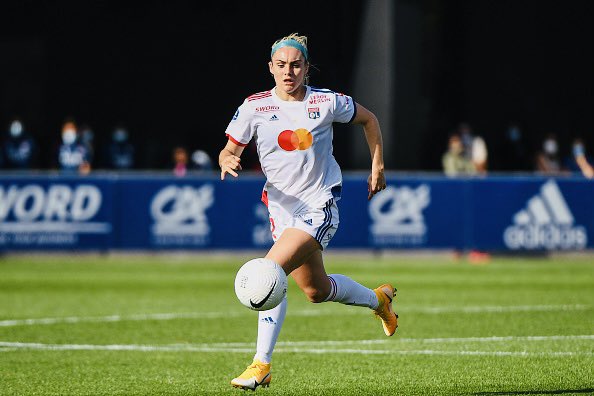
Above: Delphine Cascarino (left) in action for Olympique Lyonnais in Turin against Juventus in Tuesday’s UEFA Champions League Last 32 1st Leg. Photo: Damien LG via @OLFeminin.
68th: 2 – 2, Melvine Malard (Lyon); first goal in UEFA Women’s Champions League
74th: Maria Alves (Juventus) replaced Barbara Bonansea
77th: Selma Bacha (Lyon) replaced Amel Majri
84th: Martina Rosucci (Juventus) replaced Lina Hurtig
87th: Jodie Taylor (Lyon) replaced Sakina Karchaoui
88th: 2 – 3, Saki Kumagai (Lyon); first assist of Melvine Malard in UWCL
GORNIK LECZNA v PARIS SAINT-GERMAIN:
Paris St. Germain won away from home against Gornik Leczna 2-0 in Poland. By scoring early in the game, just after the first quarter, PSG made the match easier. At half time, things were already looking pretty good for PSG with a 2-0 lead. In the first quarter of the second half, PSG had more opportunities to score (Jordyn Huitema 55, Sandy Baltimore 58 hit the post) but they were not able to add more goals to their total.
Above: Paris St. Germain’s Sandy Baltimore (right) gets away from Gornik Leczna’s Alicja Dygus in Wednesday’s UEFA Women’s Champions League tie. Photo: @PSG_Feminines.
Highlights of the game:
17th: 0 – 1, Jordyn Huitema (Paris)
25th: 0 – 2, Sandy Baltimore (Paris)
35th: Perle Moroni (Paris) out on injury; replaced by Jade Le Guilly (18 years old)
Ben Gilby spoke to Brentford Women‘s Amy Crook about the development of women’s football at the West London club.
Brentford Women’s FC celebrates thirty years this year after being formed in July 1990 when Roger Crook founded the club in response to his daughter Amy’s passion for the game. They were then based at Feltham Arena in Hounslow. The pair are still an integral part of the club today.
Above: Going for goal – Brentford Women. Photo: Sophie Boycott.
The club started out as an Under 14 team playing in friendly matches, before entering the Greater London Women’s League in the 1991/92 season. Their division comprised just four teams with Arsenal, Wimbledon and Walton & Hersham. By 1995/96 the group were eligible to play senior age football and so the club made the move to the Greater London Women’s Football League.
1995 saw interest in the female game increase enormously with the upcoming European Championships in 1996, and it was a time of progression as Brentford merged with a team from Smithkline Beecham to become Brentford Beechams.
By 2003/04, Brentford were competing in the Greater London Women’s League Premier Division. Two years later, the Bees merged with Viking Ladies and expanded to six teams: Ladies First and Reserves plus ages U15, U13 and U11A and B. In the early part of the 2010s the first team made the jump to the London & South-East Women’s League.
Above: The Bees in action against Dulwich Hamlet Development. Photo: Sophie Boycott.
Since 2014 there have been both ups and downs. The team are now playing in the Greater London Women’s Football League Premier (tier seven) and currently consist of a First Team and a Development Team, comprising players aged 16 and over with a total of forty-seven players across the two teams.
The club is still run by Roger Crook and daughter Amy, who now works for Brentford FC and is in charge of their two women’s teams. Amy Crook also highlights the fact that we have “a team of committed and qualified coaches headed up by Brentford legend Karleigh Osborne.” Talking about the potential of the side, Amy tells us that she believes “we are capable of playing at FA Women’s National League level.”
The women’s teams are supported by the men’s team and have played several home games at the Griffin Park stadium prior to the club leaving their famous old home this summer. “Brentford have also recently employed me to run both women’s teams and match day activities. There will also be opportunities to play a home game or two in the new Community Stadium, a 17,500 all seater arena once the pandemic is over and fans are allowed back into stadiums.”
In terms of the challenges that the club face, Amy recognises: “There is a lot of competition for players in West London. But the ones we do attract stay with us – one has been with us for twenty years now. In terms of the coronavirus situation, training has been difficult as Swift Road, where we usually train, has been closed.”
Above: Dramatic action from a Brentford Women’s game earlier this season. Photo: Sophie Boycott.
The short-term aim for the coming season is at least promotion for both teams, and there is a genuine feeling that this is realistic and achievable. Amy believes that the key to this success is: “Treating all players well at whatever level of talent – allow them to develop organically or allow them to move on and develop. It’s also important to have a real honest, open and trustworthy respect for all players, staff and volunteers.” In terms of the future of the women’s game, Amy believes that whilst coverage is increasing at the top levels, it is not filtering down to the lower levels: “It’s very slow at grassroots level. We hope that with the professional men’s team behind us, we can attract more talent to push us towards the FA Women’s National League. Money needs to be invested and there needs to be more coverage for clubs at our level and lower to progress.”
Jean-Pierre Thiesset brings us all the news from the 2020 International Federation of Football History and Statistucs (IFFHS) Awards for the women’s game.
The International Federation of Football History & Statistics (IFFHS) – recently published the winners of their 2020 Awards. Olympique Lyonnais were the big winners, with four of their squad names as one of the World’s Best players and a total of seven players in the Women’s World Team of the year for 2020.
INDIVIDUAL AWARDS:
World’s Best Goalkeeper: SARAH BOUHADDI (FRANCE/OLYMPIQUE LYON)
World’s Best Playmaker: DZSENIFER MAROZSAN (GERMANY/OLYMPIQUE LYON)
World’s Best Club: OLYMPIQUE LYONNAIS (FRANCE)
World’s Best League: FA WOMEN’S SUPER LEAGUE (ENGLAND)
World’s Best Club Coach: JEAN LUC VASSEUR (OLYMPIQUE LYONNAIS)
World’s Best National Coach: SARINA WIEGMAN (NETHERLANDS)
World’s Best Referee: STEPHANIE FRAPPART (FRANCE)
THE WOMEN’S WORLD TEAM OF THE YEAR 2020
Goalkeeper: SARAH BOUHADDI (FRANCE/OLYMPIQUE LYON)
Jean-Pierre Thiesset rounds up all the action for the tenth week of matches in France’s D1 Arkema.
There were no great surprises in the tenth round of D1 Arkema matches, and no change in the standings.
Olympique Lyonnais won 3-1 at Le Havre but without reassuring their supporters. They scored three goals in the first eighteen minutes through Wendie Renard, Saki Kumagai and Amel Majri, but were not able to score again in the second half. Le Havre scored in the first half too due to a bad clearance by the Lyon defence and Sylia Koui scored. Ellie Carpenter, who was one of the players that did the job for Lyon as usual, was elected player of the game.
Above: Matildas star Ellie Carpenter was in fine form for Olympique Lyonnais on Saturday. Photo: @CarpenterEllie
Paris St. Germain won also, this time against city rivals Paris FC 4-1, keeping their first place in the table, a point ahead of Lyon. An own goal from Annaig Butel plus strikes from Marie-Antoinette Katoto, Sandy Baltimore and former Chelsea star Ramona Bachmann were the difference. Evelyne Viens got one back for Paris FC.
Elsewhere, Montpellier beat Issy 3-1 with goals from Dominika Skorvankova, Marija Banusic and Lena Petermann. Batcheba Louis scored for Issy. Bordeaux came from behind to see off Soyaux 2-1. Coralie Austry gave Soyaux a shock lead just before half time, but two goals from Khadija Shaw gave Bordeaux the points. Fleury won 1-0 at Guingamp thanks to Lea Le Garrec, formerly of Brighton & Hove Albion. Finally, Dijon drew 0-0 with Reims.
Next week Lyon and Paris SG will play away from their home in their UEFA Women’s Champion League Round of 32 ties. Lyon against Juventus in Turin, Italy. Paris St. Germain against Gornik Leczna in Leczna, Poland.
This weekend, at long last, fans were allowed back in limited numbers to the FA Women’s Super League. Ben Gilby was one of the lucky seven hundred supporters at Kingsmeadow for Chelsea’s game with West Ham United.
Watching a game in the FA Women’s Super League is a very different experience indeed – but whilst forward planning and patience are the watchwords, the rewards are oh so wonderful!
The process of attending Chelsea v West Ham United began on Monday afternoon when seven hundred tickets went on sale through Chelsea FC’s website, and being held in a “virtual waiting room” for what seemed an eternity the magic happened and ticket purchased.
Additionally, everyone attending was required to fill in a Coronavirus questionnaire ahead of the game and you would only be allowed entry to the stadium if you could fill it in, send it back and print off a reply telling you that you were cleared to attend the game medically. Coronavirus questionnaires came through early on Sunday morning which meant setting the alarm for an ungodly hour to fill it in online and there was then a short wait before the most awaited email that I have had in 2020 arrived at around 7:30am. I was officially in.
Whilst no-one is able to use their passports to go on holiday right now, if you’ve missed brandishing it this year, fear not, because you need it to get into Kingsmeadow. So, let’s see – Ticket printed out? Check! Covid questionnaire proof of health printed? Check! Passport? Check! Great – off to Kingsmeadow we go.
Above: Got your paperwork? Good! Now you can leave for the match! Photo: Ben Gilby
Leaving the house feeling as bouncy as a kid on Christmas morning, I made the short trip to Kingsmeadow feeling more excited than I can ever remember being for a football match in all my forty-one years on this planet. They say absence makes the heart grow fonder. Then, this view, which I had started to think I would never see again:
Above: Passing through the gates for the first time since February. Photo: Ben Gilby
Taking my place in the stadium an hour and a half before kick-off was a chance to catch up with familiar faces again after all those months hidden away, and embark on another pre-match ritual. It’s well known that Sam Kerr is my women’s football hero. The Western Australian branch of my own family live just 20 minutes up the road from where Sam was brought up in East Fremantle, so every game at Kingsmeadow since her arrival has seen me unfurl and tie up an Aussie flag on the barrier – today, the Matildas Active Support flag – representing the supporters club for Australian women’s football. It’s an honour to represent them at FAWSL games this season.
The first sighting of the players to come out and warm up was met by huge cheers. The first songs started up and it was quite emotional to see Guro Reiten joining in with some of the chants too once they started!
The Chelsea line-up included Beth England, Sam Kerr, Pernille Harder and Fran Kirby from the start for the first time and the movement and connection between the four was quite magnificent all afternoon long.
West Ham, with Billy Stewart taking over the reins after Matt Beard’s departure started well, but the front four of Chelsea made the difference. Fran Kirby pulled in a low cross on the quarter hour mark and Kerr steered the ball home.
Above: West Ham’s Rachel Daly fires in a cross despite the attention of Maria Thorisdottir. Photo: Ben Gilby.
Almost immediately afterwards, the Hammers could have levelled. Maren Mjelde’s pass was gobbled up by Rachel Daly who bore down on goal to reach a one on one with Ann-Katrin Berger, but the German shot stopper stood up well to the effort and saved the day.
Chelsea possibly should have had a second, but West Ham United’s Australian international Mackenzie Arnold made fantastic saves from Ji and Melanie Leupolz.
Above: West Ham’s Australian goalkeeper Mackenzie Arnold made some spectacular saves. Photo: Ben Gilby.
If any of the gathered supporters felt that a run away second half would transpire, they were put right just two minutes after the re-start when Daly swept home following a less than impressive interlude in the Chelsea defence.
Any hope West Ham had was ultimately snuffed out by Fran Kirby who was in outstanding form down the left and it was her probing and great deliveries that sparked Chelsea’s attacking prowess throughout the half.
Above: Fran Kirby was back to her imperious best. Photo: Ben Gilby
Kirby’s creativity was also added to by Pernille Harder and it was the Danish superstar that played in a cross that Mackenzie Arnold could only push into the path of Sam Kerr to smash home her second.
Above: Pernille Harder’s cross was eventually turned in by Sam Kerr for the Australian’s second of the afternoon. Photo: Ben Gilby.
It was Kirby who produced the cross for Chelsea’s third when Kerr completed her first hat-trick in English football, injuring her hip, most likely in a collision with West Ham’s Cecilie Redisch in the process of scoring. Erin Cuthbert replaced Kerr as a result, with the Scot coming on to produce another outstanding Scottish Terrier like performance.
Above: Sam Kerr, who left the field with a hip injury after scoring her hat-trick clinching goal. Photo: Ben Gilby.
Chelsea were comfortable at 3-1 – possibly too comfortable – and another worrying defensive lapse ended with Magda Eriksson deflecting Emily van Egmond’s effort into her own net.
The home side deserved their win and were hugely impressive coming forward at times, but concerns remain about the defence when Millie Bright and Magda Eriksson are not playing together in the starting line up.
Above: Erin Cuthbert produced a very impressive cameo after coming on as a substitute. Photo: Ben Gilby
As part of the exciting re-design of Impetus, Ben Gilby spoke to Chelsea and Sweden star Jonna Andersson who has played in the World Cup, Olympic Games and UEFA Women’s Champions League in a fantastic career.
Jonna was born and brought up in the city of Mjölby, south-east Sweden and her family played an integral part in her interest in football: “They have always loved football and played football so I think it was an easy choice for me. I started when I was a young age with my big brother in the garden and then I decided to go to a training session and started play for Mjölby AI/FF when I was around 7 years old.”
“My family played an integral part in my development as a footballer. They have always supported me. My dad played football on a quite high level as well so he always wanted to help me get better and better. Then of course all the coaches I have had as well but I still think the support and help from family makes it a lot easier.”
At the age of sixteen, she went to play for Linköping – which was a big step for the young Jonna: “I came as a young player to Linköping, who at that point had a very good and professional squad with so many high quality players. So it was a lot to take in and to learn as a 16 year old girl playing with these amazing players. It was a huge step going from my old club, higher quality, higher tempo, harder sessions and tougher. But I’m glad that I stayed eight years in the club because I feel that I could grow as a player and as a person. I gave myself the time I needed to grow and to develop as a player and with the high level from day one it was the right place for me to be to be a better football player.”
During Andersson’s eight years at the club, they won the Damallsvenskan (top flight of women’s football in Sweden) and the Swedish Cup several times before she made the move to England.
Jonna emphasised the big step up she experienced with her move to the FAWSL as, despite the Damallsvenskan producing many hugely talented young players, it is not as strong as it was in the past in terms of success in European club football: “The biggest difference between the two leagues, I would say, is the quality in general both in training and games. I think the FAWSL is a higher tempo, better quality and harder in general. And to have that every day in training and in most of the games in the league you have a perfect opportunity to get better and develop.”
Above: Jonna Andersson in action for Linköping in 2014. Photo: Wikipedia
Andersson highlighted that for the women’s club game in Sweden to attempt to move back towards its previous strength, some of the big men’s sides such as Malmö, Djurgården and AIK could consider doing more to support their women’s teams: “Of course I think it would help to work together with men’s teams. To build and to be even better and progress even further in the Champions League as well you need to have the money. It’s not just for one season, you need to build for a longer term as well and for that you need the money. I’m not saying that it’s the answer but it would be interesting to see for the future if the men’s teams decided to work together and support the women’s team more.”
Jonna has experienced some incredible moments playing for the Swedish national team, starting in 2012 in the U19 European Championship: “That tournament was amazing! To be with the U19 national team and to win Euro 2012 was unbelievable. A big tournament and an experience in that age was fantastic, and to end the tournament with a gold medal too!”
Four years later came another incredible experience – being picked to represent Sweden at the 2016 Olympic Games in Rio where Andersson and her team won the silver medal: “That was very cool. Just to be in a village with all the athletes – it doesn’t matter what sport they were from, it was huge and an amazing feeling. I didn’t play that much during that tournament but I’m very happy and proud that I was a part of the Olympic squad for 2016. The atmosphere in the stadiums was incredible, and to be there with all the audience at these huge stadiums were something I never will forget. And to be a part of this tournament and to end with a silver medal, that’s an amazing achievement from the team.”
Above: Jonna Andersson in action for Sweden. Photo: Mia Eriksson.
Further international success followed three years later at the 2019 World Cup in France. The Swedes had a fantastic tournament which saw them clinch third place. It was a month or so that created more amazing memories for Jonna: “I enjoyed it very much. To play a World Cup is very, very big and I will always remember it. To be with our amazing team and squad, to work hard together every day, to perform in all games and the togetherness we had all tournament that in the end gave us a bronze medal. I’m very proud that I was a part of the World Cup squad and I think the togetherness was a key and reason for why we could succeed.
Andersson is about to celebrate three years playing for Chelsea and in that period of time, standards have gone up and up each season: “I think it was a very high standard with everything already when I came but of course you can see during these three years that things are getting even better. And you know when you are in Chelsea that this club want to win everything – all the titles and that’s fantastic to be a part of this journey. You can see how much Chelsea are pushing this season trying to win everything, we have a quality squad with amazing signings and things that’s happening on and off the pitch that are hopefully going to make us be able to go all the way and fight for all the titles.”
Jonna is clear that the key to Chelsea’s success is Emma Hayes: “Emma is a very good coach who loves football. She has done so much for women’s football and hopefully she will continue this work to grow women’s football for a long period of time. She and all our coaches work together and are very focused. They work hard every day to make us better as a team and pushing us to achieve and to get better all the time.”
Above: Jonna Andersson (far right) is looking to celebrate regularly for Chelsea this season. Photo: @JAndersson25
As the Swede highlighted earlier, Chelsea have brought in a large number of big name players, particularly over the past twelve months: “I think everyone has been settling in very well. They came into a very good group so hopefully they have felt very welcome from the start and hopefully that made it easier to feel like home. It is a squad full of amazing players with top quality so all the new signings have made a huge impact in training and games so that’s amazing and with all the new signings the squad is even bigger and more competitive than before.”
The standards that Chelsea set themselves are sky-high, and therefore it should not be a surprise that their expectations are equally as high: “A good season for us this season is of course to win all the titles we are playing for. That’s what we want. We want to play a football with high quality but in the end of the day we want to fight for all the trophies and bring them to Chelsea.”
Jonna is clear that she wants to develop herself as a player and provide even more influence on both her club and country team over the coming years: “Hopefully I can continue develop as a player. I want to be even better both attacking and defending. Hopefully I will win a few more trophies with Chelsea and have played a few more tournaments with the national team. There’s the Olympics and Euros to fight for in the coming years so hopefully I can be a part of these big tournaments.”
With the qualification games reaching their climax, a great deal was decided over the past week or so. There were some shock eliminations and surprise play-off contenders. Ben Gilby rounds up all the action with Jean-Pierre Thiesset casting his expert eye over France’s progress.
Whilst the top two places in Group A have been decided with Netherlands guaranteed top spot and Russia runners-up, the latter knew that two big wins in their final games could potentially see them qualify automatically as one of the best second placed sides. That bid started on 27th November with a comfortable 3-0 win over Kosovo in a game moved to the neutral venue of Manavgat in Turkey due to security concerns. All three Russian goals emerged in the opening twelve minutes with Marina Fedorova scoring twice and Alsu Abdullina grabbing the other. The battle of the bottom two nations, both winless all competition long took place in Tallinn on the same date and it was Turkey who emerged with the honours after a 4-0 thrashing of Estonia. Ece Turkoglu, Ilayda Civelek, Gulbin Hiz and Yagmur Uraz were on target as the Turks doubled their goal tally for the whole qualification campaign in one night.
On 1st December, Netherlands concluded their qualification tournament with a tenth win from ten games with a 6-0 demolition job of Kosovo. A hat-trick by Katja Snoeijs, two from Jill Roord and one from Lieke Mertens ensured they ended with a perfect record. Russia finish second, but have not done enough to ensure they finish as one of the best three automatic qualification spots after they only won 2-1 in Turkey. Anna Belomyttseva and Marina Fedorova were on target with Derya Arhan scoring for the Turks. Elsewhere, Slovenia ensured they will finish third regardless of their final game in February after a 2-0 win over Estonia who are guaranteed to finish bottom before their last game in the New Year. Barbara Kralj and a Korina Kork own goal separated the sides.
Above: There has been plenty for Denmark to celebrate in this qualification campaign. Photo: @dbulandshold.
Group B action returned on 26th November as Malta recorded their second win of the qualifiers with a 4-0 success over bottom side Georgia. A brace apiece from Shona Zammit and Haley Bugeja earned the islanders the points. The majority of the nations played their final qualifiers on 1st December. Denmark concluded their successful campaign with a 0-0 draw against Italy in Viborg. The Italians are likely to gain one of the automatic qualification spots for the three best second placed sides if they can beat an Israeli side in February who have only won two of their nine qualifiers so far. Bosnia Herzegovina finished third after a routine 3-0 win away to Georgia who ended their qualification bid with ten losses from ten games. A brace from Sofija Krajsumovic and one from Marija Damjanovic earned them the three points. Malta concluded their campaign with a second straight win, this time 2-0 in Israel. Brenda Borg and Haley Bugeja were on the mark.
In Group C, on 27th November, Northern Ireland took another huge step towards the phenomenal achievement of making the play-offs as group runners-up. Their 3-2 win over Belarus in a see-saw encounter at Crusaders FC’s ground in Belfast means they would be confirmed as group runners-up with a win over Faroe Islands four days later. Northern Ireland took the lead after just two minutes thanks to Kirsty McGuinness’ strike. However, it was cancelled out by Anastasia Shcherbachenia’s equaliser fourteen minutes later. Just past the hour mark, Rachel Furness crashed home a penalty to restore the home side’s lead. Yet, six minutes, up popped Shcherbachenia to level again for Belarus. To the delight of the hosts, the win was sealed three minutes later when Natalia Voskobovich put into her own net. Norway’s game with the Faroe Islands was cancelled due to coronavirus and is unlikely to be rescheduled as the Norwegians are already confirmed as group winners and the Faroese can only finish bottom of the group.
On 1st December, Northern Ireland continued their fairy tale qualification campaign with an outstanding performance to brush aside Faroe Islands 5-1 at Crusaders FC. The result confirmed their place in the play-offs – a sensational achievement by Kenny Shiels’ side. There was a dramatic opening when the visitors, fielding a side full of teenagers, took a shock lead – scoring their only goal in the whole qualification period – thanks to Jensa Torolvsdottir sliding home. But, just sixty seconds later, Liverpool’s Rachel Furness bundled one over the line from a scramble. Northern Ireland dominated completely from now on and just before the half-hour mark took the lead from a sensational strike outside the box by Kirsty McGuinness. It stayed that way at the break, but another stunner of a hit, this time from Birmingham City’s Chloe McCarron extended the advantage. Caitlin McGuinness, who by coming on as a substitute to join her sister Kirsty on the pitch ensured her family became the first to represent Northern Ireland Women in the same team at the same time, then joined her sibling on the scoresheet too. The rout was completed at the end with an own goal from Jacoba Langgaard. There were joyous scenes at the final whistle in Belfast and Northern Ireland will hope that some fans will be allowed into their home leg of the play-offs in the New Year. That result meant that Wales’ 3-0 win over Belarus in Newport was purely academic. Natasha Harding, Rachel Rowe and Jess Fishlock all scored in a frustrating end to Wales’ qualification campaign. Norway are due to play Belarus in February, but as the game has no bearing on the final group table, it remains to be confirmed.
Above: Chloe McCarron hits her second half stunner for Northern Ireland against Faroe Islands. Photo: @NorthernIreland.
In Group D, Spain moved to within one victory of a place in the finals with a comprehensive 10-0 thumping of Moldova on 27th November. Jennifer Hermoso grabbed a hat-trick with Aitana Bonmati adding two more. Maria Caldentey, Alexia Putellas, Patricia Guijarro, Eva Navarro and an own goal from Dumitrita Prisacari completed the rout in Madrid. In the sole game played on 1st December, Moldova were on the end of another heavy loss, with Czech Republic hitting seven against them this time round. Andrea Staskova (two) and one each from Klara Cahynova, Jana Petrikova, Katerina Svitova, Kamila Dubcova and Miroslava Mrazova sealed the deal. There are still three games to be played in this group in the New Year with Spain, Poland and Czech Republic all still capable of finishing top of the group.
Scotland’s hopes of qualification from Group E took another downward turn on 27th November after they lost their second successive game – 1-0 to Portugal at Belenenses’ Stadium in Lisbon. Shelley Kerr’s side dominated the first half in terms of possession and territory but could not create a chance to unlock the door. Ana Borges’ strike with 21 minutes to go made the Scots pay. The visitors now slip to third in the table, four points adrift of the play-off places. Scotland will now need to win all of their remaining three matches and hope that the result of the game between the Portuguese and Finns who are above them produces a favourable outcome. In the group’s other game that night, Albania gained their second win of the campaign – both over rock bottom Cyprus and did so with a 4-0 score line. The Albanians took the lead on 18 minutes through Suada Jushari before three further goals in the final ten minutes. A Megi Doci penalty plus goals from Lucie Gjini and Kristina Maksuti completed the win.
Scotland’s shock slump continued on 1st December with a disastrous 1-0 loss to Finland at Hibernian FC – their third qualification loss in a row which means that they can no longer even make the play-offs. The hosts had a huge number of the chances throughout the game, but Jennifer Beattie, Kim Little, Martha Thomas, Lisa Evans and Caroline Weir all missed them. The sting in the tail came in the fifth minute of second half stoppage time when Amanda Rantanen scored for the Finns to put them top of the group. It means that the Scots, who qualified for Euro 2017 and the World Cup in 2019 and were top seeds in the group are now out with two games left to play. Portugal laboured to a 1-0 win over strugglers Albania. Ana Capeta scored the only goal just before the hour mark.
In Group F, Iceland confirmed their place in the finals as one of the best second placed sides with two wins in a row. First they came from 1-0 down in Senec, Slovakia on 26th November to win 3-1. The Slovak’s took the lead on twenty-five minutes from Maria Mikolajova but back came the Icelanders thanks to Sara Bjork Gunnarsdottir’s two penalties and a Berglind Bjorg strike. This was followed up with a 1-0 win in Hungary thanks to two penalties (one penalty) from Sara Bjork Gunnarsdottir and a Berglina Bjorg. Sweden completed their qualification campaign unbeaten after a 6-0 win in Slovakia. Ingrid Angeldal (2), Linda Sembrant, Fridolina Rolfo, Jonna Andersson and Rebecka Blomqvist were on target.
France overcame their off-field difficulties with a 3-0 win over Austria in Guingamp on 27th November to finally qualify from Group G. Goals from Wendie Renard and two from Marie-Antoinette Katoto completed a win which caused thousands of fans to heave a big sigh of relief. Jean-Pierre Thiesset’s report on the game can be seen here: https://impetus885775742.wordpress.com/2020/11/29/france-qualify-for-euro-2022-at-last/
Above: Action from France’s qualification clinching win over Austria. Photo: @eveperisset
Elsewhere, on the same night, North Macedonia recorded their second win of the qualification stages, both of which have come over Kazakhstan. Two goals from Gentjana Rochi and one from Elma Shemsovikj earned the 3-0 win.
On 1st December, Austria gained the win they needed to stay in the running for one of the three automatic qualification spots for the group runners-up with the best record. Nicole Billa’s goal with ten minutes left against Serbia sealed the result. France’s final game with Kazakhstan ended with a 12-0 thrashing. Jean-Pierre Thiesset reports: There was the opportunity to see a few young players that had not played a lot or at all since the beginning of the competition. Corinne Diacre decided to let several main players rest to give more chances to Lyon and Paris SG teams in their Women’s UEFA Champions League games: Wendie Renard, Amandine Henry, Delphine Cascarino and Sakina Karchaoui did not play at all and Amel Majri, Kadidiatou Diani and Marie-Antoinette Katoto played only the first half. Whilst Kazakhstan is the 77th team in the world, a 12-0 win with a lot of good passes and play was incredibly pleasing to watch. The young players showed that they were able to do the job and it was the first goal for France team for Eve Périsset (25 years old, Paris SG), Estelle Cascarino (23 years old, Bordeaux), Emelyne Laurent (22 years old, Olympique Lyonnais, on loan at Atletico Madrid), Perle Moroni (23 years old, Paris SG), Sandy Baltimore (20 years old, Paris SG) and Clara Matéo (23 years old, Paris FC). Kenza Dali and Elisa De Almeida were also on target as well as a double from Kadidiatou Diani (25 years old, Paris SG) and Marie-Antoinette Katoto (22 years old, Paris SG). The latter being the highest scorer of the qualification competition for the French with eight goals in front of Eugénie Le Sommer (seven goals) who did not play in the last two games as she was injured.
On 27th November, in Group H, Croatia won the battle of the bottom two with a 1-0 success over Lithuania thanks to a late strike from Kristina Sundov in Pula. The Croats have won both games between the two nations for their only wins in the campaign so far. The battle of the top two on 1st December saw Belgium romp to a stunning 4-0 win over Switzerland in Leuven to confirm that they will qualify automatically as group winners. Tine de Caigny (2), Tessa Wullaert and Janice Cayman were on the mark. The result now means that Switzerland are going to find it incredibly difficult to qualify automatically as one of the three best second placed sides and will most likely drop into the play-offs. Croatia’s game with Lithuania was cancelled.
Above: Tine de Caigny celebrates one of her vital goals for Belgium against Switzerland to ensure her country’s automatic qualification. Photo: @UEFAWomensEuro
Finally to Group I where Germany won their seventh successive qualifier on 27th November with a 6-0 thumping of Greece in Ingolstadt. Laura Freigang grabbed a hat-trick and Marina Hegering, Linda Dallmann and Paulina Krumbiegel completed the rout. Then on 1st December, any hope that Republic of Ireland had of making the play-offs as group runners-up faded after Germany left Dublin with a 3-1 win to complete their qualification campaign with a 100% win record. Tabea Wassmuth grabbed two and a Lina Magull penalty did the job. Katie McCabe scored for Ireland. That result meant that Ukraine’s 2-1 win at home to Montenegro meant that they would take the play-off spot as runners-up. Olha Basanska and Nadiia Kunina were on the mark. Jasna Dokovic scored for Montenegro.
With only a handful of qualification games left for February, matters are a long way towards being decided.
Already qualified automatically as group winners to join hosts England are Netherlands, Denmark, Norway, Sweden, France, Belgium and Germany. Iceland are also making their travel plans for England after being guaranteed one of the three automatic spots for the best group runners-up. Group D and E are still to be decided.
In terms of the play-offs, Northern Ireland, Russia and Ukraine’s participation is confirmed with three more spots to be filled as a result of the last few games in the qualification campaign in February.
Above: Northern Ireland celebrate their sensational qualification for the play-offs for a place in the European Championships. Photo: @NorthernIreland.
Impetus are hugely excited to announce an official partnership between ourselves and Penryn Athletic Ladies FC, who play in the seventh tier Earthbound Electric Cornwall Women’s Football League. The partnership involves regular features with key members of the squad and officials about how the club and players are progressing. Impetus founder Ben Gilby launched the partnership by having a chat with club player-manager Yaina Andrew.
Yaina and I started our conversation by discussing the history of women’s football in the historic town of Penryn, situated less than three miles from Falmouth.
“I set up the women’s team between five and six years ago now,” reveals Yaina. “I used to play for Mullion but it was quite a lot of travelling from Penryn each week. Me and my friend Bethany Hibbs who also lived in Penryn thought we should set up a team for the Penryn and Falmouth community. We had a look around for coaches and managers and started at Mabe, two miles outside of Penryn. We trained six months before the season had started just in case we couldn’t raise a side.”
“For the first four months of training we only had between two and five ladies attending each week, at this point it was not looking good! I didn’t want to give up on the idea and felt like we had to carry on training regardless of numbers (which would show commitment and how serious we were to start this team). Two months before the season was about to commence, we then started to receive a ton of interest from the local community and Falmouth University Students. We had a great first season at Mabe with between ten to thirteen ladies. As a team we wanted to progress so we moved the whole team together to Penryn AFC where David Baker (Bates) could provide a lot more for us, such as sponsorship, free facilities, a clubhouse, food and drink after the game, ground maintenance and help with league and cup funding. Since being at Penryn, we have been able to attract more players because of the great facilities and pitch there, we have grown so much from when we first started. Obviously we have had our ups and downs as most teams do but we always manage to pull through the other side both better and stronger. We now have a strong and striving team of between sixteen and twenty-six brilliant ladies and an ever growing community of support!”
Like pretty much every women’s club, Penryn Athletic Ladies have had to cope with hugely uncertain times since the outbreak of the coronavirus pandemic. However, Yaina reveals how the club kept the team links strong during the most difficult periods: “When the first lockdown was announced, we were absolutely gutted because we couldn’t finish off our season however we didn’t lose team spirit. Initially each week, which eventually turned into every night, the girls would go online and we would play quizzes and games against each other. After lockdown we were quick to go back to training, starting off pre-season strongly with full commitment. This showed in the friendly matches and the league matches as both fitness levels and morale were high. Unfortunately, the second lockdown came mid-season and therefore means we have no training time to catch up on any fitness and ball control lost before returning to matches. However, myself and the coach have been sending skills and fitness drills out for the ladies to achieve each week.”
Above: Penryn Athletic Ladies FC 2020/21. Photo: @PenrynLadies
Women’s football in Cornwall has some added extra hurdles to clear that may not necessarily be there in other parts of the UK – the geographic location meaning that it takes over an hour and a half just to get out of Cornwall should the club ever go higher in the league system – and the fact that the Duchy, and Penryn in particular is a Rugby Union stronghold. Yaina highlights some of the issues she had at the start of her own career: “Even though women’s football in Cornwall may have not been as popular than in other places up-country, we did still have the option to play and compete in youth matches. I just don’t think there was the support, funding and facilities in place for ladies teams like there is today. When I first started playing ladies football at the age of 14, there were only around five teams in the league and only one division. Now we have around sixteen teams in the Cornwall Women’s Football League which is split into two divisions with the option to go up to the South-West Women’s League as well. Rugby is and always has been a popular sport especially in Penryn, I myself know this coming from a family of rugby men. Due to the rich history of rugby in Penryn (the town’s rugby club regularly went toe to toe with some of the sport’s biggest clubs over the years – including a game against the British & Irish Lions), it would be impossible for football to compete with so many successful international rugby players. Despite this, the two sports see no challenges from each other and the community is harmonious in its support for both.”
Yaina highlighted earlier just how important the link up was with Penryn AFC men’s side, so I asked her further about the relationship between the men’s and women’s teams: “The relationship between the teams is constantly building, we have a few supporters each week from the men’s side which is starting to grow. We also like to watch the men play as well, which gives us an insight of how they manage and run their teams. We share our equipment and facilities and they also offer assistance with training. All teams get on really well and we are happy to be a part of Penryn Athletic FC.”
With league football about to recommence after the second lockdown, it felt like the perfect time to discuss the club’s season to date in the Cornwall Women’s Football League: “We have started off the season brilliantly, we have won three and lost three games. However, we are determined to improve before the second half of the campaign comes around. We’re very committed this season more than any other season due to a large number of ladies training and playing each week. We are definitely looking to finish the season in the top half, as long as the commitment levels stay high and the ladies have maintained their fitness through this second lockdown.”
With the club well established in Tier Seven, we were keen to know more about the Cornwall Women’s Football League (CWFL): “We love being in the CWFL, we love representing our County and the league has always been ran excellently with some brilliant representatives,” Yaina says.
“Of course we would love to move up to the South-West League and the more teams that actually move up the better, the quality of football is getting better, we have lost two players to Plymouth Argyle’s 1st team and one player to America. The more teams that excel will hopefully help with funding down here, enabling more youth teams for girls which will feed into the ladies. Each season we vote for what we want the season to look like. This season the vote was for a South and West league rather than a divisional split by ability. Last season we had such a low that we wanted to have a divisional split where we could regroup and build our confidence back up, however that was not the case. We actually got put into the South split and against some very good teams, luckily in pre-season we had a new manager, more players and a fresh start and we’re now proud of ourselves and how far we’ve come.”
Artwork designed by Graphics by PW: @Graphicspw
We had talked about coronavirus, geography and competing with Rugby Union as all hurdles to overcome for Penryn Athletic, but there are a couple of other challenges that Yaina highlighted: “The biggest challenges in sport altogether is lack of participation. Penryn Athletic men used to have four teams and now they only have two teams, the same for Rugby and Cricket in the town. Today children and young adults would rather play online on Xbox and PlayStation than go outside. This could become a really big problem for clubs because they would have to shut down if no money from the bar etc is coming in.”
Another issue is one which all grassroots clubs can identify with – but particularly in Cornwall: “Income is another really big one! Petrol, subs, training facilities and referee fees are all funded from each individual player however this could become unaffordable if we moved to the South-West Women’s League due to our location. It takes us eighty plus miles to get out of Cornwall as well as travelling time therefore this can put off some players. Our club is kind enough to pay for our league,county fees and insurance but the club itself, as many are these days, is struggling due to the lack of funding, volunteers and income.”
At the present time, Penryn Athletic do not have a girls team, although it is not for want of trying: “We have tried to start up a Penryn Girls Youth team however it was unsuccessful, this was due to the girls from Penryn College being involved in so many sports with the school that the days kept clashing, Yaina explained.
“We do have the support and equipment in place and this is something we are still looking at doing for next season. This would really benefit us if we put this in place and help keep Penryn Ladies running in the future.”
Penryn Athletic Ladies rely on a small but exceptionally loyal band of volunteers keeping the show on the road. “It’s really just myself, Bethany Hibbs and Hannah Batt that have kept the team going for so many years. We were the first to arrive and I can’t imagine any of us leaving now until we retire (which will be never!). Without them I couldn’t have done this and we always knew if no one else came to training, there would at least be us three musketeers!”
More widely in the club, within the Penryn Athletic Men’s teams, there are so many that help behind the scenes, the treasurer, the chairman, the club president, the secretary and the vice chairman. All of which have done an amazing job of keeping the club running and giving up their own time to do so as well as supporting the ladies when needed. However, there has to be a special mention to David Baker (Bates) and Tom Blewett for always being there from the beginning, offering support, guidance and knowledge. Bates has helped us train, watches our matches, offered us work and included us in as much as he can. He is excellent at what he does and we couldn’t have done it without him! Tom Blewett is also a massive support for the ladies team, he started off helping us train and running our line, now he manages alongside Will on match days. He has always been our number one fan and would do anything to help us out.”
“I would also want to say a massive thank you to our team Penryn Ladies for always being loyal, committed and just a great team to play with and to anyone that has sponsored us, helped us and supported us. It is always massively appreciated.”
Above: Penryn Athletic Ladies FC and a beautiful Cornish sunset! Photo: via: Yaina Andrew
The conversation concluded by looking at where Penryn Athletic Ladies would ideally like to be in five years. “We would love to win the CWFL, have two successful teams and a youth team, said Yaina. We would also love to build our fan base and see more supporters in the stands on Sundays. We would love to play in the South-West League and have our own mini bus to minimise travel costs for the ladies. As long as the team has the same commitment and happiness as it has now, then anything else would be a bonus.”
Impetus will be checking in on the fortunes of Penryn Athletic Ladies every month when we will meet different players and characters from the club, find out about their progress on the pitch, what goes on off the pitch and just what it’s like to play tier seven women’s football.
After last week’s announcement of two blockbuster fixtures over the Christmas and New Year period, the full Westfield W League fixture schedule for the 2020/21 season was announced yesterday. Ben Gilby picks out the key games and dates.
Last week we discovered that on the opening day of the new season, 27th December there will be a W League/A League (Australian men’s top tier) double header at Parramatta’s 30,000 seater Bankwest Stadium with Western Sydney Wanderers, one of last season’s breakthrough sides, hosting Melbourne Victory.
Above: Melbourne City celebrate winning last season’s Grand Final. There will be a re-run of that game on 30th December. Photo: @MelbourneCity
Three days later there will a hugely significant double header at ANZ Stadium, Sydney’s 83,500 capacity Olympic Stadium where Sydney FC will take on Melbourne City in a repeat of last year’s Westfield W League Grand Final. On the same day, the same two team’s A League sides will also face off.
Yesterday we also were given the news that 16th January will see a Sydney FC v Western Sydney Wanderers double header derby in the W League/A League at ANZ Stadium with yet another opportunity for a big crowd.
There has been one final blockbuster match announced as Western Sydney Wanderers’ W League clash with Melbourne Victory will take place on the same day in the same venue as the first ever A League derby between Western Sydney Wanderers and newcomers Macarthur FC.
The full opening round of fixtures – played between 27th-30th December – sees Western Sydney Wanderers host Melbourne Victory, Sydney FC at home to Melbourne City, Newcastle Jets v Brisbane Roar and Perth Glory at home to Canberra United with Adelaide United having the bye.
The New Year round of games (Round Two) has Newcastle Jets at home to Adelaide United, Melbourne City host Western Sydney Wanderers, Canberra United welcoming Sydney FC to Viking Park and Brisbane Roar taking on Perth Glory.
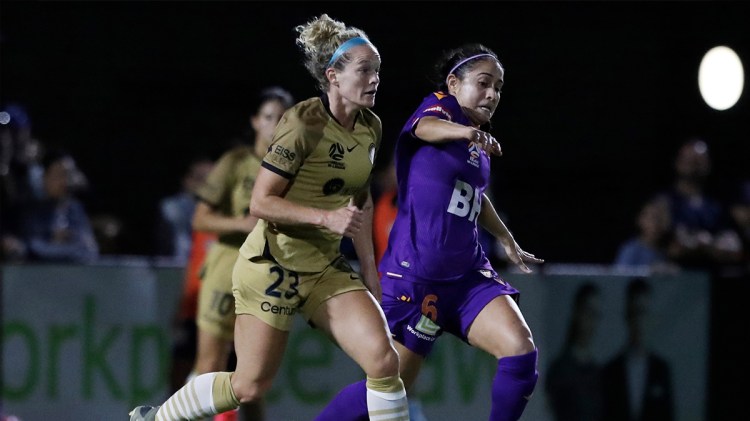
Above: Perth Glory (right) may well be fielding a very different looking side this season. Photo: @WSWanderers.
Other key fixtures sees the Melbourne derby taking place on 28th January with City hosting Victory, and Sydney FC travel to Melbourne Victory on 7th February. Canberra United, thought by some to be in with a chance of glory this season face reigning champions Melbourne City on 21st February.
The final round of regular season matches is scheduled for the period between 25th and 28th March. Brisbane Roar will welcome Canberra United to Dolphin Stadium, Adelaide United will be at home to Melbourne City, Western Sydney Wanderers host Perth Glory and Newcastle Jets travel to Melbourne Victory.
Impetus’ W League and Australian Women’s Soccer Coverage 2020/21:
Part of our overall site redesign – our coverage will be bigger and better than ever – a full round-up each week of matches with photos, plus our soon to be revealed new Australian correspondent reporting exclusively for the site on one match a week.
Don’t miss next week, we will begin our review on each team’s squads ahead of kick-off.
In the build up to the new season starting, we will have an exclusive interview with a Matildas World Cup and Olympics star!
Continuing our look at the game Down Under in light of the award of the 2023 FIFA Women’s World Cup – features on players, clubs, grassroots clubs and interviews with Australian journalists and sport officials!
It’s been a tough period for the French national side on and off the pitch with all sorts of issues being made public. However, as Jean-Pierre Thiesset writes, at least the team have finally made it to the European Championship finals even if the Corinne Diacre/Amandine Henry row rumbled on.
During the last game of France team against Austria, Corrine Diacre took her captain Amandine Henry off of the pitch after one hour in the match. Even if Amandine Henry was not performing her best game, there was no reason to take her off so soon in this game. France was dominating the game and largely ahead of Austria. Furthermore, Corinne Diacre gave the captain’s armband to Charlotte Bilbault instead of giving it to an Olympique Lyonnais player. This sequence surprised everyone. Things became a little bit clearer yesterday when according to several media, and especially from RMC Sport, we learnt that the clash between Amandine Henry and Corinne Diacre was still going on and even not close to be solved.
Henry and Diacre had a hard exchange this Wednesday during a training session.
While the players were in a training session inside, Corinne Diacre entered the building and went directly towards Amandine Henry, her captain. “Don’t worry you will have your discussion”, is Corinne Diacre launching to Amandine Henry, according to RMC Sport information, referring of course to the public interview of Amandine Henry mid-November on Canal+.
Put on the substitute team since the beginning of the camp by the coach, Amandine Henry answers “I hope so. It would be nice to be able to discuss”. What Corinne Diacre retorts “In life, everything has to be paid for”. Amandine Henry answers “You threat me?”
No answer from Corinne Diacre, the discussion stops there, and she went away as she came, in the middle of silent and stupefied players.
Now, to the actual match itself…
Even without several of its main players (Eugénie Le Sommer, Marion Torrent, Viviane Asseyi, Valérie Gauvin, Griedge MBock Bathy), France won against Austria (3-0) and have qualified for 2022 European Championship in England.
Above: The French team who played Austria on Friday night. Photo: @equipedefrance
Even if Austria is not amongst the best team in the world (in fact they are 22nd), the French team played a good game with a lot of creativity which could have led to more goals.
Once again, Sakina Karchaoui was one of the best players, not to say the best player in this game. Not only she did not stop the impact of the Austrian midfield and defence during all the game from the first minute to the last, but she came back to her defence position each time it was necessary.
Apart from Karchaoui, French players who put in outstanding performances were: Marie-Antoinette Katoto, with two goals; Wendie Renard, one goal and she secured the defence as usual; Delphine Cascarino on her right side, who put in a decisive pass for the second goal and Amel Majri on her left side and with the corners that she delivered perfectly from left and right sides.
Goals :
1-0 – Wendie Renard (11): corner from the left side by Amel Majri. Her left foot strike around the six yard box became a decisive pass for Wendie Renard who launched at the right time to catapult the ball under the crossbar.
Above: Wendie Renard heads France in front on Friday against Austria. Photo: @equipedefrance
2-0 – Marie-Antoinette Katoto (27): Eve Périsset on the right side, slide the ball back to Delphine Cascarino, who played in a perfect centre at the penalty spot to Marie-Antoinette Katoto. She rose higher than the defence to score with an unstoppable header.
3-0 – Marie-Antoinette Katoto (73): corner from the right side by Amel Majri who looked for Clara Matéo at the near post. Clara, on her France team debut, touched the ball and Marie-Antoinette Katoto just needed to push the ball inside the net at the far post.
France’s next game will be against Kazakhstan on December 1st. Even if the result will not change anything on the current standings, we would like to see a French team that finishes this qualification round with an avalanche of goals and have the opportunity to see a few players that have not played a lot since the beginning of the competition.
Teams:
FRANCE: Pauline Peyraud-Magnin (GK), Wendie Renard, Eve Périsset, Elisa De Almeida, Sakina Karchaoui, Grace Geroyo, Charlotte Bilbault, Amandine Henry (C), Delphine Cascarino, Marie-Antoinette Katoto, Amel Majri. Substitutes: Kenza Dali 60 (for Amandine Henry), Clara Matéo 72 (for Delphine Cascarino), Emelyne Laurent 84 (for Marie-Antoinette Katoto).
AUSTRIA: Manuela Zinsberger (GK), Laura Wienrother, Carina Wenninger (C), Viriginia Kirchberger, Verena Aschauer, Sarah Zadrazil, Sarah Puntigam, Jasmin Eder, Barbara Dunst, Nicole Billa, Stefanie Enzinger. Viktoria Pinther 46 (for Nicole Billa), Katharina Naschwengen 61 (for Verena Aschauer), Laura Feiersinger 61 (for Stefanie Enzinger), Lisa Kolb 75 (for Barbara Dunst), Yvonne Weilharter 90 + 1 (for Laura Wienrother).
Yellow cards: Amel Majri (90 + 2) for France; Stefanie Enzinger (42) for Austria.
Referee: Esther Staubli (Switzerland).
Above: France celebrate qualification for the 2022 European Championships. Photo: @equipedefrance







 impetusfootball.org