By Catherine MacKenzie and Alyce Collett(29/6/2025)
Above: the UEFA Women’s Euros trophy. Photo: UEFA.
Ahead of the UEFA Women’s Euros kicking off this week, the 16 countries involved have been using friendlies to assess where they are heading into the competition. Looking at the likely title contenders, what have we learned from the games?
France
France 3 – 2 Brazil
France 5 – 0 Belgium
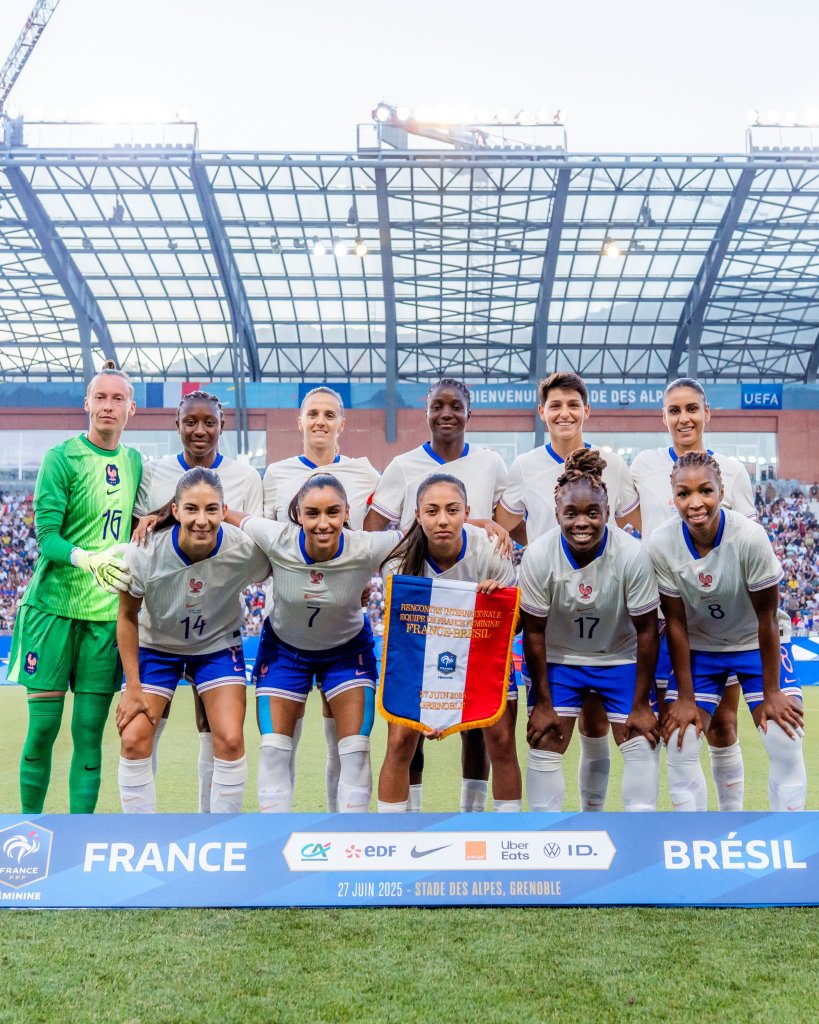
Above: France starting 11 against Brazil. Photo: equipedefranceF on X.
One of the biggest talking points surrounding France in the lead up to this tournament has been the absence of some key stars from their squad. One of those is Eugenie Le Sommer, who has been a stalwart in attack for the French for a number of tournaments.
However, their two friendlies have shown that scoring will not be an issue for the French. Not only did they score plenty of goals, they had five different goal scorers scoring the eight goals – alongside a number of different assist-providers amidst strong rotation.
The friendlies also exposed their depth up front: if an opponent can deal with the physicality of Kelly Gago, there are different profiles of forwards ready to come on – such as Sakina Karchaoui or Kadidiatou Diani.
France are on a good run of form, however they have only played one top-10 ranked team since last December’s 4-2 loss to Spain. They swept aside Belgium with ease; their biggest test ahead of the tournament came against Brazil. Les Blues were 2-0 down within 20 minutes, however clawed back the game thanks to the second half introductions of Marie-Antoinette Katoto and Melvine Malard.
The comeback showed their belief in the team, however it is also telling that they needed their more experienced players to generate the impetus for the comeback. They also looked susceptible to defensive struggles with pace – and conceding two in quick succession will be a cause for concern.
Spain
Spain 3 – 1 Japan
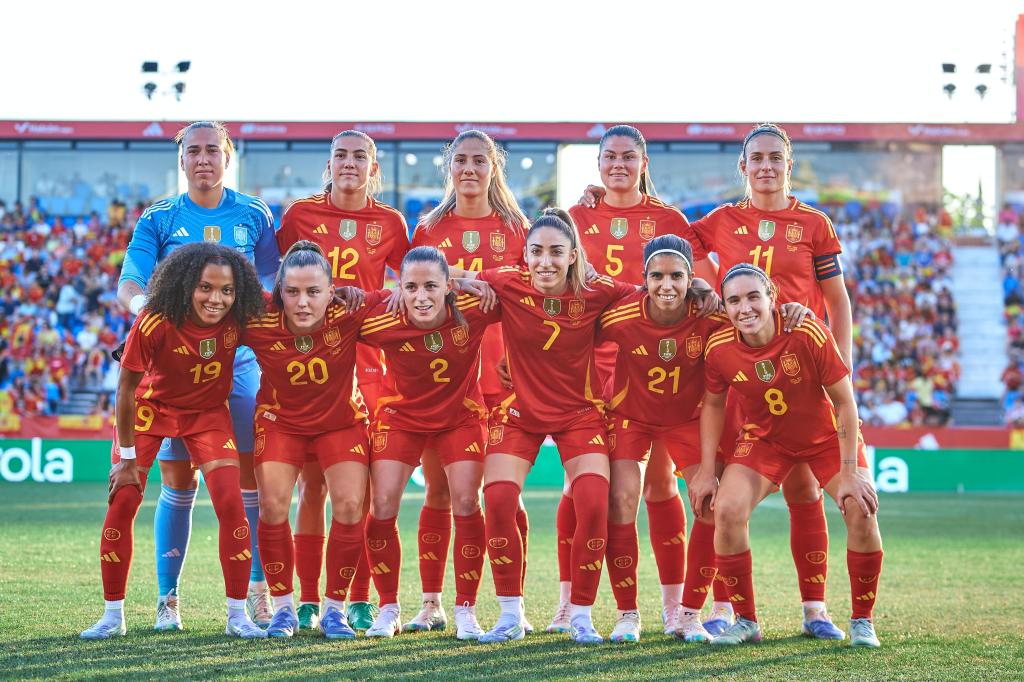
Above: Spain starting 11 against Japan. Photo: SEFutbolFem on X.
Spain opted for a single send-off game, against reigning She Believes champions Japan. Japan beat the USA earlier this year and have confirmed their status as a force not to be underestimated. With key players missing on both sides – Yui Hasegawa for Japan and Aitana Bonmati for Spain – it became a battle based on how their sides coped without them.
Spain’s comeback and eventual win showed their greatest strength: they do not need consecutive Ballon d’Or winner Aitana Bonmati to dominate and beat a top-level opponent. Whereas she would be the ultimate difference maker in most teams, for La Roja she is the best of the best.
This should serve as a warning to Euros competitors: if Bonmati takes time to recover from the viral meningitis that has left her hospitalised, Spain are still huge favourites for every game they play.
Netherlands
Netherlands 2 – 1 Finland
Above: Netherlands starting 11 against Finland. Photo: OranjeVrouwen on X.
For the Netherlands, this was an important game with many different narratives behind it. It would be head coach Andries Jonker’s last game on home soil, and Vivianne Miedema was making a welcome return from injury.
It was a game of two halves for Oranje. Miedema’s minutes were managed, and once she left the pitch in the second half the Leeuwinnen did not have the same spark. In a rather scathing post-match interview, Jonker was asked why he opted not to bring on PSG’s Romée Leuchter – a more similar profile to Miedema than Chasity Grant – and the Oranje boss replied that she is “hopeless” as a striker.
Pundits and fans were shocked – and it is likely not an entirely happy camp heading for Switzerland.
The game showed that similarly to France, the Dutch struggled to maintain the same togetherness without one of their biggest stars on the pitch – and as Miedema is only just returning from injury, she is unlikely to play 90 minutes of every Euros game.
England
England 7 – 0 Jamaica
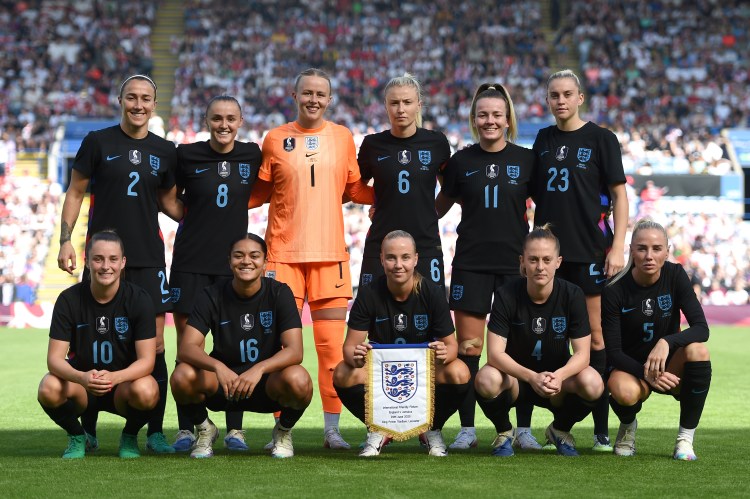
Above: The Lionesses starting 11 against Jamaica. Photo: @Lionesses on X.
England opted for an unfamiliar opponent for their send-off friendly, seeing them take on the Reggae Girlz in Leicester. The biggest learning from the game is arguably that when their first 11 is fit and on the pitch together, the Lionesses pose a huge goalscoring threat.
That the goals came from six different players is a testament to that threat. Jamaica are ranked 40th in the world and England’s dominance was not surprising. Some have criticised the England camp for their choice of opponent, considering Spain and France’s choices. However, that ignores the fact that in the last twelve months, few teams in Europe have had the tests that England have – Sweden, France, Spain, Portugal and Belgium all twice, alongside the US and Germany once each.
The game also highlighted the competition in numerous parts of the pitch – Ella Toone played in the 10 role and scored a brace, and she is in competition with Grace Clinton, Jess Park, and Lauren James for that spot. Jess Carter had an impressive game at left-back; she is in competition with Niamh Charles for that spot. The game may have given head coach Sarina Wiegman a few headaches – headaches she will be pleased to have.
Germany
Germany have not opted to have public friendlies – it is likely they have been played behind closed doors against other in-house teams. This could be a positive or a negative – whilst it gives head coaches the change to test out their tactics and start building momentum without the prying eyes of opponents, players will have missed getting a big send off. Showing off what your squad can do ahead of a major tournament can be hugely encouraging for the team, and it gives them a chance to connect with fans before departing.
However, given their form – beating Austria 6-0 and Netherlands 4-0 in their last two outings – it is unlikely to impact them too significantly.
Above: The England team that lined up in their Euros send off game. Photo: Lionesses on Twitter.
The Lionesses have already etched their names into the history books. A phenomenal run in UEFA Women’s Euro 2022 fuelled by grit and determination led them to a first-placed finish, and their run in the competition was nothing short of remarkable.
This year, with a fresh squad, a champion’s status to defend and a legacy to continue, England are likely to be a powerhouse of this year’s tournament.
Above: Head coach Sarina Wiegman. Photo: Lionesses on instagram.
Head Coach:
Manager Sarina Wiegman is no stranger to success. Leading England to their victory in a home Euros in 2022, she continues to lead the team three years on. She’ll have her sights set on the title, as reaching the final this year would be her fifth consecutive appearance in a major tournament’s final stage.
Euros History:
After a string of not qualifying three Euros running from 1987 to 1991, the nation’s luck in the competition wasn’t as successful as many would hope them to be.
The team reached the semi-final stage in 2017, and they came even closer twice in their history, being runners up in the tournament in 1984 and 2009. Triumph finally came in 2022, securing gold with goals from Ella Toone and Chloe Kelly, achieving a 2-1 victory over Germany at Wembley Stadium.
Qualification:
England’s qualification for the tournament wasn’t quite as straight forward as they would’ve hoped. With two draws against Sweden to start and end their qualification, two wins against the Republic of Ireland, plus a win away in France but a loss to the side on home turf, it’s agreeable that the team perhaps could’ve found another win somewhere.
Nevertheless, they qualified, and we’ll be seeing the team in Switzerland take on France again in the group stages.
Strengths:
One of England’s main strengths has to be the experience and ability of the squad to cope with high-pressure fixtures. They have the ability to rise to the occasion and find a brilliant form when it matters, but a lot of this will rely on the players staying fit throughout the month of the tournament, especially Chelsea’s Lauren James.
Development Areas:
With their huge successes in recent years, there comes a lot of criticism when the team doesn’t perform to the best of their ability. In order to fight their way out of group D, England will need to find a cohesive form in order to not buckle under the pressure.
After big, experienced names such as Millie Bright and Fran Kirby dropped from the squad, it’s crucial the team balance their youth talent and experience to find a new level point that works. This is especially key for the defensive players, as that area is where the team often slip.
Key players:
Above: Alessia Russo Photo: Lionesses on Instagram.
Alessia Russo:
Russo is far more than your average striker. The 26-year-old flourishes in the nine role, but also excels in her off the ball movement and work rate. Her versatility allows her to transition between different roles with ease, adding an element of unpredictability for opponents who come face to face with the forward.
Above: Keira Walsh. Photo: Lionesses on Instagram.
Keira Walsh:
A unique talent, there’s not many better options for a playmaker than Walsh. Her ability to dictate the pace of the game whilst being a composed, technically intelligent defensive midfielder makes her instrumental in England’s set up.
Above: England captain Leah Williamson. Photo: Lionesses on Instagram.
Leah Williamson:
Leading by example from the back, captain Williamson is a strong, versatile presence on the pitch. As well as her ability to lead the backline and operate as an excellent centre-back, Williamson has been called to step into the midfield on many occasions, performing each time with her eye for a long pass and composure on the ball.
One to watch:
Being labelled as the one to watch falls to Michelle Agyemang, the youngest of the team at just 19-years-old. The Arsenal forward has risen through the youth ranks and secured a spot in the squad for Switzerland where she’ll be hoping to have a good run in her breakout tournament.
If Agyemang sees game time, she could be a weapon for England. A present and clever goal-scorer, the rising star netted her first goal in style, a clever volley just 41 seconds into her Senior team debut against Belgium.
Success would be:
With such a high expectation carrying across from the monumental success of the 2022 Euros on home soil, there’s a lot of pressure for England to claim the top spot again.
Even with a difficult group to conquer, it’s likely we’ll see England in the knockouts. Realistically, it would be good to see them at least make an appearance in the final, but to get there they will have to be ruthless.
Prediction:
I predict England will make it to the semi-finals. They may go further to reach the final, however if we see that Spain-England match up again, I think the Lionesses will be the ones to fall short.
With such a talented roster of players, if things work smoothly, they could be one of the biggest threats of the competition.
Group Fixtures:
5th July- France, Stadion Letzigrund, Zurich, 8pm UK time
9th July- Netherlands, Stadion Letzigrund, Zurich, 5pm UK time
13th July- Wales, Arena St.Gallen, St.Gallen, 8pm UK time
This is the latest part of our Euros nation previews – click on the links below to view the previous articles:
by Kelechi Osunwa at HBF Park for Impetus (29/6/25)
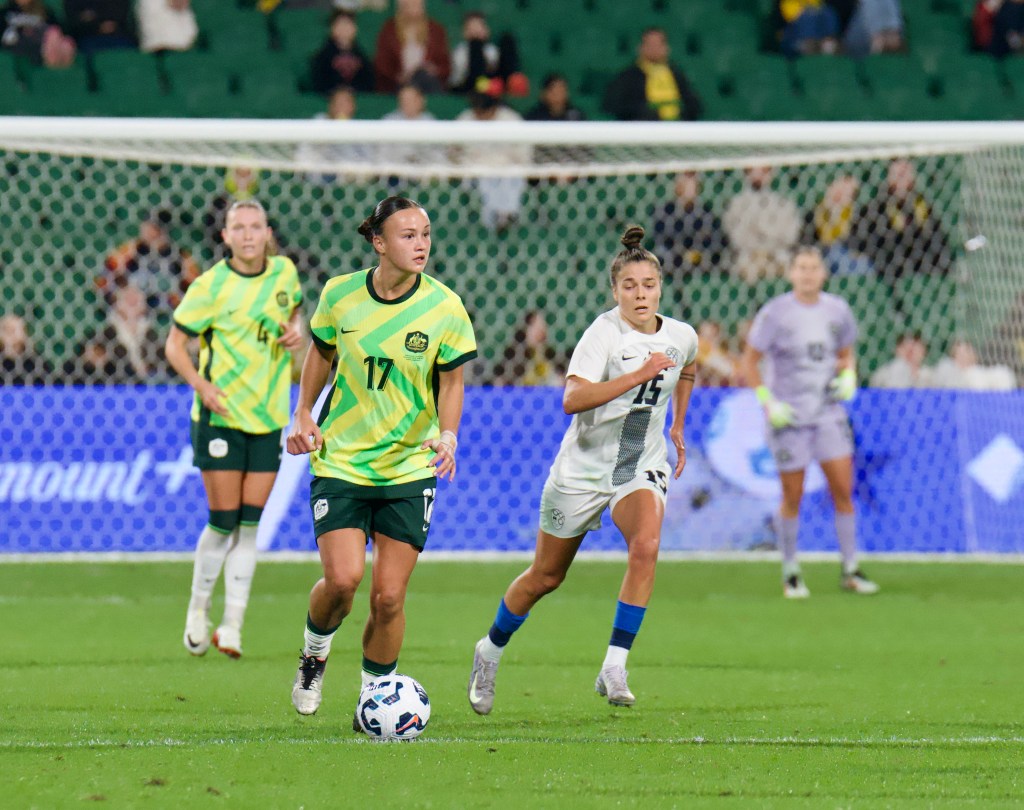
Above: Winonah Heatley, who was outstanding for Australia, wins a tussle tonight in Perth. Photo: Cat Bryant for Impetus.
On a balmy winter night at Perth’s HBF Park, Australia and Slovenia played out an enthralling 1-1 draw in match two of their two-match series.
Australia took the lead early in the second half with a volley from Michelle Heyman to claim the rewards for a dominant first half. Slovenia remained resolute, stayed in the fixture and capitalised on a chaotic final 10 minutes to grab a late equaliser when Mirjam Kastelec reacted quickest to power home.
The result is likely to please both coaches, with Matildas boss Joe Montemurro happy with his team’s defensive connectivity and attacking patience, while his Slovenian counterpart praised their persistence in claiming a draw against a side he described as one of the best in the world.
With both sides ringing in the changes, and having that added level of familiarity, the early moments of the encounter were far less frantic than Thursdays, when Australia took the lead inside three minutes.
The inclusion of Winonah Heatley, Kyra Cooney-Cross, Michelle Heyman, and the repositioning of Amy Sayer into a more central ‘number 10’ position gave the Matildas an ideal balance of composure and solidity.
Above: Michelle Heyman breaks through for Australia tonight. Photo: Cat Bryant for Impetus.
In Cooney-Cross and Sayer, Australia were able to dictate play from a central position, and the two were crucial to early attacking forays.
Sayer combined with Alanna Kennedy to slip in the overlapping Ellie Carpenter to fire a dangerous cross that was foiled by a desperate Lana Golob.
The Matildas continued to attack on their right-hand side with Carpenter a willing runner, much to the dismay of her counterpart Kaja Erzen, who had the unenviable task of tracking the fullback. Sayer and Carpenter combined again with Remy Simesen to send a low cross into Heyman, who fired wildly into the night sky.
Sayer seemed the have the freedom of HBF Park and began to conduct attack after attack. She broke into the box to collect a clever pass from Heyman, her low cross looked to find Kaitlyn Torpey, but a quick-thinking Sara Gradišek did enough to deflect the opportunity wide.
The Matildas’ press and high line was relentless, with Slovenia unable to beat it and often resorted to wild clearances to relieve some pressure. Where Slovenia had lived on misplaced passes and transitional attacks on Thursday, there were no opportunities to sustain the visitors in the first 30 minutes.
Australia could smell blood and almost took the lead when Cooney-Cross wriggled past two players to find Heyman. The striker drove towards the penalty area with options to her left and right. As the defence backtracked, she unleashed a powerful effort that narrowly flew wide.
Above: The Matildas celebrate after Michelle Heyman (second left) put them ahead tonight. Photo: Cat Bryant for Impetus.
Slovenia did well to quell the home side’s momentum and settle more into the match by forcing the Matildas to turn around, and Mateja Zver was tasked with sticking close to Sayer as halftime gave them reprieve.
Australia took the lead five minutes after the restart when Heyman volleyed home from a Carpenter cross. The Matildas won the ball in the attacking third, where Kennedy and Siemsen combined to find the overlapping Carpenter, who found Heyman. Her movement was subtle but effective enough for her to find a half-yard of space to finish unerringly.
The old adage of being most vulnerable after you score proved to be correct as the goal sprung Slovenia into an attacking flurry that needed a previously very quiet Mackenzie Arnold to spring into action on two occasions.
The most important of which was three minutes after the goal when substitute Lara Janež’s outstretched pass sprung Zver with only Arnold to beat. The Slovenian captain struck an effort with power and direction, but straight at Arnold, who was able to absorb the danger.
The match became stretched as Slovenia pushed for an equaliser, Prašnikar and Čonč grew in influence for the visitors, but their attacking forays left them vulnerable on the counter attack which Carpenter looked to single handedly exploit on several occasions with dangerous runs into and crosses into the penalty area that unfortunate to not find a teammate.
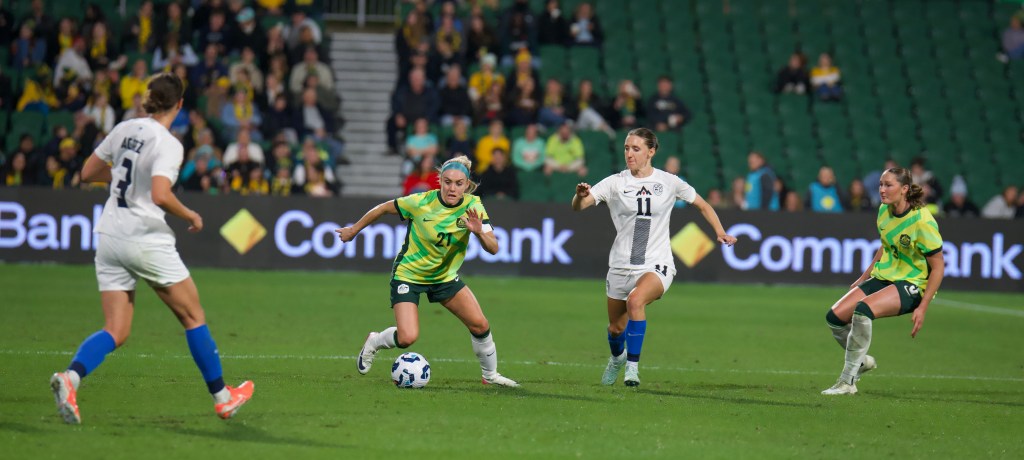
Above: Ellie Carpenter runs down the flank tonight. Photo: Cat Bryant for Impetus.
Despite only having a handful of sessions with the side, glimmers of Montemurro’s philosophy were on display. This was most evident when Heatley, Cross, Sayer, and Holly McNamara combined for Sayer to volley high and wide. The move incorporated composed playing out the back, direct dribbling, and vertical combination play; all elements that Montemurro will hope to see his team hone to a greater extent as they have more time together.
With the game in its dying embers, Slovenia made a raft of changes, and they threw caution to the wind.
Janež headed over the bar after a terrific Špela Kolbl cross to give the visitors some life. The Matildas failed to heed that warning and gave Slovenia encouragement when an errant pass from Courtney Navin caused chaos in their box that needed a clever save from Arnold before a well-timed block by Heatley to divert the danger.
Despite the warnings, the Matildas were punished minutes later when Slovenia claimed a much-deserved equaliser. Prašnikar did well to hold of her marker before finding the run of Janez, the midfielder found fellow substitute Naja Pope Mihelič who cut inside from the left and drove a low effort that cannoned off the post only for Mirjam Kastelec to burst past three defender to slam home and send the visiting dugout into a frenzy.
For Montemurro and the Matildas, the result would feel more fitting if it had come after Thursday’s more even encounter, but the controlled nature of the performance will leave them feeling like they are moving more and more in the right direction with a process they can trust.
Check out our Instagram page @ImpetusFootball for two galleries worth of Cat Bryant’s exclusive photography from the game.
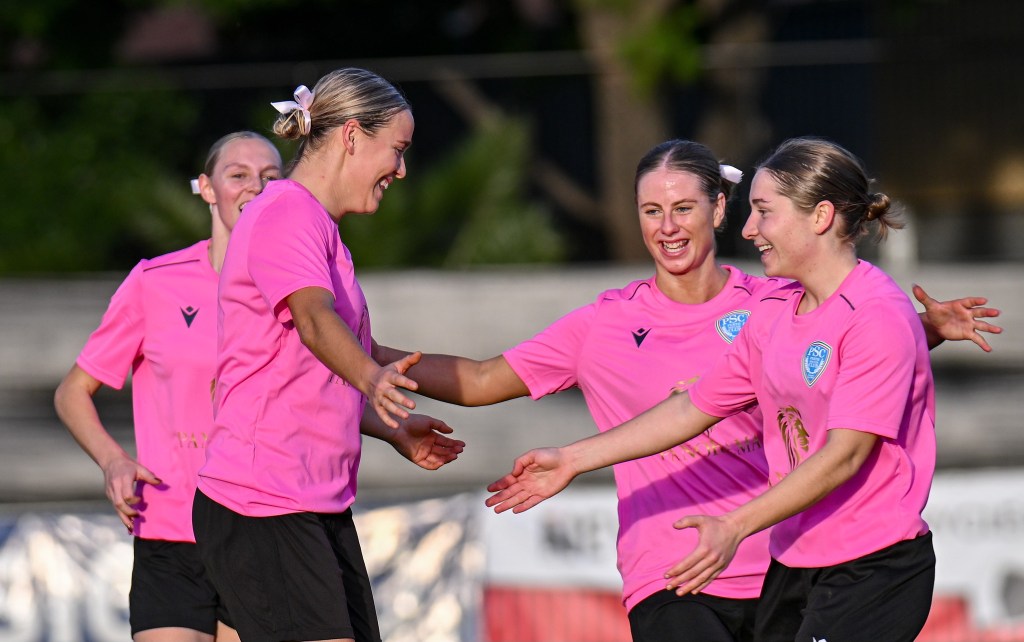
Above:Jess Flannery (pink shirt), who scored twice and provided an assist for Perth SC, bursts between the Perth RedStar defence yesterday. Photo: Rob Lizzi.
Midweek Catch-up games
Wednesday night saw two games postponed from Round Five take place. First, Fremantle City continued their good recent form with a 3-0 win over Murdoch University Melville. Abbey Green’s rich vein of scoring this month continued when she put Freo ahead after 70 minutes. Sophie Meaden doubled their lead with seven minutes remaining before Mikayla Lyons completed the scoring in stoppage time.
Balcatta Etna extended their NPLW WA winning run to six after dispatching Subiaco 5-1 at Home Group Stadium. Abbey Meakins put the home side ahead with 19 minutes played. Less than two minutes into the second half, Jamie-Lee Gale made it 2-0. So-yi Kim gave Subi real hope just after the hour mark when she tapped home from close range to reduce the deficit. However, Balcatta’s response was rapid, hitting three goals in a nine-minute spell. Ella Marwick restored the two-goal buffer before Meakins dispatched a penalty, and Gale put the icing on the cake with a superb solo run with 12 minutes remaining.
Round 13 action
Football West Academy 12-2 UWA-Nedlands
Above: Football West Academy’s Xuri Dalton, who scored four goals in her side’s big win over UWA-Nedlands. Photo: Football West.
The Football West Academy produced a dominant performanceto comfortably see off UWA-Nedlands in the round’s first game on Wednesday night.
They hit the front after four minutes when a low cross from the right found Sam Brady, who turned the ball in from close range.
However, the lead lasted for less than a minute as Chloe Rodrigo levelled, but the teenage side regained their lead on 10 minutes as Theodora Mouithys’ low shot from the edge of the box rolled into the net.
There then followed a game-breaking spell of five goals in just nine minutes, with Xuri Dalton claiming a hat-trick in the spell.
First, Dalton was released by a superb passing move that carved the UWA-Nedlands midfield and defence wide open before she rounded another defender and slid the ball home. She then side-footed home from the centre of the box when another sweeping move played her in with a low cross from the right from Cate McAuliffe.
McAuliffe made it 5-1 when she was in the right place at the right time to turn the ball home after an initial shot from the right was parried by UWA-Nedlands keeper Madison Large. She was at it again on the half-hour mark when found in acres of space from the left to sweep the ball into the net.
Above: Cate McAuliffe, who hit a hat-trick for Football West Academy in their win on Wednesday night. Photo: U18s NPL.
Dalton completed her hat-trick two minutes later as Moutithys charged up the left flank and squared the ball into the box for Dalton to dispatch with aplomb in the centre of the box for 7-1 at the interval.
The Academy then hit a four-goal haul in just 14 minutes in the second half. It began just before the hour mark when Nelli Johnson got up highest to nod home a corner from the left.
Sakura Leong got in on the action after being released with a perfectly weighted pass that dissected the visitors’ defence for her to run into and slot home. Two minutes later, McAuliffe grabbed her hat-trick goal when played in after Leong’s burst along the left found her on the edge of the box to fire in a powerful shot that Large could only help into the net for 10-1.
Leong extended the lead yet further with 21 minutes remaining as she once more accelerated along the left and then cut inside, and held off a defender and the on-rushing Large to dispatch the ball in.
Dalton got her fourth of the evening on 78 in superb style when she held off two defenders on the edge of the box with her back to goal, turned and fired home a stunning shot.
Alice Muller got UWA-Nedlands’ second with three minutes remaining, but it was very little comfort for the visitors, who have now conceded 33 goals in their last three games.
Above: Sam Mathers (second left) and Jess Flannery (right), who contributed three goals and an assist between them, celebrate with Violet Longmore (far left) and Hannah Collins. Photo: Rob Lizzi.
Perth’s sizzling first-half performance ensured they clinched a hugely important win over defending champions Perth RedStar at Dorrien Gardens yesterday afternoon.
This encounter between two of the NPLW WA’s most successful sides in recent seasons took place around the home side’s annual Pink Day festivities to raise funds and awareness for Breast Cancer Care WA.
The action exploded into action from the very beginning as RedStar broke through, with Quyen Doan seeing a shot coming back off the post after just 10 seconds.
The defending champions were continuing on the front foot in the earliest of exchanges and, with five minutes played, took the lead. Caitlin Doeglas’ corner came in high from the left, the initial Azzurri clearing header fell for Sarah Carroll on the edge of the box to crash home a volley in some style from a central position.
However, Perth responded with some major offensive power of their own as they hit three goals in a stunning six-minute spell.
Above: Daisy McAllister (pink shirt facing camera) celebrates one of her two goals yesterday. Photo: Rob Lizzi.
Indeed, less than a minute after Carroll’s goal, they were level. Tijan McKenna saw a long-range shot come back off the post, and with visiting keeper Gabby Dal Busco beaten, the rebound fell perfectly for Jess Flannery to side-foot home.
With eight minutes played, some exceptional vision and passing from Hannah Collins saw her thread a perfectly weighted ball through the RedStar box for Daisy McAllister on the left to hit a shot across Dal Busco and into the far corner of the net.
Three minutes later, Flannery played the perfect pass to McAllister, who had made a superb run to the left of the RedStar box, unmarked, to dispatch a low shot into the goal.
It got better still for the hosts with 25 on the clock. RedStar lost possession from a throw-in inside their own half, and Hannah Collins looked up on the right to see Flannery in a large amount of space on the left. Yet another perfectly judged pass found the striker in a position that she was never going to miss from, and Flannery punished the visiting defence to roll the ball home.
Above: Georgia Cassidy (pink shirt) holds off Sarah Carroll yesterday. Photo: Rob Lizzi.
In trying to stem the Perth tide, Carla Bennett was excellent for the visitors. The midfielder played some hugely intelligent balls through to her teammates, but RedStar were never able to benefit from Bennett’s vision as the Azzurri defence swept up comfortably.
There was one further half chance before the break when Epril Nossent’s cross from the right was pushed up by Dal Busco. McAllister, coming in at the back post, saw her effort go over the top.
The second half began with RedStar upping the ante, and shortly after Jay Coleman headed narrowly wide from a Sarah Carroll free-kick, they grabbed a lifeline when Leota laid the ball back to Bennett, who spotted Doeglas on her own, and fired across an excellent pass for the attacker to slot home.
Just after the hour mark, the visitors momentarily thought they had reduced the deficit further when Carroll played Doeglas through to sweep the ball into the net, but the assistant referee’s flag went up to rule it out for offside.
Above: Sam Mathers (pink shirt, left) taps home Perth SC’s fifth goal yesterday. Photo: Rob Lizzi.
Buoyed by this decision, the Azzurri pushed forward again. McAllister was fouled on the edge of the box to the left of centre. Up stepped Kim McCartney to lift the free-kick in, Dal Busco spilled the ball at the feet of Mathers to tap home from close range and restore Perth’s three-goal advantage.
The remaining 20 minutes or so of the game were largely broken up with a succession of yellow cards, but the visitors did force two further opportunities.
First, Leota fed Doeglas, who saw a shot come crashing back off the bar, and then in stoppage time, Ridley was denied first by an excellent stop by Dayle Schroeder, and from the rebound Ridley saw an effort cleared off the line by Georgia Cassidy before referee David Avison pointed to the spot for a foul on Laura Continibali. Carroll dispatched the penalty.
This was an extremely impressive performance and victory by the Azzurri against the side that were top of the ladder going into the game. Perth SC now travel to the Sam Kerr Football Centre next weekend to face the Football West Academy in an intriguing first against second clash.
Balcatta won their seventh league game in a row, but they were pushed by a hard-working Subiaco side at Home Group Stadium this afternoon.
The hosts hit the front with 18 minutes on the clock thanks to an Olimpico from the left-hand side by Abbey Meakins – her eighth goal this month alone.
Balcatta doubled their lead in the 68th minute with a move that began with goalkeeper Rebecca Bennett’s clearance from a Subi corner. Jamie-Lee Gale combined with Meakins before Frankie Murray’s cross from the left was met with a sliding volley at the near post by Gale, who collided with keeper Monique Todd as she did so. After a short consultation between referee and assistant, the goal was awarded.
Subi pushed to get back into the game, and after Greta Bailey’s burst through was ended by the Balcatta defence, Izzy Folletta was shown a second yellow card for what appeared to be dissent.
The visitors got a goal back three minutes before the end when Marianna Tabain released Tayna Campos, who swept home a first-time low shot.
Balcatta will now go into next Sunday’s trip to Perth RedStar with real confidence. In a rich vein of form, they will be determined to put right the 5-0 scoreline from their previous encounter with the defending champions this season.
Fremantle City extended their winning run to three league and cup games after this success over Murdoch University Melville (MUM FC) at Hilton Park today.
Freo took the lead eight minutes before the break in some style as an eight-pass move that swept from defence to offence ended with Sophie Meaden finding Abbey Green in the box for the former Perth Glory player to find the net from close range.
The same pair were at it again just before the hour mark as Green darted between two players to advance deep into the MUM FC half and find Meaden, whose shot was repelled by Jemma Skinner, and Green was on the rebound to turn it in for her and Freo’s second.
The home side wrapped up the points with a spell of three goals in seven minutes either side of the 80-minute mark. Meaden made it 3-0 when she was played through by an incisive pass from Janice Kiama to run in unopposed and dispatch the ball into the net.
Nine minutes from the end, Green found Leyna Wood, who threaded a sensational long low pass which completely took the visiting defence out of the equation, allowing Meaden to hit her second.
Green completed her hat-trick shortly afterwards as Meaden threaded a pass through to her to run onto and beat Skinner in the one-on-one to turn the ball home.
Euro 2025 is nearly here, but do you know the history?
UEFA organised their first Women’s Euros in 1984 (the men’s began in 1960). Before that, other tournaments paved the way. Let’s start in 1957.
Women’s football was growing as European countries began playing more international friendlies. In 1956, 18,000 people came out to watch Germany’s first international against the Netherlands – despite the women’s game still being officially banned throughout much of Europe, including both Germany and the Netherlands, England and France.
Players fought the ban with increasing strength. In the summer of 1957, Germany, Austria, Netherlands, and England formed the International Ladies Football Association in Nuremberg, Germany. They quickly organised their own European tournament with the four founding members.
Berlin hosted the event at the Poststadion, a prestigious venue. Naturally there was plenty of opposition, but also some good support. Often at that time, “national” teams were represented by club sides. England, for example, were represented by the Manchester Corinthians. The Corinthians were at the end of a tour of Germany, which they ended by winning the 1957 trophy. Unfortunately, some financial irregularities spoiled the event and it was over a decade before a similar tournament was organised.
For a period in the late 1960s/early 1970s, women’s football was organised by some Italian businessmen — who had spotted the potential of the sport. In 1969, the newly formed Federazione Italiana Calcio Femminile (FICF) organsied another European competition. The Coppa Europa per Nazioni — now considered a precursor to the UEFA Euros — included Italy, France, Denmark, and England. It was sponsored by the drinks giant Martini & Rossi who bankrolled the event. FIFA tried to stop it going ahead but were unsuccessful.
Although the ban in England was being lifted, England didn’t yet have an official FA team. So, the legendary Harry Batt took a team to represent his country. England were drawn against Denmark (represented by club side Femina BK). Despite a hat trick from Sue Lopez, Denmark won and progressed to the final. Italy beat France but Denmark took the title. England took third, beating France in front of 10,000 spectators. The event was a huge success on and off the pitch.
The Italians organised two World Cup events too (one being the Mexico 1971 World Cup), but in 1971 UEFA couldn’t ignore the growth of women’s football any longer. They decided to take control, making it “official”. They set up a committee for women’s football and then stalled the development of a Women’s Euros tournament for over a decade.
In 1984, UEFA finally caved to pressure and put its name to the Women’s Euros for the first time. Sixteen teams played in the qualifiers with only four making it to the tournament proper: Sweden, Italy, Denmark, and England. Games were 70-minutes long, used a size four ball, and consisted of home and away legs for both semi-finals and the final. England drew the favourites, Denmark, but beat them to reach the final against Sweden.
The first leg in Sweden was covered by the media and brought in a decent crowd. Sweden edged it 1-0. The return leg in England was played at Kenilworth Road, Luton on a pitch described by their captain, Carol Thomas, as “the battle of Kenilworth bog”. The only media at the match was a very small TV company that disappeared soon after. England squeaked a 1-0 win, making it 1-1 on aggregate. Because the pitch was so bad, the tie went straight to penalties. Sweden edged it 4-3, with current Switzerland head coach Pia Sundhage scoring the winner.
The format remained the same for the 1987 Euros where the four qualifiers were Norway, Sweden, Italy, and England. Norway won their first trophy, beating Sweden in the final; Italy beat England to third place. In a strange contrast, over 8000 people watched the final but only 500 watched the third-place play-off.
At this point, the Women’s Euros was the only major event so enjoyed a two-year cycle. The next edition was 1989 but still only included four teams. However, there was a host country for the first time: West Germany. Norway, Sweden, and Italy joined them and it soon became clear they didn’t need home advantage. West Germany won the first of Germany’s eight Women’s Euros titles by beating the holders, Norway, 4-1 in front of 22,000 people.
The four-team tournament continued into the 1990s. Denmark hosted in 1991 and once again, Germany beat Norway in the final, winning their second title. But the Germans didn’t fare so well in 1993 when they came fourth behind winners Norway (their second title), Italy, and Denmark.
It had been eight years since England last qualified for the Euros but they were back in 1995 joined by Germany, Norway, and Sweden. The qualifying rounds before the main event had expanded to 29 teams, meaning there were now eight qualifying groups; but still only four countries competed for the trophy. England drew Germany in the semi-finals and were soundly beaten over two legs. Germany and Sweden contested the final (played in Germany) and Germany lifted their third trophy in front of 8,500 people.
In 1997, the Women’s Euros format changed to resemble what we recognise now. Norway and Sweden hosted the tournament over two weeks in the summer. The competition expanded to eight final teams in two groups of four. Sweden, Spain (their first appearance), Italy and Germany reached the knockout stages. And yes, Germany won number four, beating Italy in the final.
The next advancement was settling into a four-yearly schedule (the FIFA Women’s World Cup began in 1991 making scheduling harder). In 2001, eight teams competed in the main tournament in Germany. Unsurprisingly, Germany won again, making it their fifth. England only managed a point from a draw with Russia.
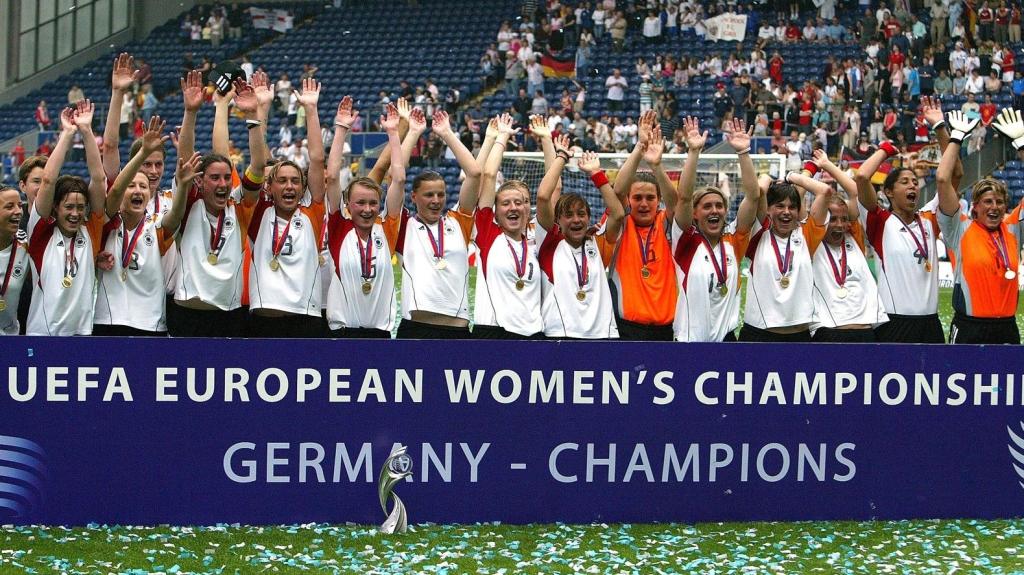
Above: Germany celebrate in 2005. Photo: UEFA website.
In 2005, England hosted the Euros and had high hopes for the tournament. It was the first time they’d hosted a major women’s competition and was part of The FA’s strategy to (finally) grow the game. It attracted record crowds. Despite a heart-stopping win against Finland in their opener, England finished bottom of their group. Finland, along with Germany, Sweden, and Norway progressed. The final was again Germany versus Norway; and again Germany finished as champions (their fourth in a row, sixth in total).
Disappointment at home for the Lionesses turned into progress in 2009. Hosted by Finland, the event saw 12 teams take part for the first time. Finland, Netherlands, Germany, France, Norway, Sweden, Italy, and England progressed to the quarter-finals. Germany and Norway continued their rivalry, this time meeting in the semi-final. England needed an extra time winner from Jill Scott to overcome Netherlands in their semi-final, lining up a tasty final against Germany. Disappointingly, England couldn’t keep up with the perennial winners and lost 6-2.
Sweden hosted in 2013, and the familiar pattern continued with Germany beating Norway in the final; their eighth title. However, this is where Germany’s run came to an end. In 2017, Netherlands hosted their first Euros. Sixteen teams took part for the first time. Netherlands, Denmark, Germany, Sweden, Austria, France, England and Spain reached the knockout stages with some familiar names beginning to appear on teamsheets.
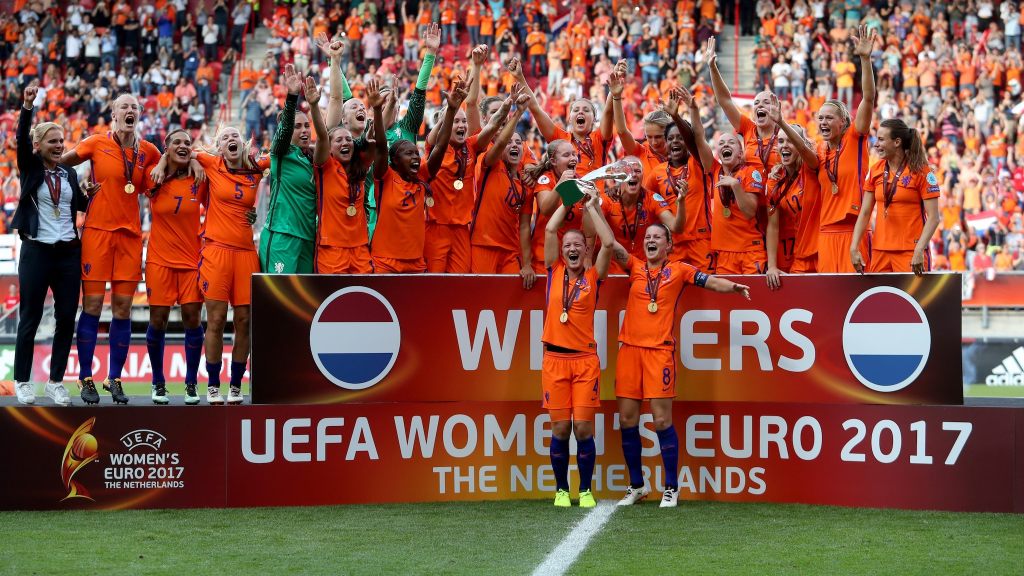
Above: The Netherlands celebrate in 2017. Photo: UEFA website.
In the semi-finals, Netherlands played England and Denmark played Austria. You read that right: Germany had been knocked in the quarters (by Denmark). Things were changing in European football. A Sarina Wiegman-led Netherlands made short work of England in a 3-0 win. Meanwhile Denmark needed penalties to beat newcomers Austria. Finishing the fairytale, Netherlands beat Denmark to win their first Euros trophy at their home event. The English Lionesses’ Jodie Taylor was top-scorer (one ahead of Vivianne Miedema).
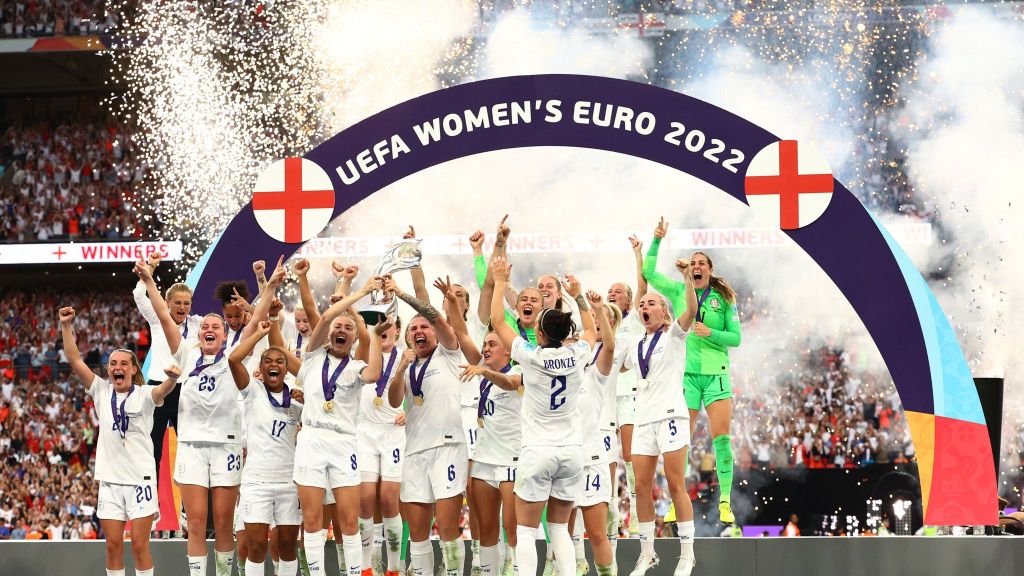
And the rest, as they say, is history. Wiegman moved to England, repeated the whole thing in 2022 and will now be hoping she can continue her unbeaten Euros streak this summer.
Above: England celebrate in 2022. Photo: Sky News website.
Above: Amy Sayer for Australia. Photo: Rob Lizzi for Impetus
Following their 3-0 win over Slovenia on Thursday night, the Matildas and head coach Joe Montemurro have set their sights on the second game in the series and on continuing to build a cohesive identity under the newly appointed boss.
The match, Montemurro’s first in charge, offered both a positive result and a glimpse into the style he wants to establish with the squad.
“As a whole, right after the game, it gave me a really good feeling and sensation, playing against a team that did what they did, allowed us to sort of really see the realities of the way we want to play and what we need to do to fix that.”
“We learned, it was a perfect game to learn and a perfect game to grow. It painted a lot of really good pictures for us. We can build on that.”
Despite the convincing scoreline, Montemurro was quick to point out the need for consistency and bravery on the ball, whilst also highlighting the various fitness levels within the squad in this window.
“We just now need to be more consistent and more, I suppose, brave with it. But we have to put in context the period of the season, players out of season, players who haven’t played a lot, players who are coming back from injury, and so on, so as a whole, we’re trying to find a good balance.”
As for tactical preparation and focus ahead of Sunday’s match, Montemurro stressed that the team’s focus is on internal development rather than being overly interested in playing based on the opponent at hand.
“It’s no disrespect to any opposition that we play, but you know, it’s really about us. We’ve really focussed on our principles, our base, and that we build a good foundation,”
“When you build a foundation that’s believable, you have those insurance policies so you know that even when not analysing the opposition team, if we do what we do well, we’ll get through the game.”
Midfielder Amy Sayer, who played her first full match for the national team since returning from injury, was encouraged by both the performance and Montemurro’s approach.
“Joe’s emphasised that it’s simple. It’s nothing life-changing, but it’s about doing the small things right and doing it together. It’d be quite easy to tidy up the gaps, and it’s just about getting used to his coaching style and playing together,”
“We gave away a few too many opportunities for Slovenia to have chances on goal, luckily we had Teagan [Micah] between the sticks, no wonder she was player of the match, because she really saved us.”
Sayer shared that post-match conversations between the team confirmed the sense of direction and growth within the squad.
“Looking at the game and talking to the girls, and talking to Joe right after the game, everything started to look good. I think he really established the playing style that he wants to have, and we’re trying to deliver on that.”
Sayer also had praise for teammate Holly McNamara, who scored her debut Matildas goal, one that has been long awaited by fans and players alike.
“I actually thought Holly had already scored, because she’s always in the goalmouth, and she’s so talented at getting in there and having those attacking chances,”
“You could see the relief on her face, especially with the trials and tribulations she’s been through with three ACLs. I can imagine, I mean, I know exactly how she was feeling.”
“When she was celebrating, she was just looking up and just so happy to get it in finally. She had a lot of chances in the game. I can really relate to it.”
As for herself, Sayer said the outing was a strong step in her own return journey.
“I feel great, so I hope I can put away another performance like that.”
With Montemurro’s foundation laid and the squad showing early signs of cohesion, all eyes now turn to game two, and the continued evolution of this new Matildas’ era.
Forwards: Delphine Cascarino (Wave San Diego, USA), Kadidiatou Diani (OL Lyonnes, France), Kelly Gago (Everton, England), Marie-Antoinette Katoto (Paris Saint-Germain, France), Melvine Malard (Manchester United, England), Clara Matéo (Paris FC, France).
Head Coach:
Above: Laurent Bonadei, France Head Coach. Photo: Courtesy of Pauline Figuet for Impetus.
Laurent Bonadei, was named the head coach of France’s squad in August 2024. He was the assistant to Herve Renard, from March 2023. Following a 15 year playing career, he moved into coaching and led several youth level teams.
Euro History:
Since an eight-team knockout Euros tournament was introduced in 1997, France had gone out in the last eight every time before making the 2022 semis, after beating title holders the Netherlands in extra time.
How they qualified:
France qualified as Group A3 winners with a record of four wins from their six games against England, with the Republic of Ireland, and Sweden. Marie-Antoinette Katoto contributed three goals in the process.
Strengths:
A lot of players have experience in major club and international tournaments. Exciting new young players have been integrated into the squad and brought a new look to the team.
Development Areas:
Since Laurent Bonadei was named as head coach, three major experienced players, Eugénie Le Sommer, Wendie Renard, and Kenza Dali have been left out of the squad for the last two games of group qualification in the Nation’s League tournament and have subsequently been left out of the squad for the tournament in Switzerland.The coach said that he wanted to prepare the squad for the future. We will soon know if this was the correct decision or not.
Key Players:
Above: Delphine Cascarino (White 20). Photo: Jean-Pierre Thiesset for Impetus.
Delphine Cascarino, 27 years old, is at the peak of her abilities. With an exceptional ability to acceleration past defenders, she can be one of the tournament’s top players.
Above: Selma Bacha (white 4), Photo: Jean-Pierre Thiesset for Impetus.
Selma Bacha debuted in France’s premier league) in 2017 at the age of just 16 years old. Now, her versatility and punch in offence can be one of the main strengths of France. People who know this highly skilled player used to say that her brain thinks what to do and her left foot does it.
Above: Clara Matéo. Photo: Jean-Pierre Thiesset, Impetus.
Clara Matéo, 27 years old, was the top scorer in France’s Première League last season with 18 goals; she also contributed seven assists. Matéo can play in midfield just behind the centre forward to organize the play or as central forward herself. Her vivacity and game vision are a true plus.
One to watch:
Above: Melvine Malard. Photo: Jean-Pierre Thiesset for Impetus.
In January 2020, Malard was named by UEFA as one of the ten most promising young players in Europe. She spent three seasons at Olympique Lyonnais between 2020 and 2023 winning UEFA Women’s Champions League in 2020 and 2022.
Success would be:
Making the final. Nothing else will be considered as successful by the fans.
Prediction:
If all the planets are aligned, France may win this Euro 2025. However, in my own point of view, it will still be difficult to do better that the semi-final even if the team does play more rapidly in midfield with new young players and continue to be more efficient in front of goal.
Group Fixtures:
July 5th- England, 8pm, Zurich
July 9th- Wales, 8pm, Saint-Gallen
July 13th- Netherlands, 8pm, Basel
This is the latest part of our Euros nation previews – click on the links below to view the previous articles:
Above: Germany taking on Australia in Alex Popp’s last game before retirement. Photo: DFB/Yuliia Perekopaiko.
By Boh Blythin (27/6/25).
Germany are heading into the 2025 Euros ready to compete for their place at the summit of European football, led by captain Giulia Gwinn. They prepare to clash with rivals Sweden and Denmark in a thrilling Group C, showcasing an eager youthful team led by coach Christian Wück. A bronze medal in the Olympics last year gave fans a glimpse of where the side could reach this summer, but they will have to put up a fight to get there.
Squad List:
GOALKEEPERS: Ann-Katrin Berger (Gotham FC), Stina Johannes (Eintracht Frankfurt), Ena Mahmutovic (Bayern Munich).
The former Wolfsburg forward is in charge of the women’s senior team after starting his journey in August 2024 and is on a two year contract. He previously guided Germany’s U17 male team to Euros and World Cup glory, and there’s no doubt he’s more than ready to start the women’s revolution.
Euros History:
Germany is the most successful team in UEFA Women’s Euro history, with eight titles. This includes winning six times in a row from 1995 to 2013 and since then Germany’s legacy has remained unmatched. In 2022, the side reached the final where they lost to a strong England side. Now, as a team that other sides will be determined to beat, Germany are back aiming to reclaim what was once theirs with a new generation of youth talent.
How they qualified:
Germany qualified by topping Group A of the Nations League, facing Austria, Iceland, and Poland. They earned automatic qualification after earning their place in the top two, alongside Switzerland. Some victories included a 3–2 away win to Austria, 3–1 at home win to Iceland, and a 4–1 home win vs Poland.
Strengths:
The side’s history alone proves what the German side is capable of. In high-stakes matches there is a winning culture and mentality between all players on the pitch, they have experience and belief which other teams are yet to reach. The team includes many versatile players, allowing Wuck to rotate his squad without losing its quality. Many of these players can play in a variety of roles emphasising the squad’s depth, keeping opponents unaware of what style of play, formation and tactics the side may use.
As well as this the German side includes some of the most impressive forwards, including the likes of Lea Schüller and Laura Freigang. These players have the ability to deliver a solid performance each game and create goals consistently. Germany can create danger to opponents from a range of set pieces, which could lead to match winners and success.
Development Areas:
However, Germany lack defensive players. Despite having strong players upfront, the squad is short of defenders who can consistently thrive from the back. It is worrying that if any injuries happen to take place the side could struggle defensively. Alongside this, the players may not have much chemistry within partnerships due to squad rotation and lack of consistent time on the pitch with one another.
Key Players:
Above: Lea Schüller for FC Bayern Munich in the UEFA Women’s Champions League. Photo: Xavi Bonilla/Getty Images.
Lea Schüller is Germany’s main striker since Alexandra Popp’s retirement. She was the top goal scorer in qualifying for the European tournament with six goals. Her ability to score in high pressure situations, especially in the air is exceptional. Now that she is the focal point of Germany’s attacking play, Schüller holds the pressure to maintain her performances and play a crucial role in the team’s campaign.
Above: Giulia Gwinn during the Women’s DFB Cup Final 2025. Photo: Getty Images.
Captain Giulia Gwinn will also play a crucial role in Germany’s European journey. She contributed to helping her country earn bronze at the 2024 Olympics after two ACL injuries. Named Germany’s Player of the Year in 2024, she sets the tone and leads her team from the back.
One to Watch:
Above: Jule Brand posing ahead of the official UEFA Women’s EURO 2022. Photo: UEFA via Getty images.
A rising star and one to watch throughout the tournament this summer is Jule Brand. The 22-year old is a versatile player with the ability to play as a winger or attacking midfielder, meaning she could easily switch roles mid game or be used as a quick rotation. She also scored and assisted in both the 2022 Euros and the 2024 Olympics, proving she can create an impact in important games.
Success would be:
For supporters, success would be to win the tournament and watch a team of youth lift the international team’s 9th European trophy. This would start a new era for the team with a team full of a new generation of football.
Prediction:
However, with the loss of legendary players Popp and Svenja Huth, Germany could come to an abrupt end during their Euro’s journey. As a strong team with youth hungry for a trophy and a strong history, they should be able to reach Semi finals. Germany have proven within the qualifying stage they can come back from behind to win games and it’s undoubtable that we will see more of this from the side as the tournament unfolds.
Group C Fixtures:
July 4th– Poland, 9pm, AFG Arena, St. Gallen
July 9th– Denmark, 6pm, St. Jakob-Park, Basel
July 12th – Sweden, 9pm, Letzigrund, Zurich
This is the latest part of our Euros nation previews – click on the links below to view the previous articles:
Within the Finnish women’s football family is there any outrage at Katriina Talaslahti’s non-selection? There is be lots of talk about the squad selection online and on various forums/social media.
Katriina Talaslahti finished 4th in Arkema Première Ligue standing with Dijon for the first time in Dijon history. Katriina participated largely in this success with 8 clean sheets in 16 games she played as starter and numerous world class saves.
However, Katriina Talaslahti is not selected in Finland squad for Euro 2025. We could imagine that the 3 goalkeepers selected play in major leagues too and have better statistics than Katriina. The teams and statistics of the 3 goalkeepers selected in the Finland’s squad are:
Tinja-Rikka Korpela plays for Servette FC, Switzerland, which is 34th in UEFA ranking. Korepela is 39 years old and played only 1 game with her squad in 2024-2025 season. However, she does have a lot of top-level experience.
Anna Tamminen plays for Hammarby IF, Sweden, which is 51st in UEFA ranking. She is 30 years old and played 6 games with her squad in 2024-2025 season.
Anna Koivunen plays for Djurgardens IF, Sweden, which is 84th in UEFA ranking. She is 23 years old and played 11 games with her squad in 2024-2025 season. She currently holds the number one spot and jersey for Finland.
In the Dijon communication about Katriina staying in Dijon squad for next season, Sylvain Carric, Dijon Women’s Manager, declared, “It is a great satisfaction to announce Katriina’s contract extension. Katriina is an excellent goalkeeper, coming off a very good second half of the season where she only conceded two goals, which is anything but a coincidence. She will continue to bring us all her qualities as a goalkeeper, but also her professionalism and her ability to unite in the changing room.”
Talaslahti also said, “signing an additional season with DFCO was the right decision for me. I’m really happy to extend my contract and it’s gratifying to see the club’s trust in me. I’m going to do my best in my field and give my best to help the team progress and achieve its goals. I’m really proud and happy to be staying here. Now, I’m going to start my seventh season in the French league.”
Compare to the other goalkeepers in the Finland squad, whose qualities and skills I do not question, I still do not understand why Talaslahti, playing in one of the best and more challenging championship for a goalkeeper and in which she has outstanding performances, is not one of the 3 goalkeepers selected for Euro 2025.
by Kelechi Osunwa at HBF Park for Impetus(26/6/25)
Above:Emily Gielnik looks to break through from Slovenia’s grip tonight in Perth. Photo: Rob Lizzi for Impetus.
The Joe Montemurro era as the Matildas’ Head Coach started the best way possible with a 3-0 win over Slovenia at HBF Park on Thursday night in Perth.
An early goal from Emily Gielnik set the tone for a frantic end-to-end match. There were chances galore for both teams, with Slovenia coming close to equalising on numerous occasions before the game was settled for the Matildas with two late goals by Holly McNamara and substitute Hayley Raso.
Montemurro will no doubt be happy to start his reign as head coach with a victory, and naturally will know that there will be plenty to work on as he has more time with his side.
The Matildas showcased the vertical fluidity and quick transitions Montemurro’s sides are known for early, when Amy Sayer broke into space. The wide forward’s dangerous cross was narrowly turned away from goal by the outstretched foot of Sara Agrež, and Australia took advantage of the set-piece opportunity and scored from the ensuing corner.
Above: Amy Sayer breaks through and looks for the pass. Photo: Rob Lizzi for Impetus.
Emily van Egmond’s low-driven corner was directed toward goal by Clare Hunt, and the ensuing goalmouth scramble saw Emily Gielnik show great desire to bundle home.
Despite the early goal, the visitors were able to settle and disrupt the passing patterns of the Matildas on numerous occasions.
The most dangerous of which was when Špela Kolbl intercepted an errant pass in midfield and drove into the penalty area. The winger’s cross-come shot bounced off the crossbar and trickled away to safety.
Amy Sayer lifted the home faithful on their feet when she went on a powerful run from her box. The forward combined with Ninja A-League Golden Boot Winner, Holly McNamara, who found Sayer again at the top of the box, but her effort sailed over the bar.
The Matildas had another terrific opportunity to double the lead when McNamara combined with stand-in captain Ellie Carpenter. The two broke swiftly from a Slovenian corner, and after Carpenter danced past a defender and Zala Meršnik in goal, it looked certain that the full back would double the lead. But with the goal at her mercy, Carpenter looked to find Gielnik only for a backtracking Kara Eržen to toe away the danger.
Above: Emily Gielnik (15) puts The Matildas ahead in Perth tonight. Photo: Rob Lizzi for Impetus.
Slovenia continued to look dangerous on the break, and when they caught Australia out of possession and created two chances that were foiled by Hunt.
The first saw her react quickly to deny Sara Agrež, and the second saw her keep her poise to block Zara Kramžar after the forward’s clever turn in the box.
The Matildas settled and would create their best opportunity in the first half when Alana Kennedy’s clever pass found Carpenter with plenty of space.
The flying fullback powered from penalty area to penalty area and held the focus of the Slovenia defence long enough to slip in Gielnick. The angle was narrow, and Meršnik proved equal to the winger’s low effort with a low instinctive save.
Slovenia started the second half as the better of the two sides and created two gilt-edged chances from their high press.
Above: Ellie Carpenter (21) drives forward for Australia against Slovenia. Photo: Rob Lizzi for Impetus.
Clare Hunt was under immense pressure and made an errant pass straight to Zara Kramzar, who had the goal at her mercy with only Teagan Micah to beat. The forward opted for power and fired her effort toward Micah, who did well to say big and parry the chance to safety.
Slovenia continued to assert pressure, and moments later Lara Prašnikar curled wide from a promising position.
Cheeky quick throw caught Slovenia off guard as Sayer drove into the box, but her effort was easily dealt with by Meršnik.
Slovenia had another opportunity from a Matildas error when an errant touch from Alana Kennedy left substitute Nina Kajzba through on goal. The forward had just Miach to beat, but once again the custodian proved equal to the moment with a fine save to her left.
The game took a frantic turn with chances at both ends.
Above: Holly McNamara heads home her first goal for the Matildas. Photo: Rob Lizzi for Impetus.
McNamara created a terrific opportunity when she chased her own flick on and sprinted past her marker, only to see Meršnik brush aside her dinked effort.
Slovenia once again failed to capitalise on winning the ball high in the Australian midfield. Prašnikar glided towards the penalty area and, after creating half a yard of space, curled an effort narrowly past the post.
The Matildas had two great opportunities through McNamara and Meršnik, but Slovenia’s cover defence was able to clear any danger.
Substitute Zala Kuštrin caused a collective gasp for the home faithful when the crafty forward created a half-yard of space and fired just wide of the top corner. But Slovenia would be forced to rue another missed opportunity as the Matildas put the game beyond doubt when they capitalised on a rare Slovenian mistake.
The Matildas found Raso from an errant pass, and the substitute’s pinpoint cross found McNamara at the back post for the striker to head home her maiden international goal.
Above: Hayley Raso (16) receives congratulations after scoring the Matildas’ third goal tonight. Photo: Rob Lizzi for Impetus.
Raso put the result beyond doubt when she capped off a trademark dribble with a composed curler from outside of the box to send the home crowd into raptures.
Slovenia would have one more shot in anger from Korina Lara Janež and Zala Kuštrin, but both efforts were matched by Micah, who saved well to deny Janež and Prior, who slid brilliantly to prevent Kuštrin from having a shot.
In the post-game press conference, Montemurro described it as a perfect game, and he will be looking for more of the same when the two sides face off against each other again on Sunday at the same venue.
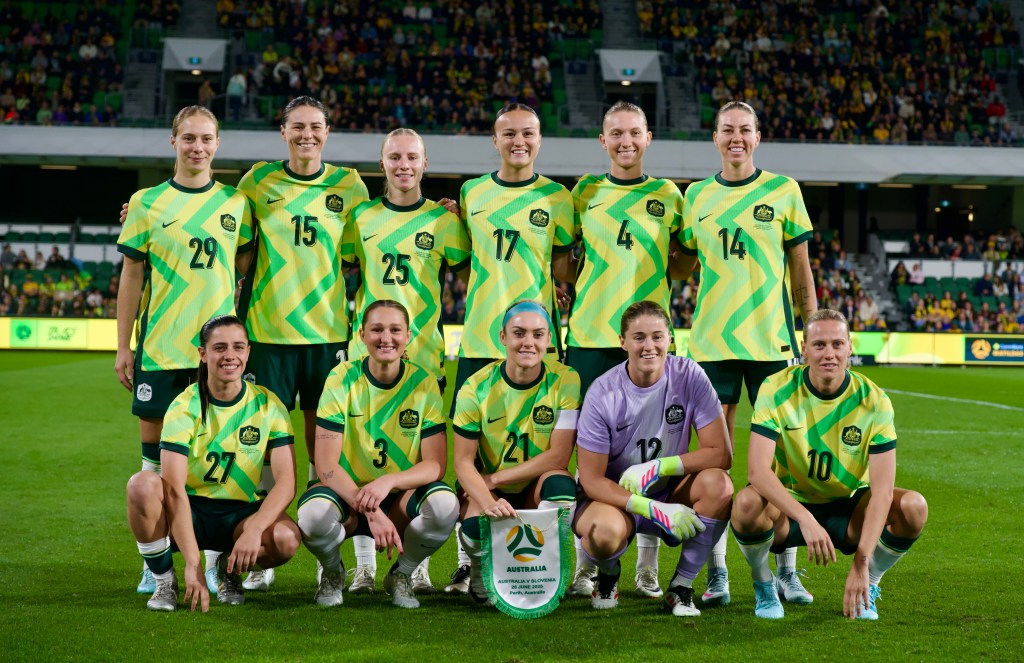
Above: The Matildas starting line-up ahead of kick-off tonight. Photo: Rob Lizzi for Impetus.
Check out our Instagram page – @ImpetusFootball for more of Rob Lizzi’s exclusive images from HBF Park.















 impetusfootball.org