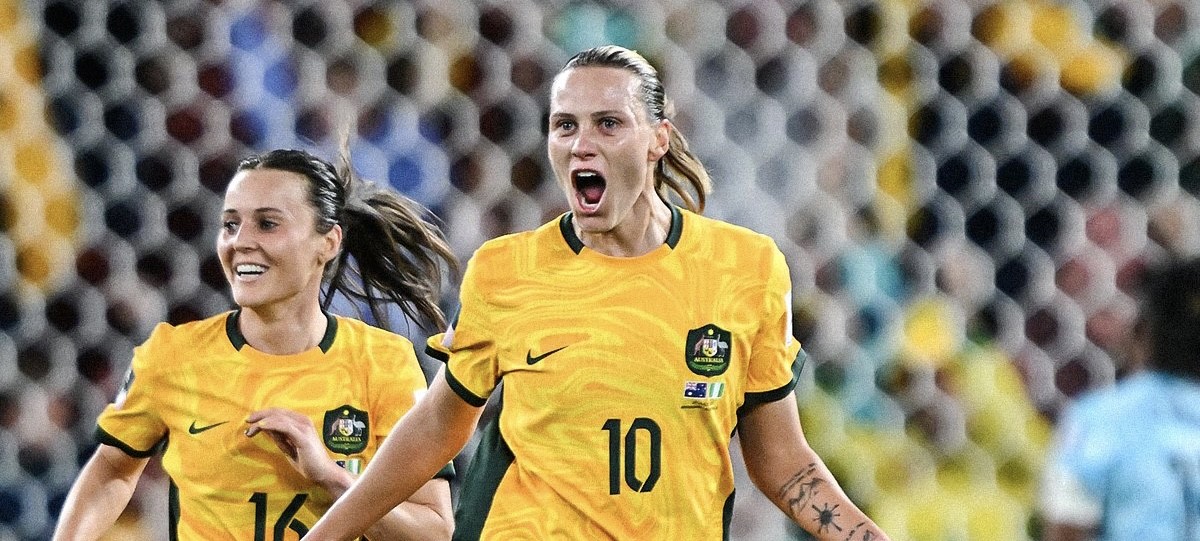
It is another huge week for the Matildas as they get set to take on Argentina in a pair of matches over the next seven days.Speaking to the media in Melbourne this morning, veteran midfielder Emily van Egmond alluded to some of the differences greeting her and her team mates this window.
The Matildas’ midfield is set to look very different this window, with no Katrina Gorry and likely limited time for Kyra Cooney-Cross.
“I think whoever gets the opportunity to play in there, it’s about dictating the ball and being a presence in there. We want to dominate games,” van Egmond explained.
“If you look at how we went against the opposition at She Believes Cup, we didn’t have our best performances. And then coming back here to perform against South Korea and have some dominant displays there, I think it shows that we’re kind of on the right track.
“We’ve still got a bit of time before the preparation, which will be good. But however the coach wants us to play, we’ll obviously try to do that to the best of our ability always.”
The midfield will not be the only section of the park that will look a bit different this window, with Mary Fowler having gone down with an ACL injury since the last window.
“It’s obviously sad for Mary with the injury that she sustained. We’re all behind her hoping that she has a good and a speedy recovery and gets back as soon as she can. But the most important thing is obviously her health and making sure that she takes care of that knee,” van Egmond reiterated.
“It’s part of football being a professional athlete and as one door maybe closes for a little bit, it’s a good opportunity for someone else to come in and experience the Matildas.”
Although it has been a while since the Matildas have faced La Albiceleste, but van Egmond has a clear idea what to expect from the Argentinians this window.
”I think if you look at their last round of international friendlies against Canada, they obviously, um, they beat them one nil, so they’re going to be a tough opponent for us, a good challenge and one that are very excited to play,” van Egmond said.
Van Egmond is also expecting the matches against the Argentinians to “be a physical game again, probably not too dissimilar to Brazil. They’re quite street savvy, so yeah it’s a good opportunity for us. Two other friendlies to get under our belt before the Asian Cup and to play against an opposition is always nice.”
It has already been a big week for Australian women’s football, with a trio of Aussies – Cooney-Cross, Steph Catley and Caitlin Foord – winning the UEFA Women’s Champions League with Arsenal over the weekend.
“They’ve worked so hard and I’m just really happy for the girls to be able to experience that,” van Egmond said.
“Not a lot of people in their careers would even get to play Champions League, so to be able to come out and say that you’re a winner is amazing. I think I read a stat that there’s only been seven winners in Australian football history, so to be a part of that is awesome, and obviously Ellie’s won it before as well, so to have four girls flying the flag there is unbelievable.”
It is also a big week for interim Matildas coach Tom Sermanni, who notches up his 150th match in charge of the side this window.
“I think Tommy’s obviously been around it feels like almost forever. They obviously won in 2010, the Asian Cup, which was a massive achievement. He’s blooded through a lot of the girls now that are in the squad, including myself,” van Egmond acknowledged.
By Catherine MacKenzie and Alyce Collett (26/05/2025)
Above: Leah Williamson battles for Arsenal against Barcelona. Photo: Arsenal website.
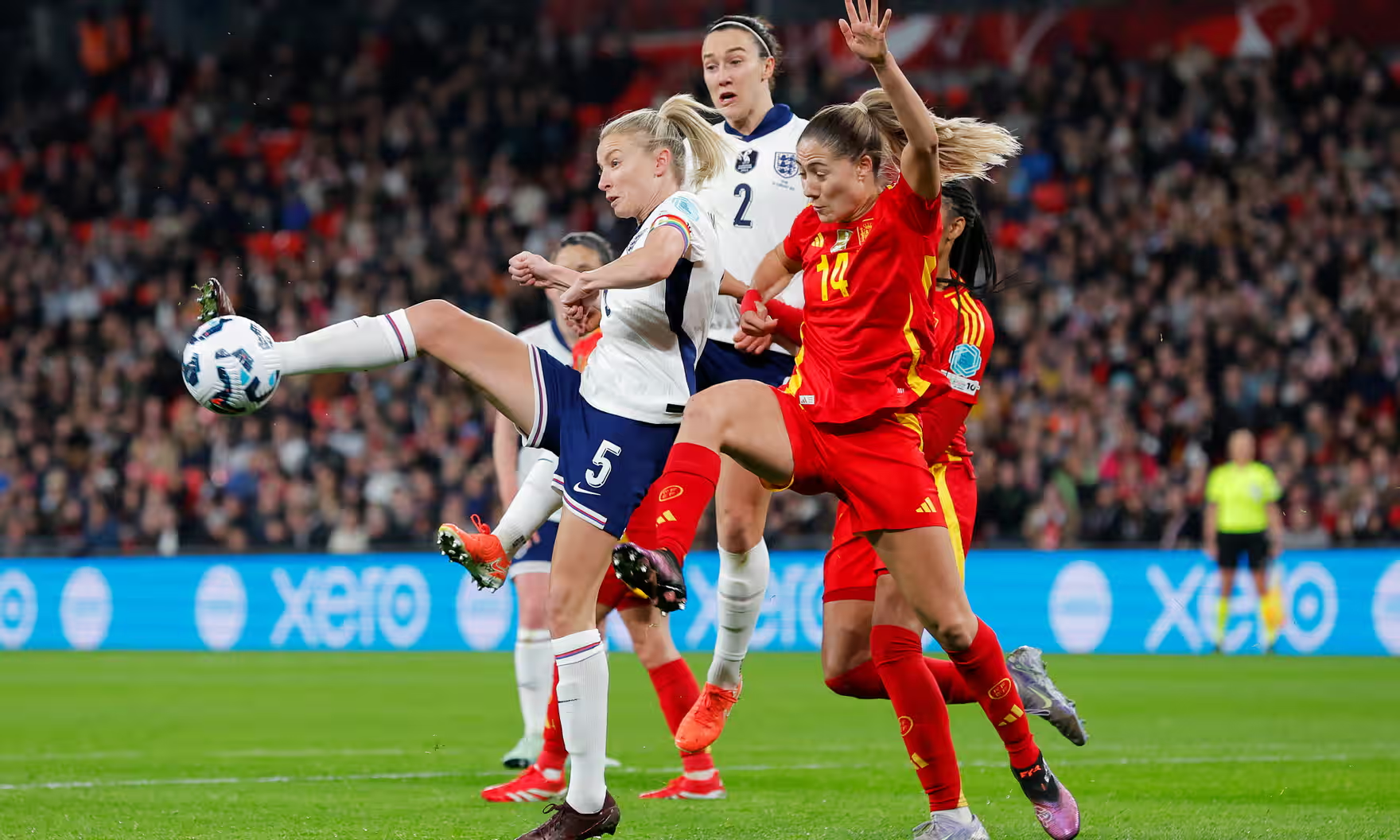
England and Spain, two favourites for this year’s European Championships, have a chequered recent history. The two nations faced off in Australia’s World Cup final in 2023, resulting in a narrow win for Spain. The previous year, England had come from behind to claim a 2-1 win in the quarter-final of the 2022 Euros, and earlier this year, the Lionesses claimed a similarly narrow victory over the World Champions, beating them 1-0 in the nations league.
The closeness of the games between nations has been echoed in matches between clubs – Barcelona’s squad includes a huge raft of Spanish national team players, including first-choice Spain goalkeeper Cata Coll; Batlle, Paredes, and Leon in defense; Bonmati, Putellas, and Guijarro forming the basis of both midfields; and Pina and Paraluello in the forward line.
Spain and Barcelona also play a very similar style of football: heavily possession-based and technical, focusing on skill and athleticism.
Although Lyon have been the dominant force in the Champions League, Barcelona have won three titles, with only one English club – Arsenal – winning the tournament throughout its history. The Spanish giants have swept aside Chelsea, who are the eight-time English champions, repeatedly in Europe.
Combined with Spain’s victories at the World Cup and in the 2024 Nations League, Barcelona’s UWCL success has prompted a narrative that Spain are the most unbeatable force in women’s football.
However, Arsenal’s win in this year’s UWCL final and England’s win earlier in the year pose an interesting question: are we learning how to play Barcelona, and to what extent do club and national football learn from each other?
Maintaining composure in transitions
The battle between Arsenal and Barcelona was, in many ways, reminiscent of England’s game against Spain a few months earlier. In both cases, the underdogs – undeniably England and Arsenal – toed a careful line balancing sitting back and defending with their entire eleven and running at their Spanish opposition to rattle them.
Spain and Barcelona have both been masters of catching teams out on the transition, using their athleticism and physicality to hold on to the ball. Where England and Arsenal succeeded was by letting the Spanish teams do this and accepting that they would not have much time on the ball. In the final, Arsenal got their win with only 32% possession – England had 41%.
Above: Leah Williamson for England against Spain. Photo: Tom Jenkins / The Guardian.
Although the recent trend is for fans to want their teams to play ‘attractive’ football – high possession, technical – the reality is that this is not always the best way to win the game. Arsenal and England both succeeded by admitting that their opponents would play more attractive football than them and letting them create chances while trusting their own defensive line.
Leah Williamson and the art of technical defending
A defensive performance is often seen as ‘playing for the draw’, unattractive and boring. However, when done well, it can be entertaining to watch – if viewers are not expecting a high-scoring game. There is a technical side to defending, and an intelligence: things like understanding positioning, anticipation, and controlling the ball under immense pressure. These are all facets of defending Arsenal and England displayed during their wins.
Barcelona had 20 shots in the UWCL final, five of which were on target. When they played against England, Spain also had 20 shots overall and five on target. There were few yellow cards in both games (one for each side in the England game, and one for Arsenal in the final), because the defenders focused on technicality rather than physicality.
A stellar example of this is the performance of Leah Williamson in the UWCL final.
Williamson played the UWCL final as the right-sided centre back, with her usual partner Steph Catley playing on her left. One of the big strengths of Williamson’s game is her positioning on the pitch, keeping her distance and ensuring the pack does not get overcrowded – whilst also getting herself into effective positions to stop the shot without impeding the goalkeeper.
Above: Leah Williamson in the UWCL final. Photo: Arsenal WFC website.
Against Barcelona, Williamson also exemplified the importance of maintaining a mindset of concentration over 90 minutes. As a player with over 200 appearances for the Gunners and plenty more at international level, Williamson was exactly the type of player whose calming influence and experience is needed in a side like Arsenal – who had exactly one player with previous experience in a Champions League Final – especially against a side playing in their sixth final in a row.
That experience proved its usefulness in the second half, when Barcelona stepped up a gear and really started to attack the Arsenal goal. On a number of occasions Williamson was able to clear the ball out of danger and give herself and the rest of the defenders some breathing space. Although these clearances were not always the most accurate in terms of passing the ball to a teammate, the clearing kicks were powerful enough that it gave her team time to either run onto it and take possession or create the pressure on the Barcelona player who did get the ball.
Arguably the biggest skill on display was her ability to time her tackles perfectly – gaining possession through interceptions and careful tackles that would not run the risk of summoning the referee’s whistle.
What next?
Spain do not have to wait for long to have a chance to get some revenge: they face England in the Nations League next week. Whilst England and clubs like Arsenal have had recent success against Spain in recent months, it remains to be seen if this will last for the third consecutive meeting.
There is something at stake as well: the winner of the game is most likely going to top the Nations League group and progress to the quarterfinals of the competition – whilst the team that loses will have to settle for second place and give up the chance for another trophy.
England v Spain is on Tuesday the 3rd of June at 18:00 BST.
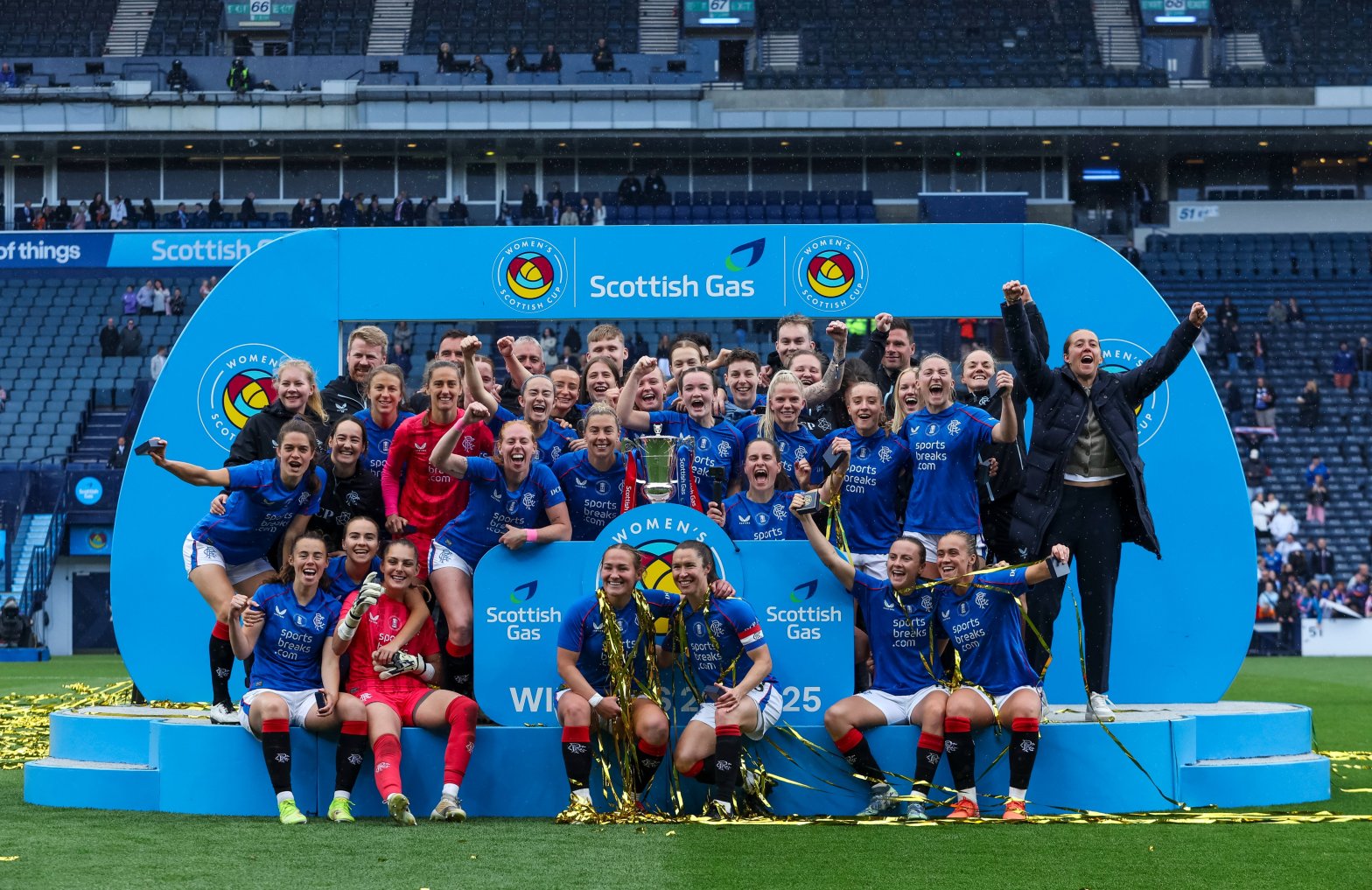
Above: Rangers celebrate the cup double. Photo: RangersWFC on X.
On Sunday, Rangers won their second cup of the season – and their fourth in two years. They are dominant in the cups, however consistently falter in the league. In this Impetus Football piece, Gethin Thurlow ponders why.
A week on from another final day heartbreak at Ibrox, the trophy, confetti and screens in the stadium were finally embroidered in blue. Rangers had won the Scottish Cup. They had in fact, won the cup double for the second year in a row.
Still, there was an inevitable sombreness to the celebrations. They had once again let the league slip away. After what was considered a disappointing season last year; all Rangers achieved in 2024/25 was the same except for a lack of Champions League qualifying.
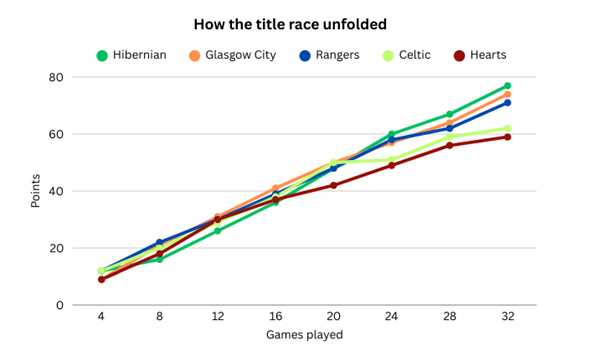
Having destroyed eventual SWPL champions Hibernian 5-0 at the League Cup final in March, Rangers asserted themselves as a team who could beat anyone when they were on it. And yet, presented with a perfect opportunity to win the league: one point clear at the top with six games to play, they lost twice to Hibs – two confusing results given the outcome of the League Cup.
During that run, Rangers also lost to Glasgow City. This was the game that ultimately decided second place (and a place in Champions League qualifying), as Glasgow claimed the position by just three points. Something that defined each of those losses is a lack of a single goal. For such an unforgiving attack – that averaged over four goals per game, and that proved they could punish even the top teams, it didn’t make sense that they could falter so consistently in crucial moments.
Conversely, at Hampden Park – the home of Scottish football – this reticent Rangers was nowhere to be seen. After a frantic opening to the game, with chances for both teams it was the composure of Mia McAulay who set the tone for the rest of the game, slotting the ball into the bottom left-hand corner from the edge of the box. From then on, it only looked like the game was going one way – with a Kirsty Howat double sealing the Cup victory for Rangers.
Above: Mia McAulay celebrates opening the scoring. Photo: Rangers WFC website.
While these two seasons haven’t been exactly the same for Rangers, they do mirror each other a lot. Fighting at the top of the league all year, winning both cups but falling short of a ‘successful’ season due to league failure. What will be particularly frustrating to the fans is that the main issue of last year was addressed. They dominated goal difference in the league yet were six points further from the title despite the influx of goals.
While it feels wrong to say, questions are being asked of Jo Potter. Four trophies in two years aside, it’s the league title that is so desperately wanted at Ibrox and for whatever reason, she can’t seem to consistently draw the best performance from her team. Whether it is a mindset issue; where they can only be motivated by a one-off game, or a tactical flaw that other teams are able to expose, the English manager will have to work hard next year to avoid being perennially labelled as a ‘cup merchant’.
To be successful next season, Rangers need to use this victory to push them on. They showed a level of performance that has the potential to blow away the league. All they have to do is be able to replicate this consistently. Perhaps a deeper squad, especially in midfield will help bring this out and the club will focus on retaining key assets from this year such as Katie Wilkinson and Lizzie Arnot.
If they can achieve this, there’s nothing that to stop them from taking the league by storm in 2025/26. Nothing that is, except themselves. This current generation of Rangers is right on the brink between being a golden era of club, and from being the bottlers who always came close but could never get it done. Ultimately, this season will be remembered based on those before and after. Their history is still to be made.
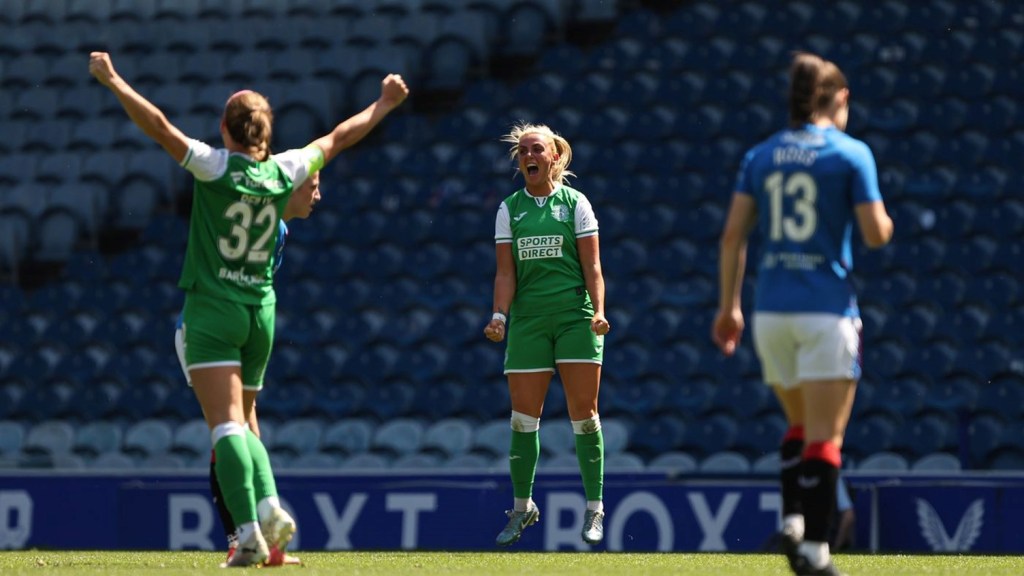
Above: Hibernian women celebrate winning the SWPL. Photo: Hibernian women on X.
The best title race in Europe? Maybe not, but certainly the best underdog story. With absolutely no title winning expectations, Hibernian – a pioneering team of the women’s game in Scotland – turned the back the clock and won the title for the first time since 2007.
While there were a few signings in the summer – Australian left-back Stacey Papadopoulos and Kirsten Reilly from Crystal Palace on free trasfer being the most notable – with Hibs losing key players Jorian Beacom, Leah Eddie and Shannon McGregor, it didn’t like Hibs had really progressed much.
This couldn’t be further from the truth though, as Ciara Grant, Kathleen McGovern, Linzi Taylor, Noa Schumacher, and loanees Erin Clachers and Caley Gibb all proved to be wonderful signings, with each playing a huge role in the title challenge. For a team that had finished fifth ever since 2022 and were 36 points off champions Celtic last year, this was an uncomprehensible turnaround, although there were already clues in the summer if you looked close enough.
After a mixed start to the season, Hibs were at eight points off SWPL powerhouses Glasgow City in December. They then went on to win eight games in a row (including against Rangers, Glasgow City and Celtic – their three main title rivals) and entered the ‘split’ equal on points with Glasgow City in first place.
The split is a unique Scottish format, whereby after every team has played each other home and away, the top six and bottom six split into two separate groups, playing the other five teams home and away to conclude the season.
So, while Hibs had shocked everyone to this point, this would be another challenge. Playing top teams every week now, people were starting to take them seriously as genuine title contenders – but could they keep it up?
The first game post-split provided an astounding answer and a reflection of Hibs’ entire season. Gritty, determined defending all game against a free-flowing Glasgow City side, absorbing all the pressure. Then from a corner in the 97th Minute, Papadopoulos shot, the ball bounced and putting her body on the line for team, Kirsty Morrison forced the ball in, taking a foot to the face in the process.
Passion. Fight. Teamwork. Togetherness. These all sum up Hibs perfectly this season, but in particular they sum up one player: Siobhan Hunter. A classic centre back, Hunter loves nothing more than throwing herself into tackles and blocks, and occasionally into opposition players. As the chant goes, she might genuinely be made of steel. The 31-year-old has been at Hibs since she was nine years old, a club legend – she deserves this trophy more than anyone.
Photo: Siobhan Hunter for Hibs Women. Photo: Hibernian Women FC website.
These attributes were on show more than ever in the final game of the season, which was quite similar to the Glasgow City game I just discussed. Going into it, a draw was all Hibs needed, and they faced a defence-shattering Rangers side who had humiliated them 5-0 a couple months ago in the League Cup final.
Facing wave after wave of attacks, Hibs headed, tackled, blocked and saved anything Rangers could muster up; before centre back Linzi Taylor scored the crucial winner. A counterattack that started with Taylor winning the ball on the edge of her own area ended with her volleying a cross from striker Kathleen McGovern – who herself had chased down every ball all game. That drive to get forward and score has defined Hibs this season, and it was well and truly on display in the crucial moment.
Something else that set Hibs aside from their previous teams was the midfield. With Ciara Grant, a dead ball specialist and Kirsten Reilly coming in and playing as a deeper two with the more attack-minded Michaela McAlonie. Grant and Reilly together provided Hibs with more control, both very talented at winning and keeping the ball in tight spaces. McAlonie, who had always been a standout in the past was fantastic at pressing and often won the ball in high areas.
This allowed the attack to flourish more than in the past, especially when facing the other professional sides. An attack that was mostly made up of Kathleen McGovern and Eilidh Adams, although Adams played mostly on the wing; and traditional left winger Tegan Bowie – who excelled down the left and provided many crosses for the two strikers to aim at. McGovern and Adams scored 25 and 24 league goals respectively, with a consistent goal flow ensuring a consistent points flow too.
The defence, led by Siobhan Hunter and Linzi Taylor in the middle was the second best in the league. This included three clean sheets against Rangers and Celtic and one against Glasgow, securing so many important results in tight games.
Lauren Doran-Barr and Papadopoulos charging up and down the field from fullback both deserve acknowledgement too, as well as back up left back Caley Gibb – who had to come in for the crucial last two weeks of the season. They defended valiantly in the moments it was needed, as well as providing some extra width and numbers in attack.
The goalkeepers, Noa Schumacher and Erin Clachers were also an important part of the team. Schumacher moving over from America and Clachers, on loan from title rivals Glasgow City. They both gave their all and had to face different moments; with the saves and composure helping Hibs to that defensive and clean sheet record.
Ultimately, this was a team that fought together and for one another from the first game to the last. No one gave them a fighting chance all season, but led by manager Grant Scott they really didn’t care. A founding member of Scottish women’s football, Hibs were there to show that history does matter and that whatever happens you can never count out Hibernian FC. On a day where the Sunshine certainly shone on Leith, the ‘Hibees’ confirmed the title so few believed they could achieve.
Above: Perth SC’s returning A-League Women star Tijan McKenna in action at Murdoch University Melville today. Photo: Rob Lizzi.
Football West Academy 2-3 Perth RedStar
Perth RedStar held off a comeback from the Football West Academy (FWA) to claim the win in the round’s opening game at Hay Park in Bunbury on Saturday night.
RedStar handed a first NPLW WA start to Young Matildas and Perth Glory goalkeeper Jess Skinner, who would be facing her former side. It was the defending champions who were the fastest out of the blocks and dominated the opening 20 minutes or so of the proceedings.
In-form Renee Leota was a player possessed in this spell and at the creative heart of everything RedStar were imposing on their teenage opponents.
The first real opportunity came after 11 minutes when Sarah Carroll fed Caitlin Doeglas out on the left. The former Perth Glory attacker saw her deflected shot roll agonisingly wide of the right-hand post. Shortly afterwards, it was Carroll’s turn to go close as she sent a curling effort wide of the same piece of woodwork.
RedStar hit the front with 22 minutes played. Andreia Teixeira’s crossfield ball from the right flank was deflected up and across to Jayna Ridley, who worked her way free from a sandwich of Harper Collinson and Marley Barlow before cooly sending a finish from a central position around 15 yards out.
The Academy responded well, and Sakura Leong became the focus of their attacking play. She was able to get behind the RedStar defence on the right on regular occasions. From one such opportunity just before the half-hour mark, she pulled a low cross across goal for in-form Cate McAuliffe, who couldn’t get her shot on target.
Seven minutes before the break, RedStar mounted an attack with Carroll getting in behind the teenage side’s defence, but her shot was wide. However, from the resulting goal kick, the defending champions immediately put the Academy under pressure in trying to play out, and as a direct result, Ridley found Leota, who in turn played in Carroll in the box. Her low shot into the net doubled RedStar’s lead.
FWA gained a crucial foothold in the game just seconds before the interval, and it was the result of yet another probing run from Leong to the right of centre. Released by McAuliffe, Leong played in yet another dangerous low ball into the mix, and at the second bite, Klaudia Houlis swept the ball home from close range. Game on at the break.
The drama continued after the interval as Caitlin Doeglas spurned an opportunity to re-establish her side’s two-goal advantage from the penalty spot, and RedStar were made to pay in the ultimate way with 65 minutes played.
Teixeira played a low pass back to Skinner who was well outside her box, but a combination of taking her time to make the clearance and a rapid closing down attempt from the Academy saw Skinner’s pass go straight to Houlis who lobbed her former team-mate from around 30 yards, with the ball nestling in the net to bring the scores level.
Parity lasted for 11 minutes before RedStar regained their lead after a sequence of events where, initially, there looked to be absolutely no chance of a goal being scored. The FWA had the ball comfortably on the left-hand flank. Ridley pushed up to close down the space available to her teenage opponents, and in doing so, forced a pass back that agonisingly rolled straight into the right-hand corner.
There was still time for one further goalscoring opportunity, and it came with the very last kick of the match. Emily Garnett released substitute Theodora Mouithys, who broke through one-on-one with Skinner, but the RedStar keeper made a superb low block to ensure her team held onto the lead, and just seconds later, the three points.
This was a thrilling encounter between two excellent sides. The outcome means that RedStar have now won three in a row in a serious statement of intent to those who thought they were not quite the side they were.
For the Football West Academy, their six-match winning run that started the season has hit the buffers with successive losses to top-four rivals Perth SC, Balcatta Etna, and now Perth RedStar. Next week’s trip to Fremantle City now looms as an important staging post in their campaign.
Teams: FOOTBALL WEST ACADEMY: McGreadie-Cole, Williams-Jones, Collinson, Barlow, Johnson, Leong, Houlis, Heys, Kuzamba, McAuliffe, Dalton. Substitutes: Dumont, Santos, Garnett, Brady, Borg (GK), Mouithys.
Balcatta Etna came from behind to record an impressive victory at Hilton Park this afternoon.
Whilst the character shown by his side in making the comeback will please head coach Pete Rakic, the win was marred by Mia Britton being stretchered off with less than five minutes remaining.
Freo hit the front with 12 minutes played in impressive style. Sophie Meaden gathered possession on the left and fed Janice Kiama in the middle of the pitch. Kiama drove through the centre and played a perfectly weighted ball through to Leyna Wood, who came onto the pass at the back post to fire home.
Balcatta levelled nine minutes later as Rachel Jarvis played a lovely ball through to Jamie-Lee Gale with the outside of her foot. Gale advanced and played in a cross for Abbey Meakins to head home at the back post.
Eight minutes before the break, the visitors hit the front when Meakins was on target from the penalty spot. Her low shot found the right-hand corner despite the best efforts of home goalkeeper Megan Phillips, who got a hand to the shot.
Balcatta sealed their win with 85 minutes played after a superb move. Carys Davis won possession and played the ball back to Alyssa van Heurck inside her own half to drive a ball forward for Zoee Spadano and Davis to combine, with the latter finding Gale who advanced to slot home the third.
Balcatta have responded well to their 5-0 loss to Perth RedStar three weeks ago, recording successive wins ahead of UWA-Nedlands’ visit to Home Group Stadium next weekend.
Murdoch University Melville 0-8 Perth SC
Above: Perth SC celebrate a second half goal in their 8-0 win at Murdoch University Melville today. Photo: Rob Lizzi.
The Azzurri ran out comfortable winners at Besteam Stadium this afternoon to go top of the NPLW WA ladder.
A first-half blitz of four goals in 12 minutes plus three more in another 12-minute blast after the break laid bare Perth’s superiority. However, it was not all good news, with key midfielder Daisy McAllister being stretchered off early in the second half after an aerial collision with home goalkeeper Kaitlyn Mohan.
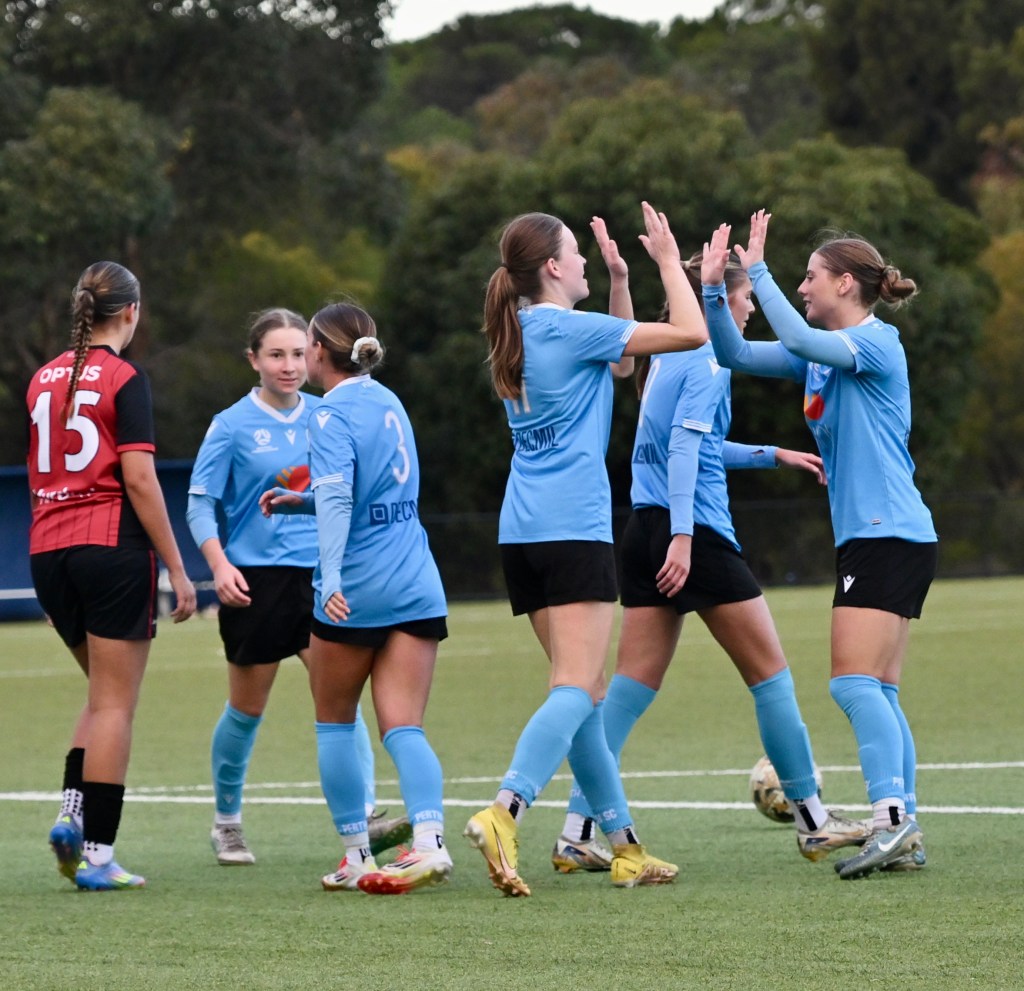
Perth Head Coach Tom Glavovic added newly returned A-League Women stars Tijan McKenna and Georgia Cassidy to his starting line-up.
It’s been a tough start to the campaign for Murdoch University Melville (MUM FC) boss Steve Atkins. He’s lost a number of first-team players and has had to call up a raft of youngsters from the club’s U21 set-up, making cohesion and competitiveness a challenge. Those more senior players will return gradually over the coming weeks, but it’s left the side doing it tough.
The visitors hit the front just 10 minutes in when a corner came in high from the right. Flannery hit a shot which came back off a MUM FC defender and fell perfectly for Kim McCartney to fire into the roof of the net.
The Azzurri doubled their lead with 20 minutes played as McKenna sent a stunning lofted shot into the net from the right-hand side of the penalty area.
Three minutes later, it was 3-0 as Mathers drove the ball across the box from the right for Flannery, who was coming in at the back post to fire home.
Shortly afterwards, Cassidy threaded a centimetre-perfect pass through for McAllister, who saw her shot roll narrowly wide of the right-hand post.
Perth had better luck on the half hour when Kim McCartney fired a trademark free-kick into the net from the left of centre at the edge of the box.
The spell of four goals in 12 minutes concluded as Hannah Collins dispatched a fantastic first-time shot as the ball came across to her from the left.
Whilst the early exchanges of the second half saw the hosts have their best period of possession all game, midway through the second half, Perth stepped it up once more with another rapid-fire burst of goals beginning in the 68th minute. McKenna found Boehm out on the left flank from the centre of the park to lift in a high ball for Louise Tana to direct a first-time low volley into the goal.
It was 7-0 with 11 minutes remaining when Cassidy’s high corner from the left was headed home by Mathers at the back post.
The scoring was completed eight minutes from time when Mathers’ corner in from the right found Boehm completely unmarked at the back post to come in and hit a side-foot volley into the net.
The Azzurri made the most of Football West Academy’s defeat yesterday to earn top spot in the NPLW WA ladder as the mid-point of the season approaches.
Subiaco 2-3 UWA-Nedlands
UWA-Nedlands gained a superb win at Rosalie Park to increase the gap between themselves and Murdoch University Melville at the foot of the ladder.
The visitors took the lead just before the quarter-hour mark. An excellent passing move earned them a corner on the left. Emily Dinsdale sent it in for Andrea Preitao to head home at the back post.
UWA-Nedlands went 2-0 up on 28 minutes when Chloe Gaspar sent a superb free-kick arrowing into the top left-hand corner from over 25 yards.
However, Subi came out firing after the interval and got a goal back less than a minute after the restart. Jaalah Rudd took a throw-in on the left and found Tabain. The pair played a one-two which ended with the former A-League Women attacker firing home from inside the box.
With eight minutes remaining, the visitors restored their two-goal advantage when Chloe Gaspar floated in a free-kick from the left, and the ball fell for Dinsdale to lift it into the net in front of Subiaco keeper Monique Todd.
Subiaco grabbed a glimmer of hope in the final minute when Tabain pounced to get another one back after the visitors failed to clear, and Greta Bailey threaded a pass through.
Going into the round only outside the top four on goal difference, this was an extremely disappointing outcome for Subi. Conversely, UWA-Nedlands’ superb battling spirit and decent goalscoring record earned them a second win of the season.
Ladder
Perth SC P8 Pts 20 GD +20
Perth RedStar P9 Pts 19 GD +24
Football West Academy P9 Pts 18 GD +9
Balcatta Etna P7 Pts 13 GD +5
Subiaco P8 Pts 10 GD +1
Fremantle City P8 Pts 9 GD -2
UWA-Nedlands P9 Pts 6 GD -21
Murdoch University Melville P8 Pts 0 GD -36
Round 10 Fixtures:
SUNDAY: Balcatta Etna v Murdoch University Melville, Fremantle City v Football West Academy, Subiaco v Perth RedStar, UWA-Nedlands v Perth SC.
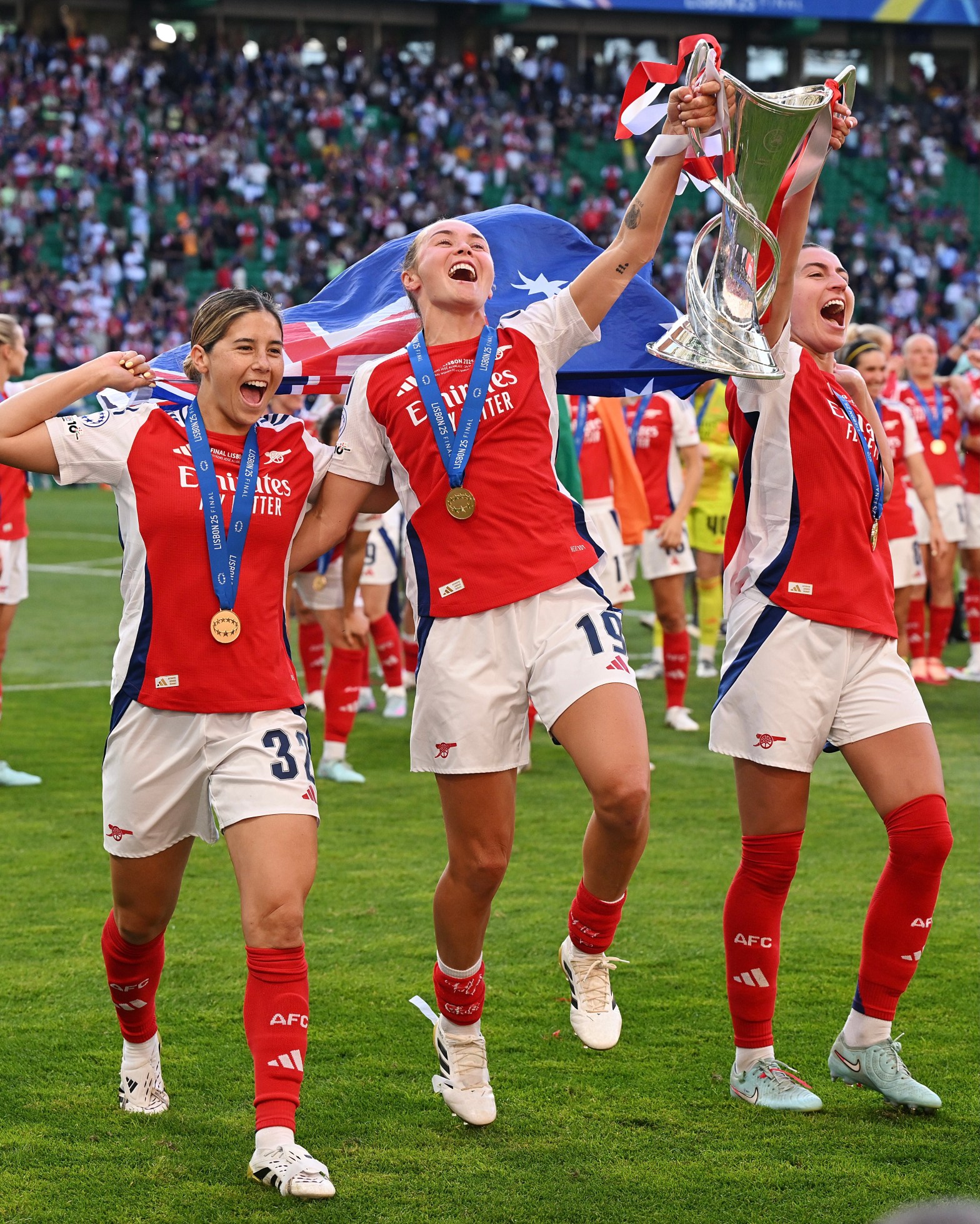
Above: From left to right – Kyra Cooney-Cross, Caitlin Foord, and Steph Catley with the UEFA Champions League trophy last night. Photo: UWCL.
25/5/25
Three Impetus writers – Genevieve Henry, Ella McShane, and Alice de Koster-Kitto analyse the impact that Arsenal’s Australian internationals had in their superb European Champions League Final victory last night.
Shining, purposeful, and well-executed
Genevieve Henry on Steph Catley
Keeping a clean sheet against a front three that has scored 80 goals between them this season is a monumental task for anyone, but Steph Catley and the Arsenal backline were certainly up to the challenge.
When one considers the formidable midfield behind, this feat becomes all the more impressive. Catley played a massive role in the famous victory, barely putting a foot wrong throughout the tense match. The Arsenal and Matildas defender kept her composure and put her extensive experience and skills to use in keeping the best attack in Europe under control.
Catley’s first half was without blemish. Tasked with keeping Ewa Pajor in check, Catley proved too strong for even the Polish goal scoring machine. One of the major strengths of the Australian’s game was her aerial prowess, winning every ball out of the air and leaving Pajor struggling to find an inch to breathe. Catley worked hard to ensure Arsenal gave away no easy chances, marking and communicating at a high level.
As Barcelona ramped up their attack in the second half and Catley’s role got tougher, she kept her calm and continued to clean up dangerous attacks. Her responsibility shifted from winning every ball meant for Pajor to clearing out everything that came near her.
The relentless pressure in Arsenal’s defensive third certainly created chances, but Catley and co stood up to the challenge. In the 69th minute, Catley made a crucial block against perhaps Barcelona’s most dangerous attack of the game, clearing the ball out from the feet of Pajor and Salma Paralluelo only a few metres from the goalmouth.
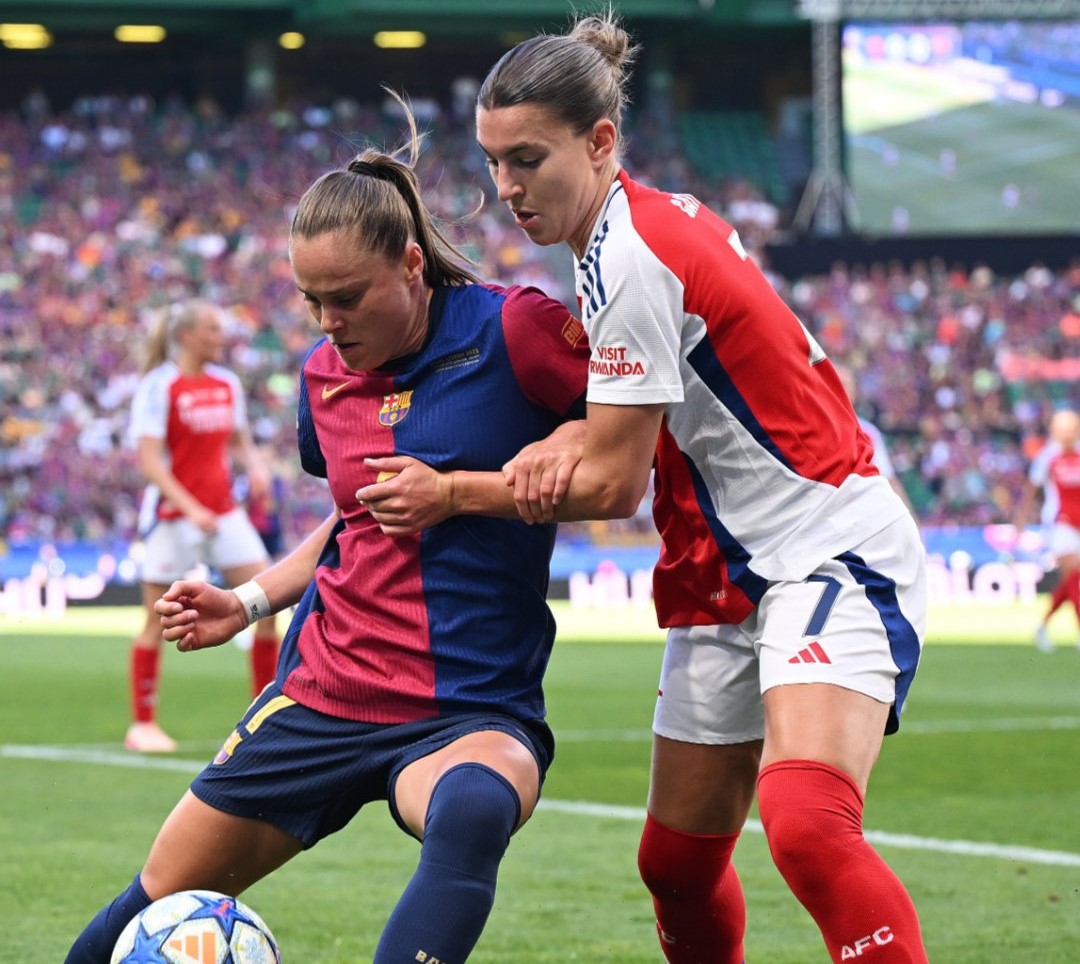
Above: Steph Catley (right) hard at work against Barcelona last night. Photo: UWCL.
Every action Catley created throughout the whole game was purposeful and well-executed. Shining in an incredibly solid Arsenal defence, Catley worked in tandem with Leah Williamson, the pair putting on arguably their most cohesive performance of the season. Their critical role in keeping the back organized was exceptional, rarely allowing a Barcelona player to find space. Where one stepped to win the ball before their opponent, the other would drop to sweep up any messes.
Although Catley’s great strength was in her ability to calm the game down and make measured, safe decisions, she was able to add something special to the attack at times.
From briefly switching with Katie McCabe to complete one of her famous give-and-gos up the left side and her connection with Chloe Kelly throughout the match, Catley managed to sprinkle in some of what Arsenal has missed with her at centre-back.
One of the best moments for the Australian defender was when she won an excellent ball to Pina out of the air and nodded it to the feet of Frida Leonhardsen Maanum, who let it fly with a threatening long-range shot.
With Australia’s recent shakiness at centre-back, Catley’s performance will give Matildas fans confidence and hope going into the upcoming international window. Whether she partners Alanna Kennedy, Clare Hunt, or another, Catley is certainly adept at centre-back and can ease some Australian fears. Especially with the showcased improvement of her aerial abilities, Catley could be one of the very best centre-backs in the world.
Truly instrumental – a performance for the ages
Ella McShane on Caitlin Foord
Above: Caitlin Foord (second left) lifts the UEFA Champions League trophy with her Matildas teammates Kyra Cooney-Cross and Steph Catley. Photo: Football Australia.
Starting in the familiar left-wing position in Renée Slegers 4-3-3 formation, Caitlin Foord displayed excellence in every corner of the pitch in Lisbon. Wollongong’s finest was truly instrumental in the execution of a game plan that ultimately diluted Europe’s best.
Foord’s trademark pace on the wing created the promising presses that established Arsenal’s early and unprecedented contention for the title. Ten minutes in, her pace in the box allowed Steph Catley’s long ball from outside to meet potential. The header was ultimately off target, but it served as a caution to Barça of the threat posed by the underdogs.
Although in the hands of arguably a world best backline, Arsenal’s defensive strategy swiftly mobilised players from all positions to diffuse the Catalan pressure. On multiple well-timed occasions, the Aussie dropped back to deny an ever-growing uncomposed Barça side.
The most notable occasion was Fridolina Rolfö’s searing run into the box that called for immediate attention. Foord swooped in with a fiery urgency, her impeccably timed slide tackle cooling things down just as the pressure peaked. The Matildas star single-handedly denied the Swedish international a chance at goal.
Foord was substituted in the 85th minute for Swedish international Lina Hurtig, after delivering a highly skilled and analytical performance. Over the course of her 85 minutes, Foord demonstrated her highly skilled read of the game, frequently dropping into deeper areas to support defensive transitions, advancing the ball up the wing and maintaining the pressure in the final third.
Covering every blade of grass, it was a performance for the ages.
Learning and growing – under the influence of those around her
Alice de Koster-Kitto on Kyra Cooney-Cross
Above: Kyra Cooney-Cross (right) UEFA Champions League winner. Photo: Football Australia.
While she’s often regarded as the player who could have made a difference in failed moments, having garnered reputation as a game-changing ‘super-sub’ over her short career at Arsenal, it’s hard to tell if the presence of Kyra Cooney-Cross would have made much of an impact in this instance given the elite performances put on by the Gunners all over the pitch.
It could be said that benching the Matilda may have been the right decision in such a crucial meeting, given her lack of minutes in recent weeks, although her performances this season have been pivotal in getting Arsenal to this point, and she has proven herself to be worthy of a starting position with the club next season.
Though a triumphant win that no Arsenal fan will be complaining about, we are left wondering if Cooney-Cross’ renowned ability in tight spaces and impeccable record of accurate passes could have gotten Arsenal out of some dangerous situations, and calmed down the pitch, leading to an earlier opener.
It is this signature calm and collected style of play that is what ultimately led the Gunners to the trophy, a testament to how she has seamlessly settled into the squad since signing in 2023, as she could have easily been a direct replacement for any of the world-class midfielders present, had Arsenal been in need of a tactical switch.
A player of Cooney-Cross’s quality being benched goes to show the quality within the Arsenal midfield. Learning and playing among such esteemed midfielders as Kim Little, Lia Walti, and Mariona Caldentey has given the 23-year-old invaluable experience, not to mention the confidence that lifting the most prestigious trophy in European club football will award her, coming into the upcoming Matildas camp.
If you missed the previous articles in our countdown to the UWCL final, you can find them below:
Melbourne City has been denied the fairy tale finish to their Asian Champions League campaign, losing to Wuhan Jiangda in a penalty shoot out.
In an at times chaotic match, it ultimately finish 1-1 after 120 minutes after Wang Shuang’s extra time goal cancelled out Shelby McMahon’s opener. It was in the penalty shoot out where the heartbreak ultimately came for City, who went down 5-4 after some clutch saves from Wuhan keeper Chen Chen, who remarkably only came on at half time after first choice keeper Ding Xuan was injured in the first half.
Possession was pretty even between the two sides early in the proceedings, but it was Wuhan who were able to get more shots away early.
One thing that was clear early was that if Melbourne City were going to win, they were going to need to be patient to try and work through Wuhan’s low block, and City were certainly showing plenty of patience early.
Both sides did eventually get their shooting boots on, with the crafty forwards from both sides starting to get into the game. For Melbourne City it was Holly McNamara who proved the biggest threat, while for Wuhan Terry Engesha really looked dangerous on a number of occasions.
City did plenty of attacking at the death of the half, but just could not quite work their way past the Wuhan defence.
Wuhan then almost countered up the other end with a Wang long bomb, but a stellar save from Malena Mires ensured it remained a scoreless draw at the break.
The half time stats really did show how even the first 45 minutes of play had been.
Although City had seven percent of the possession, both sides had registered five shots on goal, with City only getting one more of their shots on target than Wuhan did.
A well structured defence from Wuhan continued to be a thorn in the side for Melbourne City, who struggled to navigate round that defensive wall.
That defensive solidity was truly an asset for Wuhan, because City were a lot more composed on the ball than the home town team were, with the long bomb passes Wuhan was doing no help to its forwards, who were proving to be dangerous if fed properly.
Just as the doubt was starting to creep in about whether the game would be decided within regular time, Melbourne City finally found the breakthrough with about 15 minutes to go, when McMahon headed home a perfectly placed Leticia McKenna free kick.
The goal in a way emboldened Wuhan though, who began to commit more numbers forward in their attacking plays, which they had plenty of.
However the extra numbers did not help improve Wuhan’s shot accuracy, with the home town side not looking any more likely to score than they had before the goal.
City had seemed to have put the icing on the cake in stoppage time through a well placed Bryleeh Henry shot, but VAR disallowed the goal after it picked up a foul Henry had committed earlier in the attacking play.
The chaos was dialled up moments later when Wuhan earned themselves a penalty after Mariana Speckmaier handballed the ball, and Wang perfectly nailed the subsequent penalty kick.
There were some nervy moments for City in the first half of extra time, but ultimately some resolute defending from City kept the score at one all heading into half time of extra time.
The deadlock still was not able to be broken in the second half of extra time, so off to penalties the sides went.
It was impossible to split the sides in the early stages of the penalty shoot out, with both sides converting their first three penalties.
However, Mires saved Wuhan’s fourth penalty, and all Rebekah Stott had to do was convert her shot and the title was City’s, but the City captain could not get the job done and the shoot out continued. Wuhan then converted their sixth penalty, and the pressure was on Bryleeh Henry to score and keep the shoot out going. However, her shot did not trouble Chen and the title went to Wuhan.
Above:Steph Catley battles away in tonight’s final. Photo: UWCL
Arsenal produced a superb performance full of discipline, grit and supreme tactical organisation to win the UEFA Women’s Champions League at Lisbon’s Estádio José Alvalade this evening.
The Gunners won their second European trophy – some 18 years after their first – a sensational feat as they underline their achievement of being the only British side to win a continental cup.
Renee Slegers named an unchanged starting line-up from their second-leg semi-final win at Olympique Lyonnais as her side went into battle against a Barcelona side playing their hundredth Champions League game and their fifth successive final.
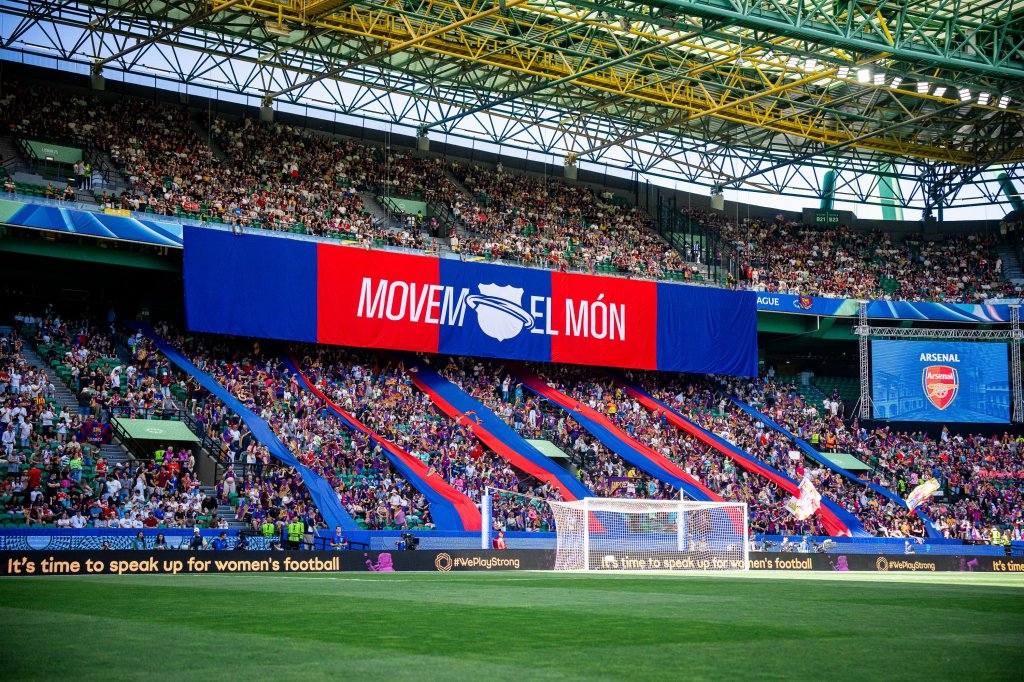
The temperature at kick-off time was in the low 80s, with the added heat in the shape of a stunning atmosphere produced by two of the most passionate sets of fans in the women’s club game beaming down from the stands at Sporting CP men’s 50,095 capacity stadium.
The opening 20 minutes were going to be all-important for the Gunners. They needed to boss the flanks in order to maintain possession and ensure that the Catalan side were denied the ability to drive through the middle of the park. This, allied with a rapid high press, was pretty much successful as Slegers’ side saw out this important period of the game largely unscathed.
Above: Barcelona fans in Lisbon tonight. Photo: FC Barcelona Femeni.
With 11 minutes played, both teams gained their first half-chances. Kim Little gained possession on the right-hand flank and floated a perfect high ball across to the back post where Caitlin Foord was waiting to direct a header across goal, but no one was coming in to put on the finishing touch.
Immediately afterwards, Aitana was found in the box and hit a shot that Steph Catley got an excellent block on to loop the ball up into the arms of Gunners keeper Daphne van Domselaar.
Foord had made an intelligent start to the game, timing her runs perfectly into space behind the Barcelona defence to create opportunities for both herself and the explosive presence of Alessia Russo.
Then, with 22 minutes gone, the Gunners penetrated the Catalan defence. Chloe Kelly played a low ball into the box, and Peredes turned the ball into her own net. The defending champions were saved, however, when a VAR check rightly showed Kelly was marginally offside.
However, it was a warning sign for Barcelona. Arsenal’s game plan was working, and the pressure was building. They were being rewarded for their intelligent and patient approach to the game that was now beginning to both nullify the three-time Champions League winners’ attack, and see them maximise both possession and territory. The chances were continuing to come.
Above: Katie McCabe (right) wins a tackle tonight. Photo: Arsenal Women.
Five minutes later, after excellent work from Catley, Frida Leonhardsen Maanum let fly from 35 yards out, bringing a fine save from Cata Coll, who pushed it over the top.
Catley and Kelly were continuing to link up well, and Foord threatened offensively as well as dropping back to assist her defence with some superb tackles. All Arsenal needed now was a goal to reward their work in the opening half-hour. At this, the highest level of the club game, you have to score when on top, especially against the Catalan giants. It failed to materialise.
As the half entered its final 10 minutes, Barcelona put together their most consistent period of pressure, although most of the attacks were coming along the flanks, as the Gunners were still managing to deny the holders the passage through the centre that they thrive on. It remained goalless at the break.
Barcelona came out in the early stages of the second half full of their quick passing triangles. From one such build-up on the left, Pina hit a shot that took a deflection and looped up onto the crossbar before Arsenal cleared. Shortly afterwards, Ona Batlle saw a drive from the edge of the box go narrowly wide of the left-hand post.
The Catalans upped the pace and intensity, crucially allowed more space to attack more centrally. Ewa Pajor was seeing more of the ball, and Aitana was aiming to get shots away. Batlle saw another long-range effort just fly over the top. Arsenal needed to slow things down and regain the middle of the park in order to end the spell of momentum that Barcelona had built.
Above: Mariona Caldentey (right) fights for possession in Lisbon tonight. Photo: FC Barcelona Femeni.
In the end, that was achieved thanks to the introduction of Stina Blackstenius and Beth Mead with 67 minutes played. Their outstanding link-up play through the centre was the catalyst for Arsenal to drive through that area of the field, and once more break up Barcelona’s favoured method of attack.
Five minutes after coming on, Blackstenius danced her way through the centre with space to drive into and let fly with a shot that Cata Coll saved with her legs. It was a warning to the defending champions of what the newly arrived pair offered – a real threat.
There was a reminder of what Barcelona could do when Alexia’s ball in was headed just over the top by Pajor.
However, it wasn’t long before the Gunners’ substitutes combined to deadly effect. Mariona’s corner from the right wasn’t cleared, and she was able to feed Mead from the same part of the field. The Lionesses’ star played a pass through to Blackstenius, who lashed the ball home.
Arsenal saw out the remaining 15 minutes of regulation time and eight minutes of stoppage time confidently and competently to earn a superb reward. They are Champions of Europe once again.
Above: Arsenal celebrate one of their goals away in Lyon that sent them to Lisbon. Photo: Arsenal FC.
By Ava-Marianne Elliott (24/05/25)
In the seventh article of special coverage building up to a huge clash between Arsenal and Barcelona in Lisbon, Impetus Football’s Ava-Marianne Elliott previews the action and looks into how both finalists reached the last hurdle.
Today marks a huge clash in the UEFA Women’s Champions League, as the last two standing on Europe’s biggest stage battle for the trophy. Arsenal, the only ever English side to claim the title meet one of the competition’s most formidable sides, Spanish giants Barcelona. The match takes place Estadio José Alvalade in Lisbon, where over 50,000 spectators are set to witness a landmark game in women’s football.
For Arsenal fans, this fixture is set to be a memorable one. The passion displayed after that full-time whistle away in Lyon after the Gunners’ s semi-final win from the team and fans alike was 18 years in the making. After their first win in the competition during the club’s historic 2006-2007 season, Arsenal have failed to reach the final again, including falling short in four semi-finals since.
This year however, the North London side have the trophy in arm’s reach. Some may say its down to new Manager, Renée Slegers, who has had a profound impact and seemingly injected a rejuvenated sense of energy into the team, despite them missing out on any domestic silverware this season.
Differing to their opponents, Barcelona have won the title the past two-years in a row, aiming to make it a hattrick this year. Last year, they successfully beat Lyon in the final and further cemented their status as a powerhouse in women’s football, but now, they’re looking to go that extra mile.
A win for the Catalan club would see them be the second team to lift the Champion’s League trophy three years in a row. They head into the fixture off the back of six consecutive title wins in their league, and the odds seem to be leaning in their favour over an Arsenal side that have been hailed the comeback queens of this year’s competition.
Above: Arsenal applaud their incredible fans after the defeat to Lyon in the first leg of the semi-finals. Photo: Arsenal FC.
Arsenal’s turbulent journey
Despite one dip in the road, Arsenal otherwise passed through the qualifying stages with ease. They started off with a 6-0 win over Rangers and a 1-0 win over Rosenborg, both at Borehamwood. It was Hacken away where they struggled, but the 1-0 deficit in Sweden was swiftly overturned with a 4-0 win back on home soil.
The quarter-finals, they were tested greatly with a difficult away trip to Madrid, where they were met with unsuitable playing conditions and handed a 2-0 defeat. The result was bleak and felt like a huge drawback, giving the team a heavy job to do at the Emirates. Flash forward to eight-days later, that night was long forgotten and hopes were sky-high as the scoreboard read Arsenal 3-2 Real Madrid on aggregate at the final whistle.
The first leg of the semis at the Emirates didn’t quite go as planned, and yet again the Gunners trailed going into the second leg after a 2-1 defeat to Lyon. Somehow, the loss didn’t quite feel like the end of the world, and surely enough, Arsenal produced more magic to sink the most successful side the UWCL’s seen, earning their spot in Lisbon.
Above: The full time score at Stamford Bridge after Barcelona comfortably knocked Chelsea out of the semi-finals. Photo: FCBFemeni on Twitter.
Barcelona’s road to Lisbon
Barcelona’s run has looked vastly different to their opponents. Coming in at the group stage, last years victors had just one defeat in the run up to the final, occurring in their first fixture of the competition at the hands of Manchester City. Despite the loss, they topped the group and advanced to the knockouts with no other blemishes to their immaculate record.
Astoundingly, they knocked Frauen-Bundesliga second-place Wolfsburg out in the quarterfinals with a staggering 10-2 scoreline across both legs. Their intense style of play and high-pressure attack proved to be too much for not just Wolfsburg, as Barcelona then went on to produce one of the most shocking scorelines of the season.
They were in full flow in the semi-finals, beating WSL title-holders Chelsea 4-1 both home and away. The team wreaked havoc at Stamford Bridge. Despite not being as untouchable as they have been in previous years and statistically having their worst season, Barca stormed past the Blues, who ultimately stood no chance against an 8-2 aggregate score thanks to the brilliance of Claudia Pina.
Above: Barcelona’s brilliant forwards, Ewa Pajor (left) and Claudia Pina (right) celebrate at Stamford Bridge. Photo: FCBFemeni on Twitter.
Ones to watch
Having spent a huge portion of her career at Barcelona, Spanish international Mariona Caldentey made the move across the pond to Arsenal last summer. In her first season, she has been more than incredible, bringing her talent to the WSL and showcasing it on a new stage. The decisive, tactically intelligent attacking-midfielder brings a whole new level to N5, and her experience in big fixtures, alongside her understanding of the opponents could prove to be vital in this high-stake match up.
Claudia Pina is the definition of an impact player. The 23-year-old forward has played just 423 minutes of the UWCL this season but, she sits at the top of the charts as the competitions top-scorer. Pina has excellent positional awareness, always finding herself in the right place at the right time to provide a jaw-dropping, clinical strike.
Alessia Russo’s season in the WSL has been outstanding. She has been pivotal in Arsenal’s lineup, scoring 12 goals in the league and always being a relentless threat, no matter the opponent. The striker is in stellar goal-scoring form, particularly establishing her impact in that crucial home win against Real Madrid in the quarter-finals. More importantly, Russo doesn’t just bring goals to the table, with her off the ball movement and work being integral to the Gunners.
Above: Caitlin Foord celebrates her goal against Lyon as her teammates run to join her. Photo: Arsenal FC.
Digging deeper
In order to sink Barcelona, Arsenal are going to have to be on their toes. There’s a very blatant reason as to why the current holders are going to their fifth final in a row. They very rarely show an ounce of vulnerability across fixtures, not giving opponents enough time to find a strategy that will crack their flawless formation.
Stats per 90
Arsenal
Barcelona
Shots on target
6
9.9
Goals
2.5
4.4
Goals conceded
1.4
0.7
Accurate passes
482.9
684.6
Accurate crosses
5.5
5.5
Above: A table containing both finalists statistics per 90 across the competition so far. Barcelona’s ruthless, possession based, quick and passing based style heavily acts in their favour, as they average 4.4 goals per match.
Barcelona operate with patience, often holding possession and waiting for the right chance to pounce, creating build-up play that travels up from their defensive line to the immense quality they have upfront. The fluidity of their attack is largely down to two of the world’s greatest, Aitana Bonmatí and Alexia Putellas, who dominate the midfield. The pair are stellar at sourcing pockets of space, no matter how big or small to dictate the pace before laying off a smart pass to one of the forwards.
To get around this, Arsenal are going to have to be creative in their movement, but also be brave and take the opportunities that they find themselves with. A higher press would effectively disrupt that build-up play from their opponent’s backline and provide them with chances to pounce at keeper Cata Coll’s net. Alongside the fact they’ll have to try and stretch Barcelona to the limit through attacking motions, the Gunners will have to keep a tight and well-constructed defensive shape if they want to see gold.
Under Slegers, Arsenal have shown that they have an increased adaptability. Their resilience has been outstanding, and with their quality-stacked squad and leadership from the likes of Kim Little, they could very well take the top spot.
“We want to show courage tomorrow. We respect Barca as a team. They are a really good football team, so we are humble, but we are here to win.” – Renée Slegers.
If you missed the previous articles in our countdown to the UWCL final, you can find them below:
The Champions league final between Arsenal and Barcelona will be played in Lisbon, Portugal on Saturday May 24th at 17:00 UK time. It will be broadcast on TNT Sports in the UK and on DAZN elsewhere.
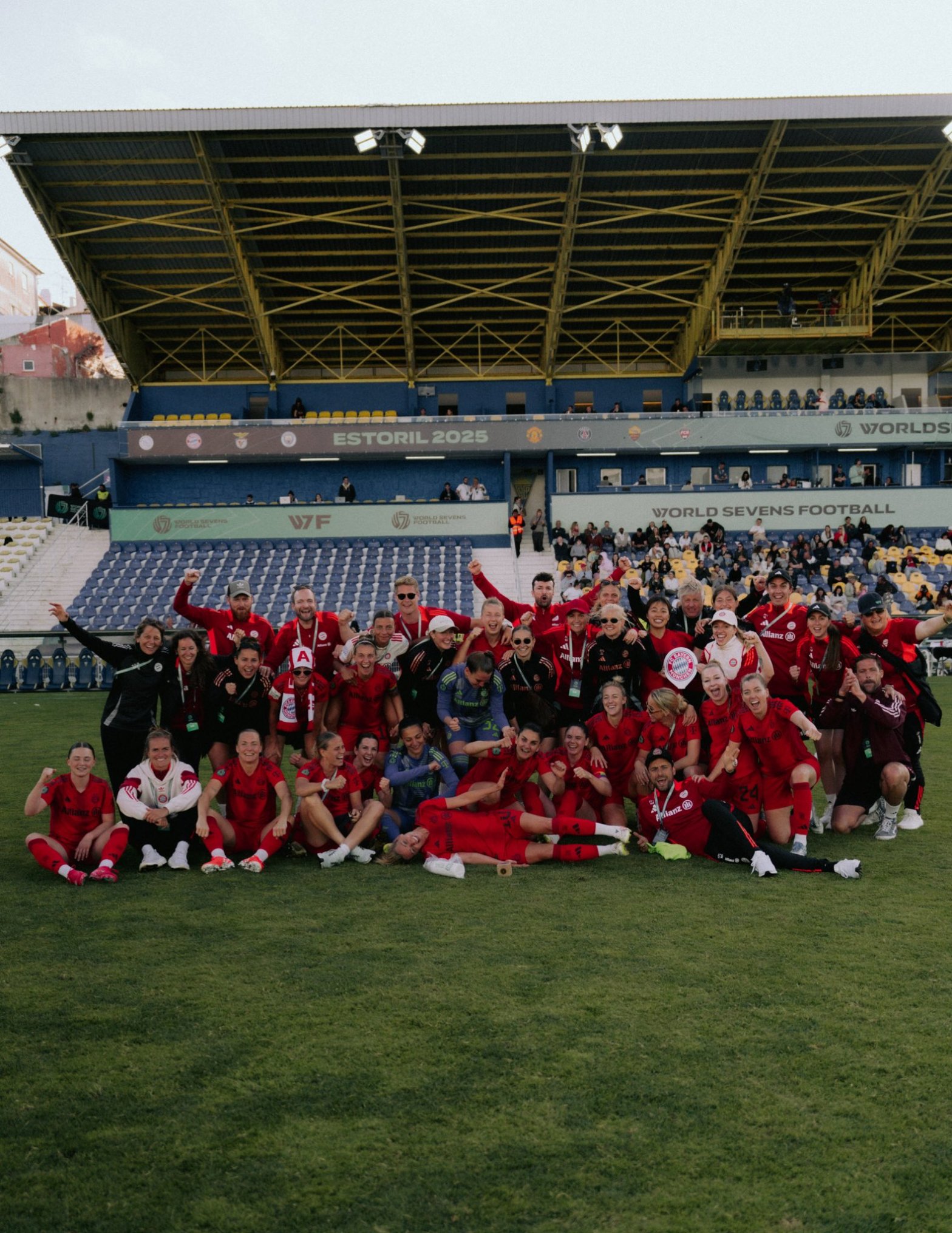
Above: Bayern Munich win the inaugural World Sevens. Photo:FCBfrauen on X.
The inaugural World Sevens tournament taking place in Portugal this week has been about fun first-and-foremost. Teams have spent longer working out their ‘introduction acts’ than they have on tactics and had a rare opportunity to network with each other in a neutral, social environment.
There have been social media posts from clubs showing their players enjoying the sunshine whilst sightseeing; playing at the beach; watching other sports like beach volleyball and eating ice creams.
The tournament initially caused raised eyebrows across the women’s game for its scheduling – being mere weeks away from a major tournament for many of the players involved – but instead of a tough tournament leading to injuries and exhaustion, it became a medium for teams to have a team-building holiday akin to some kind of multi-organisation voluntary corporate retreat.
The atmosphere around the stadium aided this. A DJ was playing music permanently – even throughout games – and players sat around the pitch in directors’ chairs to watch each other’s games. The player of the match trophy was a branded water bottle, and the stands were very close to the pitch, meaning fans were a key part of the game.
The format prompted fun as well – ‘roll-on-roll-off’ substitutions caused frequent occasions where commentators would get player names mixed up (particularly Bayern Munich’s goalkeepers Mala Grohs and Ena Mahmutovic, who frequently switched at half-time).
Beyond that, the structure of the game itself created excitement – a small pitch meant teams were initially missing the pitch completely with their corners, and the short halves of only fifteen minutes meant there was little time to gain momentum.
The opening games were more cautious as teams figured out what the format felt like. Some teams (like Manchester City) raced out of the gates and seemed to adapt to the new surroundings with ease. Once teams clocked on to the lack of offside rule and smaller spaces to work with, the chains were off, and the games became more stretched – exemplified by a more settled Ajax taking Manchester City to penalties.
Overall, the teams who performed the best also seemed to have the most fun. The two teams who reached the final – Manchester United and Bayern Munich – both have an ethos of togetherness at their core, which made them naturally good competitors in the seven-a-side format.
They knew how to work together closely; communicated clearly and enjoyed it when their teammates took the risks that are paramount in these kinds of games, even if the risks did not pay off.
Ahead of a massive summer with a serious major tournament, most discussions are inevitably around team selections and tactics. Many players will be feeling immense pressure at this point – England feeling the pressure of trying to retain a major trophy, Spain wanting to add to their World Cup win in the face of off-pitch tribulations.
At the end of the tournament, Manchester United and champions Bayern Munich celebrated together on the pitch – there was a conga line and hugs between the sides – in a scene emblematic of the three days as a whole.
Instead of creating a greater burden on players by forcing additional games before a busy summer, the World Sevens has provided a welcome reprieve for both players and fans, reminding us all that at its heart, football is about fun.
Standout teams
The universal consensus seems to be that tournament winners Bayern Munich – nicknamed ‘Vibes FC’ on social media – have been the standout team of the tournament, and for good reason. They scored the most goals – three or more in every game except the final – and looked like they had the most fun doing so. It is a fitting end to Alexander Straus’ tenure as manager to win a tournament’s inaugural trophy. Their ‘introductions’ were also top-line, such as creating a bicycle illusion and a rock band.
Above: Bayern Munich fun. Photo: FCBfrauen on X.
Their fellow finalists Manchester United also provided entertainment – from cartwheels during introductions to captain and centre-back Maya Le Tissier scoring a standout goal. On the pitch, United had perhaps the most to lose from this tournament.
Manager Marc Skinner has been forthright with his comments that United are short of funds and winnings would help them build a team capable of competing in the Champions League next year. It is telling that despite this pressure, the team still managed to play with such joy and freedom.
Above: Manchester United introduction. Photo: ManUtdWomen on X.
Less prolific in terms of goal-scoring but with some impressive performances, Roma were also a standout team. Their game against Benfica was particularly fun to watch, especially the final five minutes (including three goals).
Standout players
Young Ajax and USWNT midfielder Lily Yohannes scored a goal in every game and caused defences trouble with her technical ability. Yet to celebrate her 18th birthday, the midfielder has already scored for the senior USWNT, and it is unlikely that Ajax will be able to hold on to her for much longer.
United youngster Simi Awujo was also on good goalscoring form throughout the tournament – including finding the top corner in the final against Bayern Munich. Lacking gametime in the WSL, she is likely an important asset for a United who are heading into the Champions League next year.
A little older but no less impressive, Bayern Munich’s 30-year old Serbian midfielder Jovana Damnjanovic ran riot and seemed to want to play every role on the pitch. One second, she was backing up her goalkeeper with an important clearance. Seconds she was setting up a goal at the other end. Her work rate was stellar and her relationships with her team-mates clear to see.
The next World Sevens is due to take place this autumn in the United States, comprising of eight NWSL teams.













 impetusfootball.org