
by Roberto Revilla (23/9/26)
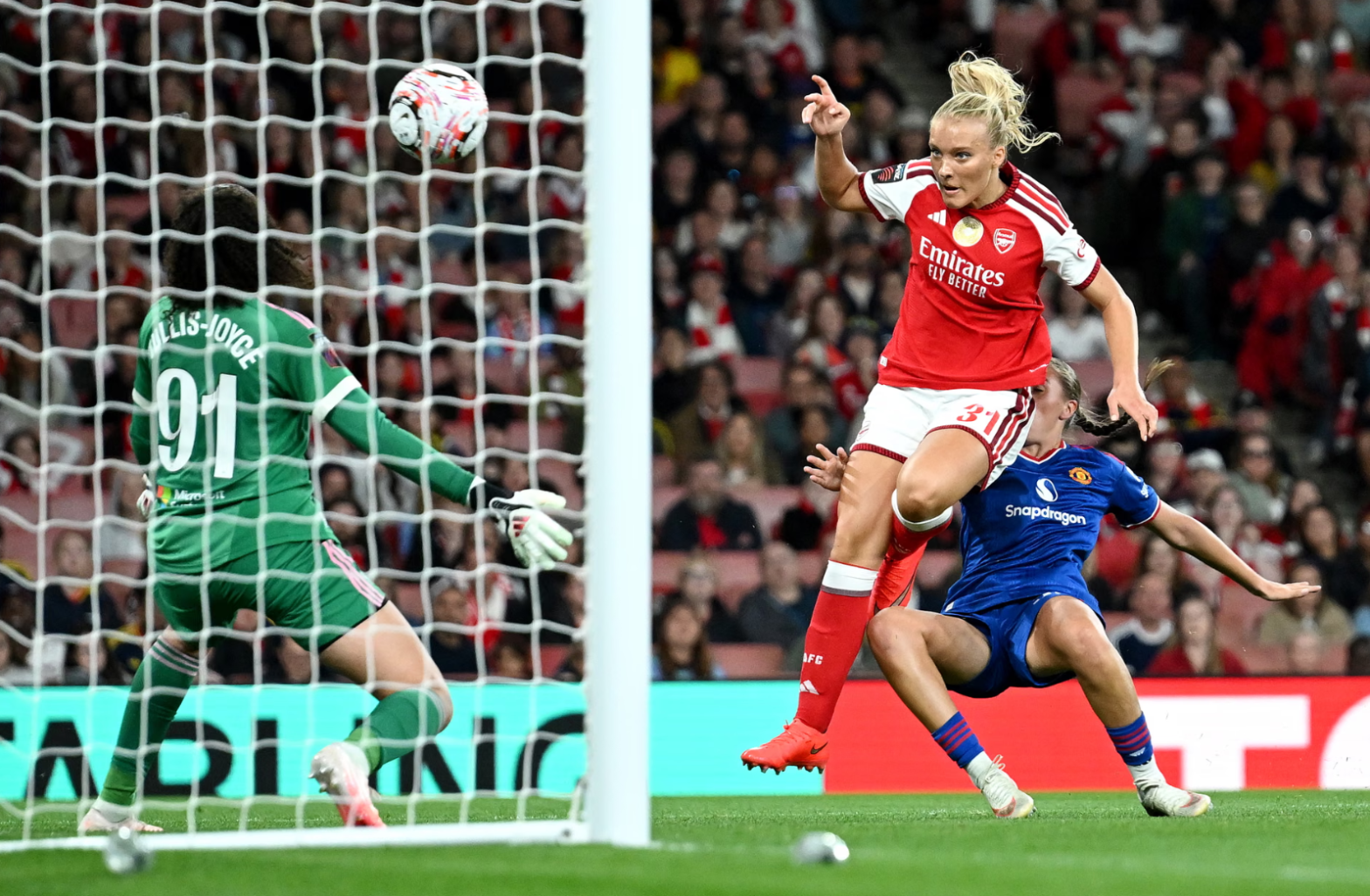
Above: Smilla Holmberg hits Arsenal’s late equaliser against Manchester United on Saturday. Photo: The Guardian.
Arsenal simply have to be quicker at exploiting the moments
Smilla Holmberg struck a superb stoppage-time equaliser as Arsenal rescued a 1-1 draw against Manchester United at the Emirates, denying Eva Olid’s side their first WSL victory of the season.
Julia Zigiotti Olme had given United the lead midway through the second half and for much of the afternoon their disciplined defensive performance looked set to deliver all three points. But Holmberg, introduced before the hour, met Leah Williamson’s long delivery at the far post in the 94th minute and volleyed beyond Phallon Tullis-Joyce to rescue Arsenal.
The result leaves Arsenal unbeaten after three league games, but having dropped four points from consecutive home draws against Crystal Palace and Manchester United, there will be frustration for Renée Slegers despite the late escape.
United provide an early threat
Arsenal began reasonably brightly, with Olivia Smith finding space on the right and Lisa Baum testing Tullis-Joyce early on.
United, however, were not content to simply retreat into a low defensive block. They enjoyed spells of possession and produced arguably the most dangerous spell of the opening half, when Elisabeth Terland forced Misa Rodríguez into two saves in quick succession around the 20-minute mark.
Misa’s first stop was particularly important, and the Spanish goalkeeper would go on to produce another assured performance, both with her handling and her distribution.
Arsenal continued to probe. One of their better moves saw Smith release Emily Fox, who found Alessia Russo before the ball was worked to Mariona Caldentey on the edge of the area, but her effort curled wide.
Their clearest opportunity of the half came shortly before the interval and began with Rodriguez.
The goalkeeper spotted Ona Batlle’s run and sent an excellent long pass over the United defence. Batlle couldn’t quite bring it under control, but Baum recovered the ball and delivered it back into the area for Stina Blackstenius.
The Swedish striker connected powerfully with her header, but directed it too close to Tullis-Joyce, who made a strong save to ensure the teams went into half-time level.
Holmberg changes the game
United had increasingly succeeded in making Arsenal’s possession relatively harmless. Olid’s side remained compact centrally, encouraged Arsenal towards the wide areas and defended the resulting deliveries well.
Slegers responded before the hour.
Kim Little replaced Mariona while Holmberg came on for Smith, with the 19-year-old immediately adding greater directness on Arsenal’s right.
Rather than continually recycling possession, Holmberg looked to attack Anna Sandberg, get around the outside and deliver early. Her willingness to run directly at United’s defence began to alter the rhythm of the game.
But just as Arsenal appeared to be increasing the pressure, they handed United their breakthrough.
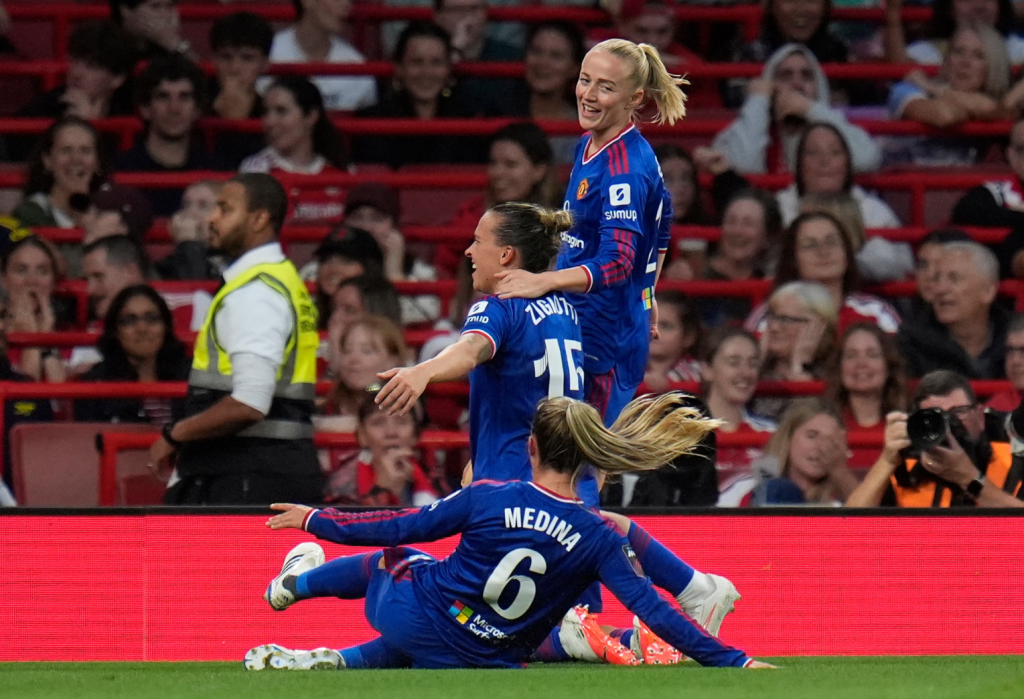
In the 66th minute, Georgia Stanway attempted to find Steph Catley under pressure, but the pass was loose and Zigiotti Olme seized upon it. The Swedish midfielder still had work to do, but finished impressively beyond Misa to give United a 1-0 lead.
Slegers responded quickly. Caitlin Foord and Selina Cerci replaced Blackstenius and Baum, before Chloe Kelly was introduced for Batlle as Arsenal committed more players to finding an equaliser.
Foord forced an excellent save from Tullis-Joyce; Cerci headed another opportunity at the United goalkeeper; Williamson went close, and Kelly tested her from distance.
United were being pushed progressively deeper but continued to defend impressively, with Maya Le Tissier particularly influential centrally and Tullis-Joyce providing the final barrier whenever Arsenal found a way through.
Cerci also went down under a challenge in the penalty area during stoppage time, but no penalty was awarded.
Arsenal would not need it.
Holmberg rescues Arsenal
With Arsenal still trailing in the 94th minute, Williamson sent a long diagonal delivery towards the far post.
Holmberg timed her arrival superbly and, with no hesitation, met the ball first time on the volley to beat Tullis-Joyce and send the Emirates into celebration.
It was a moment of considerable composure from the 19-year-old, but her contribution extended beyond the goal. Her direct running had given United a different problem from the moment she entered the game and provided one of the clearest positives for Arsenal on another frustrating afternoon.
Arsenal’s attacking problem
The result leaves Slegers with questions to answer before Arsenal’s next fixture, although the problem may be more complicated than simply struggling to break down a low block.
Arsenal finished with 16 shots, six on target and an expected goals figure of approximately 1.4. They also forced 18 high turnovers but produced only three shots from those situations and recorded no shots from fast breaks. Around 0.6 of Arsenal’s expected goals came from corners.
Those numbers suggest the issue is not solely finishing.
There were opportunities when United had not yet established their defensive shape, but Arsenal frequently failed to turn those moments into immediate attacks. By the time possession had been recycled, United had recovered their positions, closed the central spaces, and Arsenal were once again faced with an organised defence.
Slegers described Arsenal’s problem afterwards as failing to turn “dominance into danger”, and the distinction is important.
The Arsenal head coach had deliberately selected Russo behind Blackstenius to get two strikers into the penalty area when Arsenal attacked from wide positions. The logic was understandable, but too often United were organised before the delivery arrived.
Holmberg demonstrated one possible solution: attack the space earlier.
Her introduction also provides some mitigation for criticism of Slegers’ substitutions. The first changes came before the hour and before United took the lead, with Holmberg immediately influencing the game. Cerci and Foord followed shortly after United scored.
United deserve significant credit too. Having suffered a 5-0 defeat against Chelsea in their previous fixture, Olid had worked extensively on defensive organisation during the week. The improvement was clear.
Sandberg handled her individual battle with Smith well, Le Tissier marshalled the central areas and Tullis-Joyce produced important saves when Arsenal did find openings.
For Arsenal, Misa and Holmberg were the clearest positives, while their response after falling behind demonstrated the attacking options available to Slegers.
The concern is that the urgency seen in the final stages only appeared when Arsenal were chasing the game.
Four points have now been dropped from successive home fixtures and, for a side with ambitions of winning the WSL, that cannot become a recurring pattern.
The task for Arsenal is therefore not simply finding better ways to break down organised defences. They must become quicker at exploiting the moments before those defences have a chance to organise in the first place.
Keep your eyes peeled for Roberto’s deep dive analysis of last night’s Champions League opener for Impetus – on the site shortly.
Roberto Revilla is the founder and host of Arsenal Women: Trailblazers, an independent podcast and website providing in-depth analysis and coverage of Arsenal Women. You can find the podcast and Roberto’s latest Arsenal Women writing at Arsenal Women: Trailblazers.
@ImpetusFootball on Threads, Instagram, Facebook and TikTok.

