

by Roberto Revilla (23/9/26)
Above: Mariona Caldentey slots home Arsenal’s late penalty which finally clinched their win over HB Køge last night. Photo: Arsenal FC.
Arsenal find a way to win, but attacking questions remain
Mariona Caldentey’s stoppage-time penalty gave Arsenal a 1-0 victory over HB Køge at Meadow Park on Tuesday night and ensured Renée Slegers’ side began their Women’s Champions League campaign with three points.
It was a win Arsenal deserved on the balance of possession and territory, but one they made considerably more difficult than it needed to be.
Arsenal finished with 70 per cent possession, 21 attempts and 10 corners, yet only two of those attempts were on target, one of them Caldentey’s penalty.
One commentator described it as quantity rather than quality, and that summed up the evening rather well.
Slegers made eight changes from the team that drew 1-1 with Manchester United on Saturday, with Anneke Borbe coming into goal behind a back four of Smilla Holmberg, Leah Williamson, Steph Catley and Taylor Hinds.
Kyra Cooney-Cross joined Kim Little and Frida Maanum in midfield, while Chloe Kelly and Caitlin Foord started either side of Stina Blackstenius.
There was some early encouragement.
Kelly immediately looked willing to drive at the Køge defence, while Holmberg pushed high from right-back and regularly overlapped outside her. Little provided support inside, and Cooney-Cross continually looked to move the ball forward quickly.
That directness from Cooney-Cross became one of Arsenal’s biggest positives and ultimately earned her UEFA’s Player of the Match award.

Arsenal thought they had taken the lead after 13 minutes following one of their best moves of the first half.
Cooney-Cross drove towards the penalty area, combined with Foord and continued her run before finding Kelly, who finished superbly from the middle of the box.
A VAR review changed everything.
Blackstenius was standing in an offside position between Kelly and goalkeeper Alberte Vingum and was judged to be interfering with the goalkeeper’s line of sight, so the goal was disallowed.
It was a frustrating moment for Arsenal and particularly for Blackstenius, who wasn’t directly involved in the move but found herself in a position which ultimately cost Kelly an excellent goal.
From there, the game’s pattern became increasingly familiar.
Arsenal had plenty of possession and repeatedly reached the final third, but too many promising attacks ended on the wrong decision, an extra touch, or a shot from an area where Køge were comfortable allowing them to try.
The visitors weren’t simply sitting in a permanent low block.
They defended in an organised 4-4-2 shape, pressed Arsenal’s defence with their two forwards and were prepared to play when they recovered possession.
Kyra Carusa continually looked to stretch Arsenal’s back line, while the vastly experienced Nadia Nadim found pockets around the Arsenal penalty area and tested Borbe from distance.
Køge’s attacking quality wasn’t always matched by the final pass, but there were enough warning signs to prevent Arsenal from committing everybody forward without considering the space they were leaving behind.
Little produced an excellent challenge inside the Arsenal penalty area during the first half, while Borbe looked composed whenever she was required to deal with Køge’s longer passes.
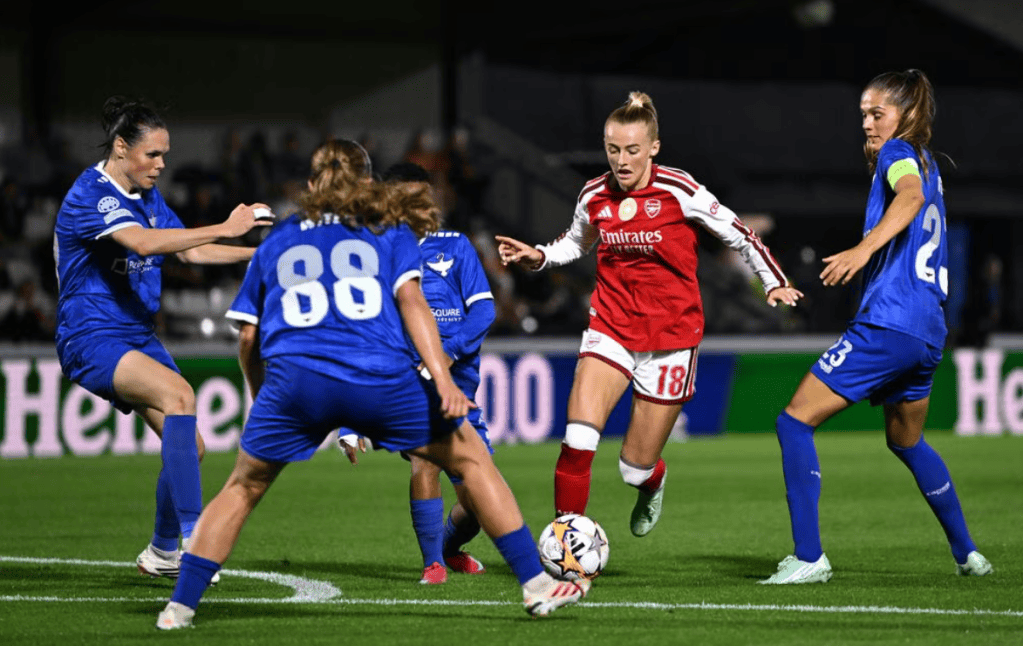
At the other end, Holmberg became an increasingly important part of Arsenal’s attack.
The 19-year-old repeatedly got outside her defender and delivered accurate balls into the penalty area, but Arsenal lacked somebody consistently anticipating where those crosses were going.
That became one of the biggest frustrations of the evening.
These weren’t hopeful deliveries thrown into the penalty area because Arsenal had run out of ideas. Holmberg was repeatedly putting the ball into dangerous positions, but the movement in front of her wasn’t good enough to take advantage.
Blackstenius struggled to become the focal point Arsenal needed and was replaced by Alessia Russo at half-time.
Russo immediately offered different movement through the middle, while Hinds became increasingly adventurous from left-back, but Arsenal were still struggling to turn their possession into clear chances.
There was also a significant warning at the other end when Køge broke through Arsenal’s high defensive line and Borbe raced a long way outside her penalty area to prevent Carusa getting through on goal.
It was an important intervention during an otherwise relatively quiet first Arsenal start for the German goalkeeper.
Slegers made two further changes just before the hour, with Caldentey and Lisa Baum replacing Little and Foord.
Kelly moved to the left and Baum took up the position ahead of Holmberg on the right, reuniting a combination which has already shown considerable promise this season.
Arsenal became more positive after the changes, but the end product was still missing.
Maanum endured a particularly difficult evening in front of goal, sending another opportunity high and wide after Russo had produced an excellent cross from the left.
By this stage Køge knew what was coming.
Arsenal were attacking from both sides and putting numerous balls into the penalty area, but the Danish champions were getting three or four players around the ball and dealing with almost everything being sent towards them.
The frustration inside Meadow Park was becoming increasingly obvious.
Slegers finally introduced Selina Cerci for Maanum after 72 minutes, allowing Russo to move into a deeper position and giving Arsenal a different presence through the middle.
It proved decisive.
Arsenal continued to push without finding a way through until stoppage time, when Cerci did something they hadn’t done often enough in the previous 90 minutes.
She attacked the penalty area directly.
With three Køge defenders around her, Cerci forced Yukina Sakabe into making a decision, and the defender brought her down.
Caldentey stepped forward and although Vingum got something on the resulting penalty, she couldn’t prevent it finding the net.
Arsenal finally had their goal.

Cerci deserves considerable credit for creating it because her approach represented something Arsenal had lacked for much of the evening.
Rather than searching for another pass or waiting for the perfect opening, she attacked the space in front of her and forced the defender to react.
For Slegers, there were other positives.
Cooney-Cross was direct and decisive throughout. Holmberg once again demonstrated the attacking qualities which are making her increasingly difficult to leave out. Kelly continually tried to make things happen in crowded areas, and Borbe handled everything asked of her.
Køge also deserve credit.
They were well-organised, committed players around Arsenal’s attackers, and retained enough ambition in possession to ensure the hosts couldn’t simply forget about defending.
But Arsenal’s attacking numbers remain difficult to ignore.
Twenty-one attempts with only two on target cannot simply be dismissed as poor finishing.
Some of it certainly was, but there were also too many attacks where the problem came before the shot: the extra touch, the delayed pass, the run that wasn’t made, or another accurate cross arriving without anyone attacking the space.
Arsenal are producing plenty of attacking activity, but too much of it isn’t ending with a player receiving the ball in a position where they would reasonably be expected to score.
Tuesday night may at least have provided some clues.
Cooney-Cross speeds Arsenal’s possession up. Holmberg can provide consistent quality from the right. Kelly is willing to attack defenders, and Cerci again showed that her instinct is to attack the penalty area.
Slegers now has to work out how to put enough of those qualities onto the pitch at the same time.
Arsenal have their first three Champions League points and, ultimately, that was the most important requirement on Tuesday night.
But with Chelsea waiting at Stamford Bridge on Sunday, Arsenal’s attacking play will have to improve.
They won’t have 70 per cent possession and 21 attempts every week.
Roberto Revilla is the founder and host of Arsenal Women: Trailblazers, an independent podcast and website providing in-depth analysis and coverage of Arsenal Women. You can find the podcast and Roberto’s latest Arsenal Women writing at Arsenal Women: Trailblazers.
@ImpetusFootball on Threads, Instagram, Facebook and TikTok.

